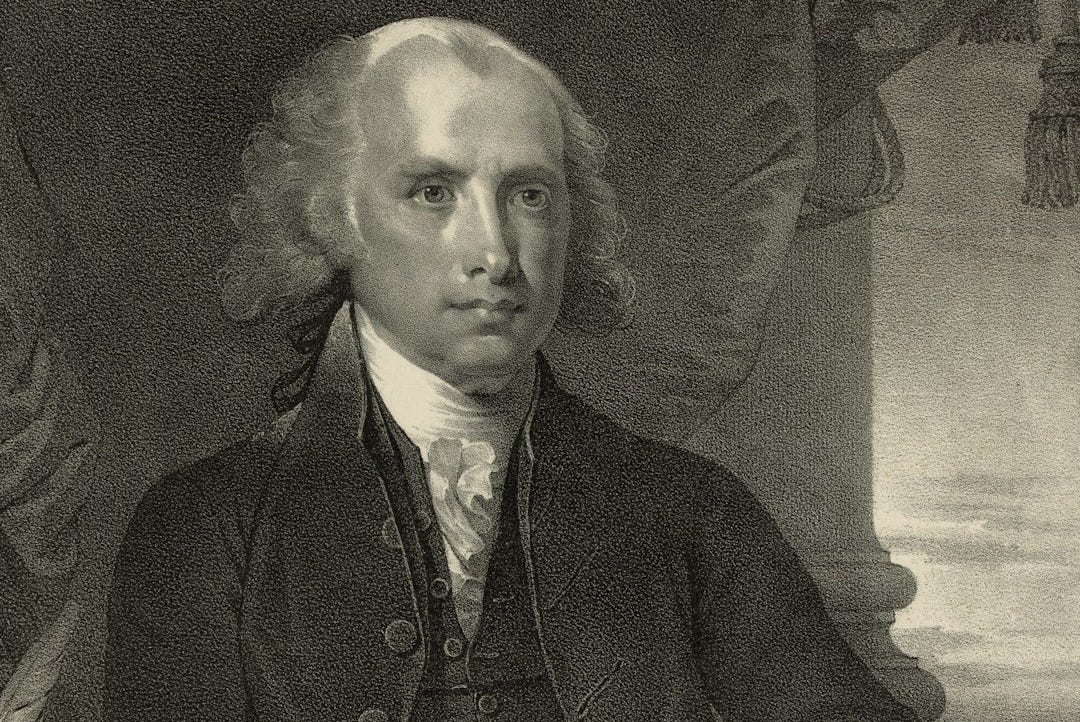
The Best Answer to the New Right? The Founders (with David French)
The New Right came to the forefront with the rise of Donald Trump, but its ambitions extend well beyond him.
Episode 77 · July 30, 2026
Welcome once again to the Oath in the Office. I'm John Peogle Sang, please welcome the star of our show around Brown University. They called this man the mac the author of the Oath in the Office, Constitutional Law Professor Corey Bretschneider.
Hello, sir, Thanks so much, John.
I just had a note from a listener telling me that these intros are worth the price of admission, and.
So I appreciate them.
You know what, It's a free podcast, so I believe they're worth every penny. Absolutely, Corey, I'm so glad that you're here today. There's so much I need to ask you about. Professor. I got to cheat off your paper in many ways. And I understand. We have a special guest on today's show as well.
Absolutely.
You know, we have a really important discussion about the President's disaster in the correspondence dinner. We're going to talk about that and other issues. And the guest really this week an amazing conversation that I pre recorded with David French, the New York Times columnist, somebody who really defies categorization. He's been considered a conservative at different points, but he has been a brilliant critic of Donald Trump. And part of what we're going to talk about, which of course relates to everything that we discuss, is the coalition behind Trump and how diffuse it is the new right, and it's really a deep dive not only into the different parts of it, including Christian nationalists, White nationalists relevant to topics like the Smithsonian that we'll talk about as well, but also how it relates to really frightening movements in American history, and in particular the VSHI movement in France around the Nazi period, and why really we have to distinguish between the particular threat of Nazi, New Right and Old Right and vc France. Really fascinating historical discussion, thoughtful. You know, David and I don't always agree, but we also have a common vocabulary and certain a common concern and fighting fascism.
I'm excited for it. But meanwhile, Professor, as you know, FEMA and the Red Cross are still surveying the casualties after the human rights disaster that was the White House correspondence to Wow, did you watch Donald Trump? Set Corey, Did you see any of it?
It was really tough to watch, But I think you know, oddly, you know much of disaster it is, And you know, there's nothing worse than watching comedians bomb.
As you know, there's something worse than that. There's something worse than watching professionals bomb Corey go on.
Stand up comedy, but the cringe that you feel.
And yet when Trump bombed, I thought, you know, there is something that we're learning about this man, about his disposition and his lack of ability to be aware of situations. His lack of humor tells us something about the narcissism of the moment.
So you know, you're way too polite, Professor. This was like a eulogy for charisma.
Sir.
This was like ing bar Bergmann directing bass five. Do you understand that's how unfunny this was, Like it was so unfunny the crickets walked out, you know, like I have seen funnier Hiroshima footage, Professor Bretschneider, I have seen Hiroshima footage with more laugh It was so unfunny. The silence got a writing credit at the end. I mean, I just felt like Lars von Trier doing crowd work, Like what could be less funny than this? And it was astonishing in terms of the hate. But I think you're right, I mean applying the stuff that we've talked about with authoritarianism. This was all about a tax on journalists, his recycled personal insults. Right. The jokes all failed, but it seemed like authoritarian politics relies on humiliation. Do you think this purpose of this speech of Trump was comedy or domination?
Well, you know, he got evidently a right wing comic who's evidently not very funny. And part of what made it so cringe, I guess is the word for it is that he saw how badly he was bombing. Because what was happening in that room, and Caitlyn Collins, for instance, has given interviews about what it was like.
To actually watch this.
There was just dead silence, not only from journalists who were skeptical of him, but from his supporters. Remember that room was filled with the White House staff, and yet even they couldn't laugh because you know, all he was doing was engaging in a kind of you know, bullying, the normal put downs about Senator Schiff and the others. And yet you know, there was a heroic moment wolf Blitzer giving an award to journalists for covering Trump's connection to the Epstein files.
For uncovering that disgusting.
Picture that he drew for Jeffrey Epstein and really being detailed in the description of it. I saw Caitlin Collins talking about her friendship with well Blitzer, and really they were the two stars. She receiving the president's hate and really giving him nothing back, and Blitzer just to his face, really talking about what it is to stand up to a bully. And that's what gives her award to these journalists was all about.
Yes, sir, Blitzer literally handed an award to a woman who Trump had doxed, and he revealed how Trump had endangered her safety. And he's doing all this, Corey, and Trump is sitting right there just Trump has just taking it like a Democrat, just sitting there like a Democrat being a pinata, taking all those I mean, what was weird for me was not so much that he openly blamed the joke writers when the jokes fail, that's him, but the speech itself, it seemed to oscillate between demanding approval from the audience while also attacking them. Then you notice that like he wanted them to like him, but he couldn't stop insulting them. Does that contradiction reveal something to you about authoritarian leadership.
Yeah, I mean I think it reveals two things.
One is that for him, for this authoritarian and you know, I get into this with David French. There are authoritarians who have abhorrent philosophies, you might call them. They write books mind compost Famously, Donald Trump doesn't have a philosophy. He has a disposition, and his disposition is both narism looking for praise no matter what. As he often tells us, I like people who like me. I don't like people who don't like me. So when Caitlin Collins from CNN asked him a question that he doesn't like, specifically, she asked him famously about his pardons for crypto currencies CEOs, who he was in league with and who he's benefiting.
From, and you know, he shuts her down. He just responds.
So he both wants that love and he instinctively is an authoritarian in the sense that any dissent, any criticism, any question. And that's actually an important point about authoritarianism. It's sat odds with reasoning and questioning that scene as a threat. So he doesn't, unlike some of the New Right, have a deep philosophy.
He has a disposition, but we saw it on full display.
And one last thing to say about this is, you know, although I did learn from it, and you know, we're having an interesting discussion about it, the main lesson was it was a mistake. And this isn't somebody that you can invite to an event that is supposed to be a set celebration of the First Amendment, the celebration of the freedom of press. And in the background you saw the First Amendment. You know, there's that was the background that they provide when you have a president who isn't disagreeing with the press or not liking the coverage, he is trying to shut it down.
That is his goal. Yeah, so it was a mistake.
And Peter Baker, who I've collaborated with and for instance, he did an interview with me about my book right before it came out in the New York Times. You know, somebody really is good at covering this president. He admitted it was a mistake. We shouldn't do it again.
Yeah, I think he's completely right. I mean, I just want to say one other thing about the comedy. You know, there are no great right wing comics. There are great comics who are right wing, but they don't do material as a right wing comic, because great comedy involves punching up, not punching down. And this is something that it's true in religioon it's true in Christianity, it's true in comedy, and it's true in politics. You don't punch down on those weeks than you. You go to a comedy club and you'll, you know, go on a weeknight where you got a bunch of hacks, and you'll see guys doing jokes about the homeless. You'll see guys doing jokes about developmentally disabled people. They'll say they r word all this nonsense, and then you know, maybe some people will laugh, and you'll go home and you'll feel dirty because you're punching down on people weaker than you. This is why there are no great right wing comics, because you're defending the status quo, and you can't be funny while defending those in power unless you're going to be mean. This is what this new right alt comedy, These these these humps like THEO Vaughn push on us. It's punching down and immigrants and minorities and LGBTQ people and journalists as well and I just wanted to ask you do you find that politically significant?
You know, John, I of course you are a stand up comedian. You do comedy. I am a fan of it. So you know what you're saying is really making me think, because as I watched him, I thought, this is the least funny thing I've ever seen. The silence in the room. You can feel it in your soul watching this person. Now, why is it so un funny? Because it doesn't even approach something that would get a laugh.
It is just pure bullying, and hearth it is.
And you know he thinks it's funny because the bully enjoys the bullying. The bully thinks that punching down, as you so perfectly put it, is funny. And you know, when you watch it, it's just sad. It's just somebody without any awareness and without you know, I think also humor at its best it gets to a kind of humanity or reflection, and that's not what this was.
This was anti humanity. If anything.
Well, I don't want you to be sad, Corey, so let me let me give you some good news, and that is that the Tape brothers were arrested, and that They are being extradited to the UK for fifty nine charges ranging from child poorn to rape to trafficking, and these guys are going to be in jail for a very long time now. A year ago we talked about this when Trump was inaugurated and they triumphantly welcomed Andrew and Tristan back from their prison sell in Romania, which you guys might right if you guys remember them. The tapes are these grifting, violent, misogynist losers with all the humanity of a prison urinal, and they do these manisphere videos where they teach guys how to blame real women for their problems in their life and monetize resentment and disparage female psychology to other virgins. And these guys who've gotten very rich off of this mentality that women are property and empathy is weakness and reading books is gay. But Donald Trump a year ago was welcoming them. The Trump kids were buddies with them, and they were saying, how, oh, Trump's going to help us, and Trump's the greatest, We're going to help him. What does it say now that a year later, Professor, they sprung them from Romania. But evidently Trump or Susie Wiles or someone in this White House decided we're already handling rapists with the Epstein files. We don't need these guys. I think the most significant thing about this, what it says about the manisphere, is that Trump's cutting these guys loose after all this hype and all these years. They're going to England and they're going to be in jail for a long time.
You know, on this podcast, we're always trying to be honest about the threat to democracy, but we're also looking for moments in which democracy is pushing back and democracy is winning.
And yeah, I think this is one of them.
Because Donald Trump, you know, his son Baron is a big fan of the Tape Brothers.
He's evidently in touch with them.
The idea, by the way, that that shouldn't be covered by the media because this is the son of the president, he's no longer a minor. I think that is a fair game, and in fact, it's an illustration of what's so pernicious about the Tape Brothers, because they're not just engaged in misogyny, they are selling it, and they're selling it, unfortunately to children and young people, and teaching them that to be a misogynist is to be a man the worst forum of anti female violence and disparagement. You know, that's what they're selling, and that's why they are such a threat. One thing, you know, this also prefigures some of what I'll talk about with David French. But there's so much of the different coalitions behind Trump so different. I mean, the Christian Nationalist support for Trump is of course very different than the Tate brother Manisphere support or a related podcast support. And yet you know, all of a sudden there's weakness. Why is their weakness? Because Susie Wilds, this is my surmise, I don't have direct reporting on this, realizes that as a result of our guest, Katie Fang's lawsuit and other ways in which the Epstein files are becoming front and center an illustration of Trump's own misogyny. After all, this is an adjudicated rapist at the Supreme Court has refused to overturn the decision awarding his victim monetary damages for this rape and for his lies about it. And you know what is all that show that we are starting to become aware of what we should have all been aware of. But even his own base is becoming aware of not just his misogyny, but of his sexual assaults, of his violence. And so if he associates himself directly with the Tape Brothers by fighting their extradition, for instance, that just makes things so much worse. So he must be hearing even internally from those who are trying to protect them, like Susie Wilds's chief of staff, I should say that no more Tape Brothers because it just highlights your association not just rapist scene, but.
With sexual abusers and trap. Yeah, exactly right. There's nothing for him to gain. He's not running for office again. And I just want to say about the Manisphere, because it's very interesting that the Manosphere as they call it, is becoming such a comfortable home for trump Ism. It's not really a movement, you know. It's it's more like group therapy where no one's ever allowed to meet. They're sad, you know what I mean. Like the Manisphere is a support group for young men who desperately need hugs, and they've been convinced that hugs are woke socialism, you know what I'm saying. Like, guys like the Tates don't cure loneliness, they feed on it, and I think the manisphere, not everyone, but generally it's where emotionally unavailable men go to learn how to become even less emotionally available. And again they masculinity is dominance, right women are adversaries, Empathy is weakness. There's a lot of overlap between that worldview and authoritarian politics.
Yeah, and you know, there are a real deficits in the society loneliness, for instance, among young men, you know, inability to find fulfillment in intimate relationships. And what happens as a result of those failures in the society and the isolation is something is going to fill it. And that's what right wing movements do. They cater to a kind of weakness in the society, but they don't cater to it in a way that lifts it up or solves it.
It makes it worse.
I should say too, you know about Donald Trump's lack of ideology, as I've been putting it, you know, I would see authoritarian character is a way to put it, or personality as opposed to ideas. Because he has no ideas. It fits poorly with some aspects of the New Right and better with others. And you know, the Christian nationalism and Donald Trump are not a natural ally.
You know, this isn't somebody who really is well versed in the Bible.
He's not going to sit there John and debate with you about any Biblical text, because I'm sure he hasn't read it and doesn't care and doesn't But what he does fit with so well. And this is one of the unfortunate things that helped him I think in the campaign, for instance, his interview with Joe Rogan, which so many people saw, is that his misogyny fits perfectly in the manisphere and that that really is I think part of his power, but also part of what's being exposed for the history of violence that's associated with him, and that really is you know that that is a good thing.
Not oh hey, what's more alpha than four dollars for a gallon of gas? All right, we got to take a very quick break, Professor. I have a lot more to talk with you about, including some questions about censorship or stochastic self censorship and who's resisting. We'll be right back on the Oath in the office.
The new John Fiegel Saying Show every day at twelve noon.
Good afternoon, John, and welcome back to Afternoon Radio.
I have missed you.
Now you're back into the daylight.
Good afternoon, John, congratuations on the new sh Congratulations all the changes happening with the show.
Excited for you, Excited for me personally, like, oh my god, I can call an again.
The new John Fugel saying, show every day at twelve noon on Serious XM Progress Channel one twenty seven or on the Serious XM after.
Welcome back to the oath in the Office. I'm John Feugel, saying so, Professor Bretschneiter. Donald Trump put out an executive order directing federal officials. This is a weird one, Corey. I might need you to walk me through this, but you know they've been going after the Smithsonian. They don't like museums that teach actual history that might make the grandchildren of racists feel weird. So a little too much truth for some of these people. And this is tied into what they've done with the National Park Service, removing markers about embarrassing, painful parts in our country's history, erasing the achievement of anyone who's not a white, heterosexual male from depending on website. But this is weird. He's attacking the SMITHSONI a lot. But now they want to put temporary signs outside of the National Museum of the American History in DC on the sidewalks to correct what they call inaccurate information presented in the museum. This is insane, Corey, I mean, this is like so I mean, because I don't know if you know this, the Smithsonian owns a printer, they can hang their own signs. I'm saying, no, it's all true. It is yourself. They actually have access to a printer. Inside this it is dry. Is controlling historical narratives so central to authoritarian movements. This reminds me of the photos i'd see as a kid of how the Soviets would photoshop cosmonauts out of old pictures because they'd run a foul of the government, Like they're just doing cultural erasure and they don't care how fake it looks.
Yeah, I mean, I'll begin with just the legal explanation of what's happening, because I think it's interesting and as you said, it's quite weird.
So we need to understand that the.
Smithsonian is not part of the government. It's not an independent agency. It's got an independent border directors in fact, John Roberts, the Chief Justice is the head of it.
And I feel so much better now.
And actually it's interesting right that he is really trying not to cater. He's supporting the staff who want to tell the truth about American history, including the history of slavery and segregation and American apartheid.
And you know, I should.
Say, too, is just to frame it when you understand that history. And this is true of my book, The Presidents and the People. It's true the way the Smithsonian tells the story of American slavery and segregation.
There is a lot of hope in it too.
So the idea that it's just making people fail bad or it's bad news, that's the first lie here. It really is a story of people resisting tyranny, resisting authoritarianism. So it's independence is what allows it to tell continue to tell that story. Even though the President has succeeded in largely gutting destroying independent agencies like the Federal Trade Commission.
They slavery is depressing, slavery depressing, they do we see that.
They are standing strong. They are an independent entity. So now he can't control them, but he can do the next best thing, which has put these stupid signs up. One last thing, John, and then I'll throw it back to you. You know, I talked about how uneasy he is with Christian nationalism. Yes, that isn't something that fits his personality authority, but the racism, I think is pretty native to who he is, and so that is why he cares about this so much.
So you have a mix.
Yeah, racism is white supremacy and is attempted authoritarianism.
But again, good news. People are fighting back.
Even John Roberts is not willing to look like he's catering to the president, and that's why we've got this weird story here.
Well, I just want to say one more thing about it. I mean, because I wanted to ask you about this. This executive order. Yeah, it doesn't control the Smithsonian directly, so it's an executive order for the sidewalks and the public space around. I mean, let's talk about how limp and flaccid and unmanly and pathetic and impotence this is. I mean, does this it's pathetic, Corey. I mean, you could put a side on the sidewalk saying don't believe what the museum tells you. And this is the president, this is all the power he has. Doesn't it reveal we still have limits on executive authority in this country?
It does, you know, and people continue to resist. And you know, let's just say a very clear shout out on the same way those civil servants who are remaining in agencies doing their job protecting the law despite this authoritarian threat.
And that includes people in really all.
Of the federal government which is being taken over by this authoritarian threat. And yet you have civil servants fighting back here. The Smithsonian staff are doing their jobs, I should say. The head of the Smithsonian talked about what it was like to tour Donald Trump around and how he just had no interest, was completely bored about any exhibit about slavery, and course, and one other kind of just deeper point here that there is something you said something about this in the beginning.
I want to pull it out even more.
Part of what authoritarianism and here we're talking about racial authoritarianism, the idea of reinstituting white supremacy, firing military officials or degrading them, or demoting them, or refusing to promote.
Them because they are black.
That is what this president and Pete hag Seth under his direction have done. And the lack and really almost complete absence of black Americans in the presidential staff, in the cabinet, all of this is an attempt to resegregate America. We saw this before, and the role of history was also crucial during the Wilson administration.
The federal government had been desegregated. Woodrow Wilson resegregated it. And it's not a mistake that he was a historian.
He in his textbook tells the story of reconstruction of the Thirteenth Amendment ending slavery, the Fourteenth Amendment providing equal protection, the Fifteenth Amendment protecting a right to vote free from racial discrimination, at least from men. What all of that was turned to into for Wilson was the lie that the post bellum amendments, those amendments didn't add a single right to the Constitution. That's what he was saying in his lectures, that's what he was showing in his textbook where he even celebrated the ku Klux Klan, so reinstituting white supremacy as policy for a president and literally whitewashing history, which is what Wilson did and what Trump is trying to do. That is part of the authoritarian playbook, and that's part is not new.
Meanwhile, the Trump administration professor subpoena third party providers to seize the phone and text records of several New York Times journalists and their spouses and one reporter's mother. This leak investigation was overseen by petulant, unqualified, alcoholic dude pro Cash Betel, and it's pretty terrifying. I mean, the DOJ is getting phone records for reporters, subpoenaing phone records for reporters and their family members over a leak of true information. Constitutionally, where do we begin to explain why this is so troubling, sir.
Well, part of it is, you know, in whenever we cover the attack on dissent, we recognize that these reporters are not going to be convicted in a court of law and go to prison in the way that the newspaper editors of the Sedition Act in the eighteenth century went to prison at the behest of John Adams.
Something else is going on.
They're trying to have And if you listen to Jake Clayton and to the administration or Todd Blanche, they so well, these reporters aren't being targeted.
We just want to question them under the course of law.
And what that all is about is is a chilling effect because you know, the family members are involved. They contacted these reporters in some cases in front of families, and you know, are hauling them into the grand jury. What that is about is trying to get into the minds of those who are doing their job as journalists and telling the truth about what's happening and make them think twice about it, to think, you know, I might not do that story about Trump, maybe I.
Can exactly something else. And so it's not about winning, it's about just intimidating.
Self censorship, stochastic self censorship. Yeah, I mean, I got to say I was a bit shocked that any journalists would show up at the White House Correspondence Center, much less shake his hand on stage after this. They had just pulled these subpoenas right before the White House Correspondent Center. They've already backed down. But I mean, Corey, you're targeting journalists spouses because they leaked true information. Doesn't this cross a line we've rarely seen in American history?
Well, John, you can tell me if you agree, But you know, as much as I want to celebrate the courage of those who were standing up, those are the Smithsonian, the journalists who, after all, did cover this story that we talked about last week, the bribe playing from guitar, and you know, basically the naked corruption that's existing in this entire administration. Those are heroic acts, but there is also a lot of cowardice. And when you combine that with the real threats that are out there, you know, it is frightening. And so I think some journalists, as much as you know, I want to celebrate those who stood up, think to themselves, well, we contame this guy. As wild as that is, at this moment, we can at least pretend that things are normal.
It's not just journalists.
I'm seeing it from so much of the academy, from Vanderbilt University, which seems to be caving in to the Trump administration, from those law firms that really went along with the demand that, you know, stop criticizing the president's not being involved in lawsuits against him.
And agreed.
So there is you know, let's be honest, that there are heroic acts. They are made even more heroic when you recognize that there is also a lot of cowardice at the moment, or at least, let me call it something a little less harsh. In the case of the journalists, it's putting your head in the sand.
And yeah, that cowardice is fine. Cowardice is actually accurate, Professor, because I'm thinking about you know again, it's it's not that they're doing government censorship. They're intimidating media into censoring themselves. That's the game. And we saw this with Whitney Cummings. She just, you know, did a set at the Mark Twain Price ceremony for Bill Maher at the Kennedy Center, and she came out and said that she had all of her jokes about Trump. She said he was late because he got caught in sex traffic and that was cut. She said all of her jokes about Trump were cut because the staff at the Kennedy Center was terrified. Nobody formally banned the joke, but people feared the consequences anyway, right, Self censorship is essential to maintaining authoritarian systems.
Yes, and you know, I think that this is unfortunate that as much as I want to applaud Whitney Cummings for telling the truth about what happened. The fact is that Netflix allowed this to happen. They did televise the special. To me, that is giving in it is a kind of cowardice of their executives. You know, you could add something to the special where she talks about what happens, where she retells the joke and says, hey, this is That would have been a great intro to it. But the bottom line is, you know, it's not enough to say, hey, I was censored, woe is me?
You have to actually do the work.
And yes, it is difficult to have courage in this moment, but it's so important I should say. You know, when government crosses the line of not just saying you know, here's our opinion, or this is information we'd like you to carry, but threatening private entities, including Netflix, if that's what's going on. We had this amazing discussion with Senator Wyden about this. Difficult to understand, but I think listeners really got an idea of job owning, which is when it looks like private companies are self censoring, but really it's coming from the government. As Widen's legislation makes it clear that ought to be illegal. So go back and listen to that. I urge listeners to do that. It was an amazing moment. It's certainly relevant to this story.
I want to SKay it one more thing. Before the break, Chuck Schumer said that he's going to block any proposals to rename Penn Station after Donald Trump. Sean Duffy, who's our Secretary of Train Intation, who's another no talent racist twit from the Real World and MTV. He's also an amoral liar. I'll put that in there too. Sean Duffy announced that, oh, we're going to renovate Penn Station, and we might tell Amtrak that they have to rename the station after Donald Trump. Schumer is saying he'll block efforts for all of this. But Corey, what is the deal with the authoritarian leaders who always need to have monuments or renamed buildings or museums or flags or holidays or public rituals. I mean, it seems like the bigger the ego, the more fragile the ego when it comes to these guys.
You know, when Donald Trump says that he admires the dictator of North Korea, when he says that he Admires putin a lot of us rolled our eyes, and now we see that's not what's going on. When you combine the authoritarian shutdown of free speech, the authoritarian white supremacy, with this esthetic, which is to try to plaster his name on everything, which as a businessman, now he's trying to do it as president, you really see what you're up against, which is a kind of authoritarianism. And it's why it is symbols matter. The Smithsonian isn't just you know, some story. It is the story of our national identity. And so yeah, I think Schumer is exactly right. You know, no matter what, we're not putting his name on Penn station.
Yeah. Absolutely. I mean it's kind of funny to just realize that he's doing all this because he knows once he's gone, no one's going to name buildings after him. I was working we haven't heard it like people need to want to put your name on buildings, and it seems like enough of them know that is never going to happen, so they're going to try to force it before he dies.
I was working with a reporter in the New York Times around twenty sixteen. I've written a lot about free speech, but also the idea of state expression that government sometimes sends its own messages, and its obligation to send messages consistent with, not opposed to democratic values like equal protection. And so when I was hoping he was going to lose the twenty sixteen election, which of course he didn't, I thought he did, But go on, well, we need to do we need to do is we need to ensure that he's repudiated, and part of that is never celebrating him on any public building. And you know, his name was taken down from the woman rank, something that I think was really important to.
Do a small gesture, and I look forward.
You know, I'm talking about a hope there is a good off the Kennedy's sign when we're gonna take his name down. We already have seen it taken down at the Kennedy Center. There should be nothing in Donald Trump. And in fact, and I know you and I have talked about this before, and I think you agree, we should be at the point where it's just embarrassing to have that last name, where no descendant of Donald Trump wants to call himself a Trump.
You're all excited about future buildings losing his name. I'm excited about his grandkids losing their last I want him to live long enough to see his descendants change their last name because they realize they can't make a living with a name like that. But hey, I'm a romantic, you know, of spiritual. That's why I think about things like this. All right, quick break when we come back at the big interview with David French on the Oath and the offer us.
Hey, al, Glenn Kirshner here, So, friends, I hope you'll join me on my audio podcast, Justice Matters. Do you care about ethics and government, criminal justice reform, a conflict free federal judiciary?
I thought so.
On Justice Matters, we take on issues involving the need to reform our government and its institutions, and we talk about real, achievable reform.
I hope you'll join us.
Look for Justice Matters wherever you usually get your podcasts.
Welcome back to the Oath in the Office. It's my pleasure to introduce our guest, David French. David French, of course, is a New York Times columnist. He's a graduate of Harvard Law School, and I recommend his book Divided We Fall. We're going to talk about the ideas of the new ride post liberal is we'll talk about birthright citizenship and whether or not trump Ism can out last Donald Trump. So, David French, welcome to the Oath in the Office.
Well, thanks so much for having me. I appreciate it.
I wanted to start off by asking you about birthright citizenship. We've talked a lot about the case and the details of the legal issues. We had Cecilia Wang in a previous episode who argued the case. But one of the things I was very interested to have you on is you've been writing in your columns in the New York Times about some of the ideas behind the right to birthright citizenship, and so let's start with that.
I mean, what do you.
See as the main ideas behind birthright citizenship and how do we understand the challenge to it that we're seeing in this executive order?
Yeah, just the legal issues.
Yeah, that's a really good question, and I think you really have to sort of go back hundreds of years to really understand the root and origin of this, that this sort of is rooted in a notion that if you were born in the soil or the under the sovereignty of a particular king, that you are a citizen of that of that domain, of that regime. And it's an idea that carried across the Atlantic to the colonists, and it's also an idea that matched very well with the American idea, because the American idea wasn't one that was really rooted in this. You know, if you're looking at sort of European notions of citizenship, what you really have had over time is sort of this idea of blood and soil, the sort of notion that you know you're you're if you're going to really be a member, say of the French family or the German family or whatever, then you're going to be have to have a particular kind of lineage that is locking you in. Whereas an American, the American nation is really based on an idea. We're not based on blood. We're based on an idea, the idea that all men are created equal, endowed by their creator with certain inalienable rights. You know, to go back to the Gettysburg Address, conceived in liberty and dedicated to the proposition that all men are created equal. So we really are an idea, and then from that standpoint, birthright citizenship. This idea that if you are born here that you can become an American is very sort of deeply embedded in the notion of a creedle nation. And so whereas in other conceptions of citizenship it is something sort of handed down by lineage. This is something that you know, and this is the opponent's of birthrights citizenship use this term magic dirt. They derisively use the term magic dirt to say, oh, you're just arguing that there's something magical about being born in the United States. It just suddenly makes you a citizen. No, it's not magic dirt. But America's location of the magic idea, and the magic idea, of course is you know, as we discussed earlier, all men are created equal, and yes, a person who is born here can and is going to merint a in this sort of magic idea. It's not the dirt, it's the idea. And so it really is an expansive way at looking at this American family and really matches with sort of the expansive way in which the founders thought about citizenship. So this is something that goes back a very long time as a distinctive away from sort of you know, however you want to call it patrilineal citizenship or you know, other forms of citizenship that are rooted in blood from your ancestry as opposed to really truly honestly rooted in the idea of the country itself.
Yeah, so you see a continuity.
It sounds like between the eighteenth century idea in the Declaration of Equality and the ideas promised by the Bill of Rights and the nineteenth century fourteenth Amendment guarantee that if you're born in the country, then you are a citizen.
And as listeners to the.
Show, No, we couldn't be more kindred spirits on that idea of what America is. I mean, I want to pivot a little bit and ask about.
What we can learn.
And of course we can learn something from the attempt to revoke birthright citizenship through executive order. Sometimes the new Right talks about ethnicity in in this sort of explicit way, and you have this sort of soil idea that really is not at home in the American founding. Sometimes and I don't know, I mean, you can talk to me about whether or not this fits into the sort of soil idea and the challenge to the American Creedle ideal of America.
But sometimes or.
Whether it is just a strategy and a legal argument, but sometimes you hear the claim that you did here in the briefs the idea that there was this allegiance theory of America. And the problem with birthright citizenship is that if you're born in America and just get your citizenship, you in a sense didn't earn it, or you didn't buy in to the idea of America. So is that a kind of hybrid of the soil idea and the idea that we're talking about, or is it just a cynical legal strategy and what do you think?
I mean, just to be clear, you.
Know for the listeners that I don't think there's anything to the idea that there is this allegiance theory. And when you heard the Solicitor General try to defend it that it didn't fit with any of the ideas of the nineteenth century, but it is what the new writer's saying, at least in this context.
Well, it definitely doesn't fit with a text.
You know.
One of the things that's interesting about this argument is, you know, we have a text right of the fourteenth Amendment, which talks about people who are subject to the jurisdiction of this country. If you're born here in subject to the jurisdiction of this country, then you're a citizen. It doesn't say domiciled. It doesn't say swore an oath of allegiance upon reaching age of majority after being born here. It doesn't say these things. And so what they're trying to do is import extra textual tests and extra textual requirements into the text and then trying to ret con the whole history to sort of say, well, this was intended to be there from the beginning, or this text was supposed to encompass all of that, and it just falls apart on a historical basis. I mean, if you're looking at the combination of the Fourteenth Amendment and the wankim Ark decision, what you're really saying is that they're trying to do correct the giant, glaring, horrific error of Dred Scott, where black Americans were written out of American citizenship, not just by creating a rule for freed slaves and for black Americans, but by creating a standard rule of citizenship that applies to everyone. With the word subject to the jurisdiction thereof not that really mysterious in their meaning, to be honest, like, this is not like uncovering an ancient manuscript written in like a lost version of Sanskrit. No, these words are capable and have a meaning. And Wankim Mark outlined it pretty well. Look, who's not subject to the jurisdiction of the United States, Well, children of diplomats. When diplomats are here, they are not. They have diplomatic community there and a special legal status. If you're a soldier in an invading army, for example, you're obviously not subject to the jurisdiction of our country. You're trying to defy the jurisdiction of our country. Supplant it, replace it, et cetera. You know, if you go back generations, Native American tribes had special legal status, they were recognized as sovereign or quasi sovereign in ways that say, you know, if you're a citizen of Alabama, you're not right. And so all of these things were very linked to text subject to the jurisdiction thereof. What the New Right has done is sort of come in and basically said, yeah, forget the text. The text is really trying to put in place a particular kind of history, and that's the history that we're sort of relating to now. It's a history of domicile, as Clarence Thomas wrote at length, right, the allegiance history that you just talked about. So it's sort of pay no attention to the words on the page. We have kind of the special historical. And one of the things that's dangerous about sort of the newer methods of originalism is that it can often just uses the text as a springboard for this sort of open ended historical inquiry, which I think is completely inappropriate when the text is clear. You don't go to the historical inquiry when the text is clear. But what the new Right is wanting to do is do essentially a historical inquiry only basically according to their specific terms.
Yeah, and of course, a lot of the techniques of originalism, the conservative idea of reading the Constitution for its original meaning and to sort of turn this into a linguistic dictionary idea is to do nothing less than to read out the ideas of the American founding, of the second founding of the Fourteenth Amendment, thirteenth Amendment, fifteenth Amendments, and so.
That's not a mistake.
And I thought it was a really important point too, that it's not a mistake that they move to this sort of fake interpretation of domicile, which is another way of talking, of course about your point about soil. I haven't heard people making that point, but it's a nice way to say. What they're really doing is reading in this very anti American different tradition of soil or domicile into a text which is really about the idea of equality, as so much of the Constitution is, and at least we attempted in the nineteenth century to re up on that idea. One thing, David, that just to switch places, I mean to understand this phenomenon which you've been so great on of the new right, some of which pretends to be originalists. Sometimes there's an idea of common good constitutionalism formule, and.
It kind of flips back and forth depending on who you're talking to.
Yeah.
Yeah, So one thing I wanted to ask right exactly that you know, different conservatives will do different ideas. I mean, one thing I will say about the common good idea, and I want to pivot to to your.
Column about v sheism.
Is it sort of lays on the table what's really going on, and stops playing these games. And so I appreciate something about that as much as I.
Think it's headed.
But one thing that you've done so nicely that I want to ask you about is we've talked a lot on this show about the collapse of Wymar, the way that the collapse of Ymar shows the fragility of American democracy and all democracies. But you've taken a different angle that I think gets into the cultural arguments of the new ride in talking about VC France and the way that the philosophy of VC France really fits with a lot of the new right ideology. So can you talk to me about what you know, give us the time period, tell us something about the history, but also so importantly about these ideas and how they fit with what we're seeing which and just to emphasize for listeners what you and I agree with so much and why I was eager to have this conversation is what we really are seeing in conservatives today isn't a traditional kind of conservative ideology.
It really is a.
Foreign, anti American ideology, and you pointed that out so well, and looking at VC Frands, I think helps us to see that.
Yeah, it's really fascinating because you know, we grew up in an era. You know, one of the seminal books of the era that we grew up in was The End of History. Francis Fukiyama's book At the End of the Cold War, often misunderstood, like the last chapter is very eerily prescient of the present moment. But essentially we grew up in the triumph of liberal democracy, where Nazi Germany had been defeated, Soviet Union collapsed in front of our eyes, Imperial Japan had been defeated, at least for a while. I remember the heady days of nineteen eighty nine and tien Men Square. We thought we're communist China is going to fall as well. So we grew up in a time of extraordinary optimism about liberalism. And so it's very hard for us, many of us, to put ourselves in the mindset of, say the late nineteen thirties and early nineteen forties, when liberalism seemed to be not just in retreat, but in a state of total collapse. So you had a liberal government fym Our Germany that's supplanted by a Nazi government. You have the Soviet you know, the Russian Revolution results in the horrific totalitarianism of the Soviet Union. The three great liberal democracy at the time, Britain, France and the United States seemed to be and you have of course Imperial Japan rising power on the march in China. And so you have the three great liberal democracies of Great Britain, France, and the United States, and all of them were failing in certain ways. The United States had pulled back into isolationism and had abandoned, you know, the League of Nations and all of this sort of idea of an international means of preventing another World War. We pop smoke on that and we left that idea like even before it was really born. Britain and France were slow to recognize the threat of Hitler. And then when Hitler attacks into France in nineteen forty, you know, it's I think we are unfair about the French army. A lot of French soldiers fought incredibly valiantly, but the German army had superior tactics, had superior equipment, smashed through French defenses and the French government fell. And you know, we look back at Churchill stand from the standpoint of being the victors and realizing how brave that was, how courageous that was, and how was the key ultimately to victory. At the time, it could look suicidally stupid. Right, So you had a Nazi Germany overwhelming power, France being essentially knocked out of the war, and we look back on Vishi and we say collaborators. Well, that's only a very small part of the story. Actually, what happened is a lot of more illiberal right wing forces in France said this is our opportunity to remake France and to turn from the collapsed the failure of liberal democracy. Liberal democracy has failed, and now it is time to rebuild something new. And so when you look, it's not so much Hitler's Great, Hitler's Great, It's much more reminiscent of the language you read out the new right. Liberalism creates successive individualism. Individualism creates successive selfishness, the foreigners or an invasion that undermines sort of the cohesion of the country. The women's advancement in the workplace is undermining the cohesion of the family. So again and again, it's remarkable. You could put some of the Vshi rhetorics side by side with the rhetoric from say Doug Wilson types in the Protestant world or some of the Catholic integralists, and they would be shockingly similar. Liberalism eats away at institutions like the family, it eats away at the church. So to restore the family, to restore the church, you have to have a strong government that is advancing these civilizational values. And so you have all of this rhetoric about how a woman's place is primarily in the home. You had rules passed where, you know, only children of French fathers could serve in certain positions in the government, and all of this is very reminiscent of sort of this social cohesion project of the New Right. Except the thing that's happening that's different. It's arising when liberal democracy has not failed. It's arising when liberal democracy is actually still ascendant and more powerful in the world. So it's a rising without a Iyemar, It's a rising without a fall of France.
Yeah, some ways, I wonder if you agree with this. I mean, it seems to me, and it makes it more dangerous in a way because this rhetoric is so far into the American tradition, to American ideals of the Constitution, to ideals of equal protection and birthright citizenship. So when we hear it, it sounds like, oh, that's kind of new, and that's often you know, how Trump's rhetoric was received as something different, and you know, the more philosophical versions of this that talk about soil and talk about family. You know, I don't know that the threat is quite recognized. By putting it in the context of the nineteen thirties, we see what it is, which is it might sound innocuous compared to, you know, the rhetoric of explicit white supremacy or Nazism, but it is meant to be a challenge to liberal democracy. I think too, there's a kind of abstraction when you challenge some of those on the new right to ask, well, what is it that you're opposed to, you know, free.
Speech or you know, they won't be concrete.
They'll talk in terms of this generalized idea, you know, of soil or blood.
Also, I think is part of it.
Let us that's the heritage American concept is how far back can you trace your history? And I mean we can trace ours back to the Mayflower. That doesn't make me more of an American than anybody else, right, it absolutely doesn't. And we define our own citizenship by our own actions. We can be proud of our ancestors, but we don't carry their virtue, nor do we carry their advices. And so this sort of idea that you know, as JD. Vance said, you know that those of who have ancestors who fought in the Civil War have a greater claim to this country. No, absolutely not, absolutely not. But here's what's insidious about the post liberal argument from the right. Many dangerous ideas often begin with some truth to them. So, for example, a country that does not have thriving families, that where you know, sort of this the bowling alone phenomenon, sort of the collapse of belonging to civic institutions, you know, the collapse in church attendants. The all of these things do fray the bonds of a society. It is true that when families fail, it puts a society into stress. It is true that when civic institutions and shared public spaces become you know, they start to vanish, then it does put us I mean, one of the most prescient books of the last quarter century was bowling alone, was Putnam's bowling alone. What it does to us to be atomized, to be individualistic, and that is something to be concerned about. But guess what does not fix it? Poritarianism right right exactly. That is the opposite of the fix. You know, we've had a couple of social experiments in Vladimir Putin's Russia and to a lesser extent, Victori ra Bond's Hungry. They did not. They have not made Russian and Hungry homes of religious revivalism and economic prosperity and deep bonds. No, they have. Just look at the trajectory of Hungary, for example, compared to many of its more liberal neighbors, Hungary has been left behind compared to say, Poland.
Yeah, and I think we do well to recognize that the ideas that we've been talking about throughout this episode, that a nation the United States can be based on an idea, that of course is going to come with some vulnerabilities because it's not going to be a nation based on shared family heritage or blood or soil. It's going to be based on an idea. And ideas are tough to form bombs around.
But yet we've continued to do it.
And the mistake, I think is to think that somehow, because there's a challenge to a cultural democracy and a multi racial democracy that we've been trying to build for so many years, that a better route would be pure authoritarianism. And as you say, we have examples of what that looks like vs. France, Nazi Germany, Putin's Russia, and thankfully now in retreat Victor Orbon's Hungary. I mean, one thing that's been great about this conversation, and I think it's a good way to pull back to the United States into our current politics. And I know you've written about this as well, is the degree to which trump Ism is going to disappear after Trump. And I take it from what you are saying what you've written that you worry. It's not that it might be too strong. Of course, Trump in many ways is responsible, maybe entirely responsible for the spread of trump Ism.
It's named after him.
It captures a set of ideas that has a lot of resonance with these authoritarian not just nations, but cultures.
So what do you think you mentioned jd Vance?
Of course, who if I had to pick one person to spread the ideas of the new Right and what's sometimes called post liberalism. Patrick Denin, who I knew actually is a graduate student at Princeton or Adrian Vermule at Harvard. I mean, he's really taken those ideas and sees those two as mentors. And these are two academics. Also, we have gone over and explicitly met with Warbon. They've made those ties, and they would just be obscure academics possibly if they didn't have leaders in the new right grabbing onto those ideas, and Jade Vance, I think is probably the most prominent person who's done it. You know, would be great if they were just obscure academics who are off, you know, in a corner, arguing in a conference or in journals, but no their books are read. Incidentally, Barack Obama might have inadvertently furthered this by naming Patrick's Denien's book, you know, one of the most important of the moment or something. I think he was trying to say in order to understand it, but might have spread that book beyond what he intended. So what do you think, though, David, I mean, once we get rid of Trump, he won't be with us forever. Is there a danger that this remains a tradition to challenge the American idea that we've talked about, and I guess I also I'll throw something in just you know, I don't know if you'll find this sympathetic.
I think it is.
But We've always had multiple traditions alongside the credle idea. Of course, we've had a ku Klux Klan, We've had white supremacy, and those are ideas explicitly that have drawn on the ideas of blood and soil, and so this is in some ways a new form of it. It is foreign, I think, to the true American tradition, but it does have a legacy. So what do you see as the future of trump Ism? Is it going to disappear after Trump?
Yeah? So, you know, I've always been in the view that trump Ism, properly understood is just the ambitions of Donald Trump. MAGA, which is the larger enterprise around Donald Trump, is a really far more diverse political movement than people realize. And because what he's sort of done is he's taken different sort of fringe strands of American life and united them under the red hat. And there's going to be a big battle when he goes to see sort of which part of this coalition sort of emerges triumphant, And I would peg several parts of it. So what we're talking about. The group we're talking about is sort of the most nationalist part of the coalition. These are the people who've taken sort of the nationalist impulses of Trump tied them to sort of a larger, pre existing, more authoritarian enterprise, which is sort of this JD vance post liberal you know what, You've talked about. Their names like Patrick Denien, Adrian Vermule, Douglas Wilson. On the Protestant side, the people the constellation of people that DeCamp to Hungary, and in raw numbers they're probably the smallest camp, but in intellectual horsepower they're the most influential as far as they punch above their weight online, they punch above their weight in academic journals, they punch above their weight in the public conversation. So that's one group. Another group is what I would call libertines. And the libertines are sort of like they kind of gravitated to Trump for obvious reasons. Trump is a libertine. He doesn't like anyone telling him no. On anything he wants to do. So a lot of the anti woke people kind of got drawn into that because of you know, perceiving sort of the woke's golds and you know, and so they they're personified by sort of the Barstool Sports podcastis stan world. That are people that are just like, don't tell me what to do. And the right is already flirting with losing these people because the nationalist right and the libertine right they are on a collision course. And then you also have the religious right. And the religious right is pulled in a bunch of different directions, but it is possibly more driven to the nationalist right, but it's also its own thing. It is just trafficking on decades of Republican loyalty in the evangelical world, a lot of prophecies about Donald Trump. And then you have the conspiracists. You know, Robert F. Kennedy Junior would be your lead guy there. You know, the people who didn't feel at home really anywhere. They had cranky out of their ideas and they found out that they could enter the halls of power if they put on the red hat. So you have all of these different groups of people who found that they have an avenue to be in the room where that happens, so long as they have the red hat on. And so there's going to be a battle royal when Trump leaves. Now, the one thing that you know, I don't think that Democrats watching that should necessarily say, oh, well, that means that the Republican Party is going to be weak and divided.
No.
The other thing that unites all of those groups is they also really hate the modern Democratic Party, and so there's a real possibility that what you'll have is kind of a power struggle between different strands that then tries to unite everybody to take on the hated foe, say in twenty twenty eight or whatever. But I will say this, I think the group of people who are the most organized, who have the most coherent plan or theory of the case, they're all in the post liberal sort of more nationalist right that they're starting journals, they're creating think tanks, podcast to stand. It's not institution building, it's personality building. Right at the conspiracists movement, you know that you can handle them, You can kind of give them some room to run in their chosen areas, and then the sort of the religious right will fall in line against whoever's taking on the Democrats. And so you can begin to see how there's a pat how I JD. Vance could say, even though I'm not a member of, say, the most numerous or even most popular faction of the right, I am a member of the most organized and disciplined faction of the right. And when you hear them talk it to each other and amongst themselves, they are very much convinced that very small, very organized my minorities can capture democracies, and by capturing one of the two major parties. And so so I think that you know what you're looking at as a situation where you know, is Donald Trump a post liberal Catholic thinker.
He can't say those words that many words together, no any of them.
But has he kicked the door wide open for postliberal whitewing thought? Yes?
But is that because I mean, it's a really important analysis to sort of carve off the different aspects of the new ride. And what is remarkable about him Donald Trump is that, unfortunately, through his technique, and I want to talk about what this might be, he's been able to combine these without standing for any ideology. He's not smart enough to read Patrick Denin's book or certainly Adrian Vermule's, or to have a conversation about you know, any of this. Right, we know he doesn't read, but yet his you know, kind of like the character Chauncey Gardner, you know, he's able to sort of back his way into these things, maybe more intentionally than Chauncey Gardner, and in that you know, he uses these clips, these words that trigger people in order to think, Okay, this is my guy. Of course, his promise to appoint justices, which he delivered on to reverse roversus way that might have helped him, you know ingratiate himself to people who otherwise might not have gravitated to his philosophy. So I mean, one question, I guess to me, the million dollar question is do you see anybody out there who can do what he did, which is to have a form of rhetoric that's going to combine.
These different things. Because when I think about JD.
Vance, for instance, watching clips of him on Joe Rogan, he's so uncomfortable and trying to pretend to be, you know, one of the cool guys in a way that Trump sort of naturally did just fit with Rogan, and you know, just anecdotically, I've talked to a lot of people who listen to him on Rogan and thought, oh, what a cool guy. I don't think JD. Vans is going to be able to pull that off. I mean, so is that you know, we always look for hope and optimism, and one thing I guess I'm counting on is as much as there's a challenge ahead and we'll have to fight against so many of these ideas of the new Right, but they don't have a natural politician and I don't think it's JD. Vance certainly who's going to be able to combine all these forces.
But I'm wondering what you think and if that's help.
You know, this is not my first rodeo with an ism. You know. So we've had Reaganism, We've had Clintonism. You know, we've had Obama and the emerging demographic majority, the coalition of the Ascendant, and every single time, the name, ultimately over time proves more important than the ism. So it's that Reagan had a particular appeal to America. Not necessarily Reagan's ideology, now elements of it were certainly popular. Clinton had a particular charisma an appeal. Obama had a particular chrisma and appeal. And I feel like those of us who analyze politics tend to underestimate the personalities and overestimate the ideology. And I feel like with Trump, nobody's like him. You know, I'm in Chicago right now. If you look down, if you walk out of my apartment building and you look to the right, the back of my apartment and you look down Wabash, there's this beautiful skyscraper and right there is the word Trump, just like right there. No other politician in America has that kind of cultural resonance that he has. So I do think the smarter people in MAGA know that trump Ism the ism is much less important than the name, and that when he goes it's going to be very difficult to put together the coalition that he put together. That's going to be hard. And so that's why, and you're seeing the sort of the preview of coming attractions and the midterm elections that their theory of the case is not that they have to necessarily replicate Trump's particular charisma. They just have to be more popular than the Democrats. And so what you're going to see. And there was this headline I saw yesterday that and you know, interesting article that a Republican operative said, this is going to be the hate election. In other words, the entire goal is to turn a critical mass of the electorate so much against the Democrats that they are going to be willing and you know, willing, ready and able to accept whatever the Right offers as an alternative to Trump. So I don't think the smart people in MAGA think that they can replicate Trump's appeal. I think the smart people in MAGA say the way to continue to hold power is to relentlessly demonize the Democrats, so that we are going to look better even if you're a Ken Paxton with all the corruption and adultery. You know, even if you're some of these fringe MAGA candidates, at least you're not a Democrat. Right is going to be the way they're going to argue this case. And so look for the rhetoric to really I mean, is it even possible for the rhetoric to escalate. But if it's possible for rhetoric to escalate, look for it to escalate, because you know that the old saying is I don't have to be the fastest person in my hiking group. I just have to be able to outrun the slowest when the bear comes. That's their view is, I'm going to outrun the slowest the Democratic Party. And this is why you see, for example, let's say a DSA candidate wins a primary in Brooklyn, or you have a very fringe left wing candidate win another primary in some other place. Immediately that person becomes the face of the Democratic Party in right wing media. And so this is all part of the you know, at the end of this election, you might have I don't know two three, four five DSA affiliated members of Congress. They're going to be the face of the Democratic Congress in right wing media, because this is how the game is played, and so that's going to be that's what they're They believe they're key to power is the Democratic Party and the leftism of the Democratic Party, because their whole view is they just have to be more popular than the Democrats.
And David, you know'd be impossible to some all this up. We've traveled, you know, to the nineteen thirties. We've talked about the American Founding and the Second Founding. But I wonder if one kind of as we start to close off, I'll offer you a closing thought and just let you respond, is that, you know, part of what the Democratic Party has to learn to do to offer an alternative is to tap into these deep American ideas. Of course, things like affordability matter, and I understand why candidates want to talk about that as well they should, But part of it, I think also is that we have to reclaim these ideas that have really been destroyed and degraded by the new Right into talking about liberty, thinking that liberty somehow means, you know, just lead me alone, rather than a deep commitment to the freedom of speech and religious freedom. And of course there's a long tradition, as you've written about, and certainly listeners to this show know from John and from me talking about my wife's grandfather, who's the dean of Louisville Seminary and involved in the civil rights movement, that there's a long tradition and believing in the ideas of liberal democracy and religion that of course these things are compatible, and seeing too at the same time that these ideas can fend off explicit authoritarianism and ideas like blood and soil that are not part of the American tradition.
I mean, so what do you think.
I mean, I think that's the right thing to believe in a lot of what we've talked about as.
Ideas and political theory.
But how about a strategy for the Democratic Party. I guess putting my cards on the table of the belief that that has to be part of it, reclaiming the ideas of the Constitution, not just in seeing the threat that is Donald Trump, but affirmatively.
Yeah, my message to those people who are opposing the New Right is the Founders are your best friends. Yeah, okay, so think of it like this. You know, I know a lot of folks, maybe some folks who are listening to the podcast it sort of you know, maybe from the center towards the left have looked at the Right and sort of seeing how the right so revers the founding and so revers the Founders that maybe you've been exposed to sort of the more of the contrary and or more skeptical takes that justifiably point out their flaws.
Right.
I'm not here to come here and say embracing the Founders means embracing everything they did. No, no, no, okay, you can hold two thoughts at once. James Madison was a slave owner, so was George Washington. And also they advocated for American politics some beautiful ideas that we should wrap both arms around their ideas, right, And so I think that if you want to refute, then you right. There are few better people to go to than George Washington and James Madison. And why this is so effective, why this is so effective is that it actually speaks in the language a lot of right leaning people understand. Because if it's between James Madison and some politician they barely know, they're generally going to go with James Madison George Washington versus some random congressman, They're going to go with George Washington. And so I really want more liberal critics of the New Right to bear hug the founders. Guys bear hug think about this, think about how relevant, like, for example, this statement from James Madison is. And in seventeen eighty five he wrote a remonstrance against religious assessments, which was Virginia was going to impose a tax to pay for religious education. And so James Madison writes just very stirringly against it, and at one point, he says, the proposed establishment, this would be the tax that was going to the fee that was going to be assessed. The proposed establishment and I'm paraphrasing it, but is antithetical to that policy for which this nation would be attracted to the persecutre in and oppressed of all nations and all religions, and that by bringing these people in, we would add to the luster and number to the luster of the nation and the number of the citizens. That's James Madison. So here he is. He's wading in from the eighteenth century into the twenty first century immigration debate, and he's saying, Hey, you guys who think that immigration is only for Judeo Christian people, know all nations, all peoples. You think that we shouldn't be a home for persecuted and oppressed people. James Madison says differently, Do you think it makes us weaker? James Madison says, it makes us stronger. Now, you might be a smart person, and you might be somebody who has some interesting ideas worth considering, but I'm not putting you over James Madison in wisdom about this country. And so I do think that there is and we talked about George Washington and don't run away from religious argumentation in American public life, run towards it in the way the founders did. So what did James Madison say in Remonstrances? He said that this religious assessment would diffuse the light of Christ, though it did harm Christianity. When George Washington reached out to the Hebrew Congregation of Rhode Island to welcome them into this American family, very famously, he quoted Scripture. So they made religious arguments for pluralism and tolerance.
Yeah, right, And if I could, yeah, I mean, and if I could just add on to this, of course, I knew we'd be kindred spirits.
And that's been clear through this conversation. I mean, just to add on.
They use those arguments drawing on religion, drawing on the Enlightenment ideals to enshrine them, first of all in the First Amendment banning establishment.
And to argue against theocracy.
And so much of what we're talking about are theocratic ideas that had their home and v She France, that were anti liberal in the nineteen thirties and that are finding their way here. And although they're drawing on Christian ideals. They're using it to reassure a Jewish community in Newport that, no, we're not going to have the Inquisition here exactly, We're not going to have the establishment of religion. And to put it bluntly, I think the way to sum it up is, we're not going to have theocracy. And yet so much of the New Rite is an argument for theocracy. And George Washington, I'm fond of. My favorite presidential speech is the shortest ever given the second inaugural. What does he say, I just took the oath of office. I have to preserve, protect, and defend the Constitution. And if I violate it, you know, criticize me, upbraid me, subject me to constitutional punishment. What a different idea from Trump or trump Ism or the New Writer.
When speaking of George Washington, he had a favorite Bible verse. He used it almost fifty times in his writing. And Mount Vernon very wonderfully highlights this. There's a whole like, there's a whole web page that's dedicated to his use of this Bible verse. And it's Micah four to four. And what is it? If you saw the musical Hamilton, you've heard it. Every man shall sit under his own vine and his own fig tree, and no one shall make him afraid. That is a beautiful Biblical argument for tolerance and acceptance. And he used that Bible verse when welcoming in the Jewish congregate, you know, when he welcomed Jewish Americans into this into our republic. And so realize that there is religious argumentation for American pluralism and tolerance, and embrace the founder's arguments against the new Right. I love what George Will said, you know, I think about you know, as a conservative, I think, what is conservatism trying to conserve in this moment? And George Will put it brilliantly, It's trying to conserve the American Founding. That's where we're trying to conserve.
Yeah, and I'll add one last thing, which is we've been talking, you know, in this part of the conversation about the eighteenth century Founding. We began by talking about what is a refounding of the United States, or sometimes called the Second Founding, and what was the technique that was used there by the most powerful advocates of it, and Frederick Douglass, I think is chief among them. It was exactly what we're talking about to recognize not that the Framers were gods or they were perfect. No, of course, these deeply imperfect people with imperfect beliefs, but the best of their ideas are to be understood as the center of the American tradition. And that's what in refounding the United States in the nineteenth century and creating birthright citizenship, which we started with. What they did and what you know I as we're looking for hope, what I think we all need to do and trying to recover from this assault on our democracy. David French, what a pleasure to have you on the Oath in the Office podcast. I knew I would enjoy it. I know the listeners enjoyed it. Thanks so much.
Well, thanks so much for having me. I really appreciate it.
Great stuff. Corey, thank you so so much. I'm always learning a lot here. What is the best way for our listeners to follow you, professor and keep up with your brilliance the other six days of the week.
Well, leave us a review, I should say, first, subscribe if you're listening to us on Spotify, on Apple, really wherever you get your podcast on Amazon, push that subscribe button and leave a review.
That's how we grow.
Tell others about the show, and you can also find us if you're want to watch us and just listen to us on YouTube. We have the Oath in the office substack, a newsletter that really details what we're talking about, the links to the stories that we're discussing, if you want to go deeper than the show. And let me just say too, John, you know, David French was such a great guest because he just coheres with the themes of this show, especially his criticisms of the New Right. And you know, as I told him off air, the way in which his project and your projects are so sympathetic to really rescue Christianity from Christian nationalism. What could be more important at a time in which authoritarianism is on the rise.
Now, you're too kind, Professor I, thank you so so much, and I want to tell everyone you can hear my show on Sirius XM Progress Channel one twenty seven every weekday at it's twelve New Now Right Corey twelve noon Eastern time, nine am Pacific time, So come join us in the afternoons if you don't have Serious XM. We're also a free podcast and my book is called Separation of Church and Hate. And we just were notified that we are a recipient of this year's American Book Award, which is pretty groovy as well. So yeah, it's amazing and whoopee Goldberg Summer pick on the view, So hey, pick up my book, professor. I want to thank you. I want to thank Wendy and Beowulf and everyone who helps put this show together. And most of all, I want to thank all of our deeply attractive listeners who are making this podcast insanely popular. My god, Corey, where are we on the on the rankings this week?
Well, first, John, I've got to just say congratulations, you know, on my behalf, but also I'm sure the listeners would send you the same congratulations. Those are really incredible honors. And that book, you know, I'm proud that. On the other in the Office podcast, I think we did have the first interview about it that was great to do and amazing response.
And if you haven't read that book, go out and get it.
And then I'll say people are responding because really, you know, for a long time we were top ten, and we were top five in terms of Apple podcast trending episodes, and last week and really this has been regularly true. We were number one at one point for a good period of time. So thank you, and as I said, push that subscribe button.
That's all due to your riz Man. I want to thank everyone for joining us again. And a reminder MAGA may think that Andrew Tate is some kind of philosopher, he's not. He's Tony Robbins. For people who think consent is woke, don't forget. Thank you so much, Professor Bretschneider. We will see all of you next time on the Oath and the Office
The New Right came to the forefront with the rise of Donald Trump, but its ambitions extend well beyond him.
The answer isn’t magic dirt. It’s a magic idea.
Follow the show
A new episode every week with Corey Brettschneider and John Fugelsang, free in your podcast app.
Now playing
Episode