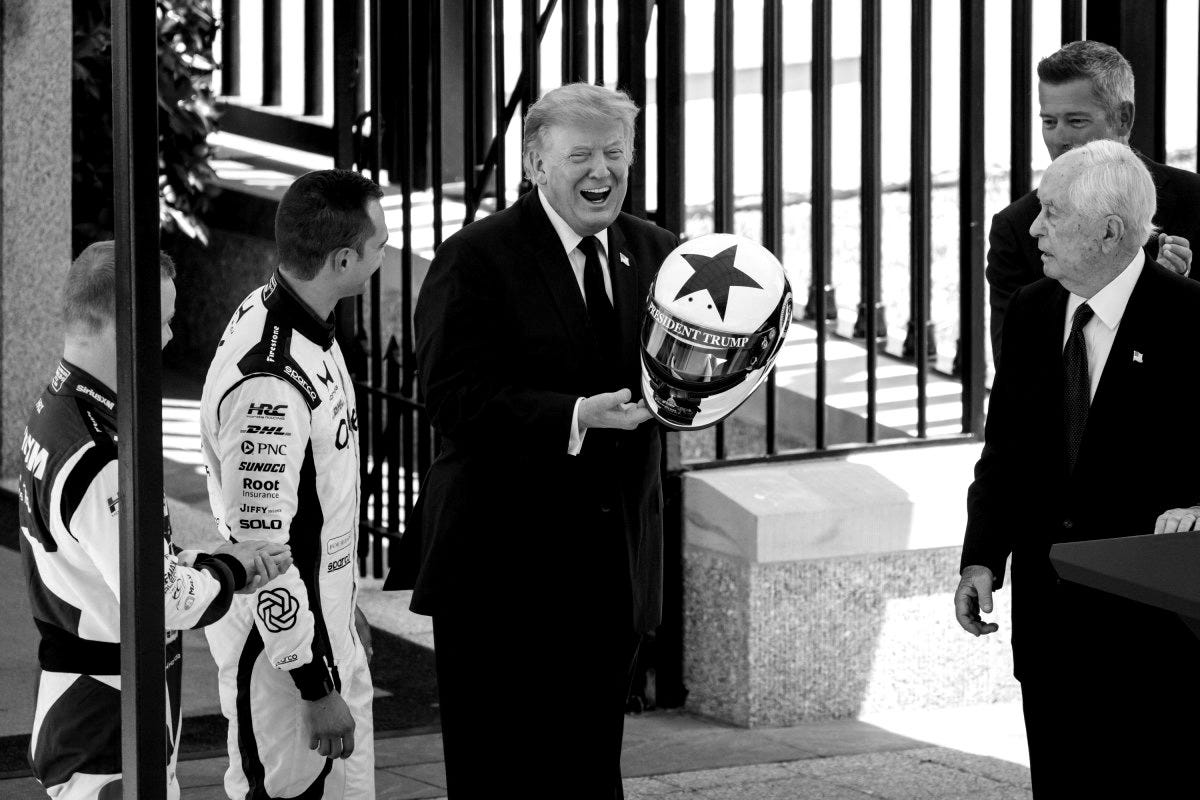
Donald Trump Isn’t as Invincible as He’d Like You to Think
As the 2026 midterm elections approach, a CNN poll suggests that Donald Trump is not as invincible as he would like you to think.
Episode 78 · August 6, 2026
Welcome to another episode of The Oath and the Office of the podcast. I'm John Pegel, saying it's so great to have you with us because we've pretty much reached a point where the Constitution is basically America's most ignored terms of service agreement, and when it comes to fitness for running the Department of Justice, Todd Blanche has raised the bar on lowering the bar at a time when constitutional norm sounds more and more like an endangered species. Let me please welcome the star of our show. Constitutional law professors have become America's trauma counselors and no one saves more. And Professor Corey Bretschneider, the author of The Oath and the Office. Professor, welcome back. It's great to see you.
Thanks so much, John. I'm looking forward to this episode. Although I'm distressed by what's happening with the confirmation of Todd Blanche, which was voted today out of the Judiciary Committee, I also think gets a chance to talk about how the system's supposed to work and what confirmation is supposed to be, namely our main check against a monarch, and so as much as we're failing in our current moment, we'll also talk about the hope of how the system's supposed to work and how to revive it and what to expect the representatives who defend it and those unfortunately who don't.
I was on MSNL the other night to talk about Senators Tillis and Cornon and their valiant Mister Smith goes to Washington efforts to get Todd Blanche to agree in writing to get rid of the slush fund for the January sixth terrorist. It was essentially they were saying, well, listen, all this corruption we're okay with, could you not do this one piece of corruption in writing? That's all we're asking. And Corey he said, I'd said under oath that it's dead. And they're like, sorry, we don't trust you swearing on a Bible on camera under oath, mister Blanche, can you please, we need to know it's dead, Corey. Ten years after Trump started all this, Republicans are demanding Trump produce a death certificate for something. The irony floors me. Blanche said, we won't do it. And so suddenly Professor all the Epstein cover up, given Dlane Maxwell a cushy club fed prison, all those pardons for all those January sixth terrorists, I mean everything, the subpoenas for the New York Times reporters. None of it matters anymore. They made this big drama about one little thing, and it successfully seems to have distracted everybody from talking about the gigantic pyramid of corruption this man represents.
Absolutely, you know.
And just to go back to the beginning, of course, you know, there are a number of questions in this nomination.
The failure to.
Release the Epstein files, which we've covered with Katie Fang, who's suing actually to get this release, and then these immediate issues about both the deal that Donald Trump essentially made with himself he claims with the IRS, and a settlement that resulted in a b with billions, you know, over in the billions of dollars, this settlement, which was really a slush fund to fund the allies of the President of the United States, including potentially to pay off the January sixth rioters. Now, a lot of the Republican Party has been fine with that, but these two senators, as you suggested, in the Republican Party.
Seemed that at a moment anyway to.
Have a conscience and to say, you know, I'm not going to vote for somebody that approved all of this. And yet you know the thing that they still are saying that, But yet they're being naive. It looks like and thinking, well, as long as Donald Trump and or Todd blanche in particular puts into writing a promise that I'm not going to do this, then we can trust it. Now when they're pushed, I've seen comments that suggest they realize, like, yes, maybe we can't hold him to these promises. But really, the assumption that there's any trust in an administration that is trying to do this in the first place, I think that, yes, it really is, but it does you know, John, Yes, we'll talk a lot about history. I want to say one last thing. There is this tradition of getting promises from nominees that were carried out, and so the most important I think is Elliott Richardson, the Attorney General, who is in the midst of the Watergate scandal, not just nominated but confirmed to the Senate, promises he's not going to stop the investigation, he's not going to fire Archibald Cox, the special prosecutor looking into Nixon's crimes, and he stays true to that promise. He basically says, fire me rather than see me do this because I'm not going to break and this is how we put it. I'm not going to break my word to the Senate. So there was a past moment where these promises met something. But yet look a moral age of.
The golden moral age of Watergate, when Republicans were men of character. Yes, wow, we never knew how good we had it. I mean, Corey, I want to ask you about you know something that you just said, because it seems like with the Weaponization Fund, doesn't the fact that Blanche was willing to pitch it in the first place before we're sending it, doesn't that on its own render this man unfit for office?
Exactly, John, That's such a great way to pull out the really absurdity of the situation, because you know, if you're saying, I'm going to basically destroy the Department of Justice and the Department of Justice.
And this is partly also related to Watergate.
There was an amazing Attorney General named ed Levy who was appointed by Ford, nominated, I should say, and confirm by the Senate. That's an important distinction. You don't just get put there.
By the President.
And what ed Levy did was he instituted a lot of these norms that we think are supposed to govern the department, like don't well even meet with the president, remember the famous tarmac meeting. Even interaction was supposed to be dangerous because of the worry that we'd return to a Nixonian moment where the president was essentially telling the Department of Justice to do his own bidding. So, you know, there is this history of norms, and what Todd blanche has done is just destroy all of them. Now, how has he destroyed them? He's basically acting as the president's personal lawyer. So to get to your point, which is, if you're doing that, if you're destroying the Department of Justice, you have no integrity. How are we going to trust that you say you're not going to continue the weaponization fund.
That's why I felt very uncomfortable on MS NOW the other night discussing these two senators as performing any kind of meaningful oversight or even procedural oversite. It was all just theater. I mean, this man has gone from personal defense attorney to publicly funded defense attorney right right, and again if you want proof of that, and again of the unfitness for office. The administration narrowed language regarding the tax audit protections they want to give Trump and his revolting sons, Fredo and shimp I mean, Corey. I don't know any private citizens, certainly not any convicted felons who are now immune from IRS audits for possible tax fraud in the future and in the past. I know of three people alive that this administration says should not have audits. You'd think our conservative brothers and sisters would find that a bit untoward and unfair, wouldn't you. I mean, constitutionally, are there broader equal protection concerns for when a government is clearly creating a different legal standard for a few private citizens.
Well, it really is the destruction of not just equal protection, but the rule of law, the idea of democracy because Republicans.
Voted for it. Every Republican voted for it.
Sorry, the President of the United States, you know, has this immunity that the Supreme Court basically pulled out of thin error, and he's doubling down on that with this IRS deal, this fake deal again, a deal between himself and himself, and also trying to extend that to his family. And so absolutely, this is, you know, just a real attack.
On the rule of law.
I should say something too, you know about all this, which is I think a part of the story that I haven't seen talked about, but it was talked about on this podcast. As you know, a friend of the show, Sky Perryman, was our guest two weeks ago, the head of this amazing group, Democracy Forward, and what we spoke about was the way that she, you know, really was her organization and these amazing team of lawyers, many of whom are former DOJ officials themselves and are horrified about what's happening. And I've worked with some of them, as you know, on the tariff's case. At any rate, they brought a case to both against the IRS deal that we're talking about, but also against the weaponization fund.
And just to remind people, the.
Way this worked was the IRS deal was not, in the end a payment to Trump directly, but was an agreement that the IRS had engaged in this weaponization and so he would be given this multi billion dollar fund he and the DOJ to fund his friends and the January six rioters and those who were supposedly the victims of shutdowns of political speech. Anyway, Perryman stopped it essentially in the courts for the time being. Now here's the point. Now he says it's dead, right Todd blanche Ye, if it really is dead? And she we brought this out in the podcast in a way. I'm not seeing any media covering this. So I know a lot of journalists are listening to this show, and I hope that they're they're going to use this moment to report on this. That lawsuit hasn't been dropped. So how can all this bs about where there was a letter and we're not going to do the weaponization fund? And I promise, and I promise, you know he's got his fingers crossed behind his back, And how do I know that because he hasn't dropped the cads just give up? Why litigate in court on behalf of a weaponization fund that's dead. And so that was a really powerful argument. And that's the real litmus test, not what he says, not what letter he promises, and.
All this back and forth. The reason for their suspicion should be.
At its height no matter what he says, because he hasn't dropped the case.
What does it say that these senators would vote to advance this nomination for a man they acknowledged they don't believe when he's sworn under oath. I mean, they don't accept his word under oath on camera. That's not enough for him to believe it. And they vote for him anyway.
And again, this is all just days after the DOJ subpoena is targeting the New York Times reporters.
Can I ask you about this?
I know that on a constitutional level there has to be a line between legitimate leak investigations and protecting a free press. But the DOJ withdrew these subpoenas after a federal judge said, no, you didn't follow procedure, So unlike these Republican senators and the Congress, at least one judge is practicing some judicial oversight out there. But how insane and illegal was this? They're subpoena New York Times reporters and he still shows up at the correspondence dinner.
Well, you know, if we're going to make a list of what's wrong with the blanche nomination and the reason why every Republican senator, every Democratic senator should be voting, no, that's not what's happening.
This is high on the list.
We talked about the DOJ slush fund, the creation of the slush fund, the fake IRS case that came from it, with a federal judges called a fraud on the court. And now we're onto this other topic, which is that, under Blanche's direction of the Department of Justice, another nominee, who we're going to talk about, Jay Clayton, who is now the Director of National Intelligence, a totally frightening thought.
Subpoena these journalists.
Now they trying to back out of this, claiming, oh, they were never really subpoenaed because they were targets of the investigation.
They weren't criminal targets.
There's a distinction in prosecution between the target of the investigation and somebody who's essentially a witness, and somehow they were just well, what was the crime. We haven't even heard that. And what was obviously happening here was, although they knew they weren't going to get a conviction, harassment to create that chilling effect that we're often talking about, not to prosecute anybody in the way John Adams did and get a conviction and put people in prison, but to make them think twice before they do. Another story about a bribe plane. That's what the story was about. The cutter gave Donald Trump this bribe plane, and the New York Times was investigating on why it needed to be retrofitted because it wasn't prepared to have the defenses to cover to carry a president of the United States.
So, you know, here we are again.
The main point is there's this story after story, and that's all under his leadership. If he found out, you know, maybe wanted to blame it on Jay Clayton, that he was the one to do it, he could have stopped it, or he could have called it out, and he didn't do anything of the sort. To talk about how far we are from Watergate, think of how far that is from a devoted Republican. Elliott Richardson was a devoted Republican who had served multiple cabinet positions, nominated to be Attorney General, he was a party stalwart.
And yet you know heid by.
His word, which is I'm not going to stop the investigation of Richard Nixon. Look how far we are we have somebody who's just presided over destruction of the Department of Justice and presided essentially over an attack on democracy, and then we're supposed to trust them.
I don't think so.
Republican senators who have turned their backs on democracy.
Okay, as bad as you make it sound, I want to remind people it's worse because the DOJ wasn't just seeking reporters phone records, but they wanted records involving their family members. Right, try to imagine what would have happened if Barack Obama wanted the phone records of Sean Hannity's trophy wife. I mean, like, try to imagine if a democratic president had tried to get the call records of a right wing journalist family members. I mean, doesn't this raise constitutional and civil liberties concerns?
You know it does, and you know, sometimes you have to go I'm always talking about hope on this show, and one thing that I really do think is hopeful is that we forget some times where the norms, where the rules of the Department of Justice came from. And Nixon was so terrible, not just in the crimes of Watergate, but in his attack on political opponents, his abuse of the irs, his attempt to manipulate actually antitrust suits, including one involving a company called Itt, and over and over these abuses were coming to light. And when Ford took after Nixon resigned, Ford takes his place. This new Attorney General, ed Levy again had been the president of University of Chicago. He picked somebody who wasn't his friend, who was at the height of the legal profession. And you know the institution of these norms, which say you're not even supposed to talk to the president, much less allow the president to commandeer the department, and the department is supposed to defend the people, not the personal interests of the United States. Those were in place so much so that if any president violated them, even in the slightest and I do think this was true of Democratic and Republican presidents, that what would happen is the press would go crazy. It would be a scandal, even a discussion, And that's what we were Now.
Todd Blanche really has destroyed that. I mean completely.
It's been on the run in the first Trump administration. Certainly we saw a tax on it with Bill Barr and others, and we could talk about that, but this is somebody who really is acting. You said this, I don't want people to miss it, not just as the president's lawyer, but as his criminal defense lawyer, and he had, of course been Donald Trump's criminal defense lawyer in the Stormy Daniels case in Manhattan. That's how he's acting. It has blown apart these norms. One last thing on this point, The norms themselves turn out to not be a good way of guaranteeing democracy because if you just get somebody wants to violate them, norms are not really a legal check on this event. Right, That's why we're seeing what we're seeing.
I mean, right now, somewhere in hell, Nixon is looking up at these guys saying too much.
Guys, too much, pull it back, pull it back.
But in the midst of all of this, you know, Senate Democrats are asking whether the White House played any role in directing these subpoenas Corey. And now we're getting into real Nixon territory, because how problematic would it be. I know this sounds really impossible, but go with me on this hypothetical. But what if Donald Trump personally influenced criminal investigation decisions regarding I know it's hard to believe, but what if Donald Trump ordered the code read Corey, I mean, right.
You know, so much of the problem here is getting the information, and we have journalists. We had Jody Kanter, one of the best, I think probably the best journalists out there covering the courts, who's gotten us secret memos from John Roberts showing us what's.
Really going on behind the scenes.
And there are other great reporters doing work about Donald Trump and his secret orders. Yeah, but the problem is how do you get that information? And so much of what happens between the President and the Department of Justice is concealed, and so the more we learn, I have no doubt that as bad as what we're seeing is that it's not a coincidence that his political enemies James Gomi gets target. No, he tells us that, I mean, listen to him in his public statements, and so of course it could be that these subpoenas for the brideplane were at his direction, because you know, that's just how he operates.
Again and again, one thing on this.
Is, you know, we do need there's so many pieces of legislation we need to recover from this mass and the hope is that as we see how bad it is, we see the laws that we need to recover. And we talked with Senator Wyden who's been at the forefront of a lot of these battles about the need for legislation that would allow people to get access to this information.
The jaw Boning Act is one example.
Katie Fang is using the Epstein Files Act in a totally innovative way to get access for journalists. So that's the kind of thing that we need more and more and more laws that are going to.
Do this absolutely.
And you know, again, Donald Trump really is not going to be able to persecute James Comey as fully as he'd like unless he has really creative ways to cheat in the upcoming midterms. And we've talked extensively about how they've been trying to since early twenty twenty five with Jerry benderin in Texas in a very off year from a census. So they're now asking the Supreme Court to revive portions of their old executive order that affect mail voting. Once again, Donald Trump, a guy who votes by mail, is trying to make it harder for people to vote by mail, because, as we've said, it's going to be deaf by a thousand cuts. They're going to try to make a little bit harder with a voter ID law a little bit harder with getting rid of drop boxes over here, maybe the Save Act and you ladies change your name a little bit harder. I mean, what constitutional questions are at the center of this case, trying to take a means of exercising a right away from citizens.
Well, you know, let's start from the beginning that what the Post Office is being tolled by Donald Trump is that there is massive voter fraud. And to say the obvious listeners are not going to be surprised by this in the least, there is no such voter fraud. This is the same kind of thing he's been saying since the twenty twenty election, when he claimed again and again that there was voter fraud and there wasn't And now he's doing it again.
Now.
The problem is that he's saying it this time not to courts, who are an independent branch of government that are going to push back, but to the Post Office, which is dependent in many ways. It is part of the executive branch. And with the theory of the unitary executive, this Supreme Court has strengthened the position of the president over any civil servant in the executive branch. Even though there are laws that govern the executive branch.
That's how it's worked.
So the Department of Justice and the Solicitor General. I just went and looked at this argument to see how blatant it is. Is essentially saying, what are you talking about that the president can't stop fraud. That's not up to you the courts to decide. That's between the president and his employees. Through the theory of the unitary executive, the Post Office are his employees. Now, a federal court has pushed back the Court of Appeals.
It's gone to and what.
That court has said is, no, the president can't say that you have to do things that are illegal. You can't do things that are going to undermine the state constitutional ability of the states in the document to regulate elections. And you can't go back on prior agreements that keep from the politicization of the Post Office. So you have these two battles happening now. So far, the winning argument, thankfully is the rule of law that says, yeah, it doesn't matter what branch are and you can't break the law period. You can't undermine the power of the states just because you're in the Post Office. And that's part of the executive branch. But what's the Supreme Court going to say eventually? I'm not sure because they are the ones that have built up this theory of the unitary executive. Yeah, even in the Court of Appeals there was you know, the three judges agreed basically to put a stop to this, but there was a trumpet point to judge who had a lot of wiggle room in there when it comes to the ability of the president of the United States to control the Post Office.
And so this is scary stuff. John definitely, Well.
I mean, and again, these like Trump, the Supreme Court, their executive power is something they treat like I treat my airplane carry on bags. I'm trying to see how much more stuff I can keep on stuffing into it every time and cram more and more into it. I mean, I don't know. I went to public school, professor, but I always thought elections were administered by the states. Seems like this is a states rights issue, except that's only deployed when people are trying to justify racism. Where in this instance does presidential authority end and state authority begin? Because it seems like this Supreme Court is going to have to do some really creative dancing to make this fly.
I mean, I love this airplane analogy that you know, you're exactly right that what the theory of the unitary executive is becoming is a theory of everything. So what's in the executive branch? What are the powers everything?
More and more? What about the power to destroy.
The laws that are supposed to govern the civil service? Put that in the unitary executive and destroy it, get rid.
Of all of those laws.
Put the power of the states is supposed to be independent of the federal government and certainly of the presidency, in the executive branch. Well, let's put that in the theory of executive power. And so it's trying to swallow up everything. And notice how they do it. You know, lawyers are so crafty. And these lawyers, the lawyers of the unitary executive, which go back and you know, part of what I'm talking about in my book is the lawyers of the nineteen eighties, people like Elito and people like Roberts, who were crafting this theory of the unitary executive. It's the same people people that's who's doing it.
And they are expanding and expanding it.
And that's what's really scaring me about this case because when I read what the Solicitor General is saying in the brief, it essentially is no, this has nothing to do with courts. It's all between the president and his employee who he has command total loyalty from and has to do what he says. And you know, that's how they're trying to skirt the law. That's what it comes down to. So far, not successful, but we'll see what the Supreme Court says.
Could a president with an obedient Supreme Court effectively like nationalize a whole election just through executive orders or would he still have to get congressional authorization.
I got to say, John, you know the answer should be absolutely should be that you need congressional authorization or even you know that this again, the states have this role in regulating elections too, that there are all these checks, a check from Congress and a check from the states. You know, now, when you start to look at the facts, the way legal cases work, and this is something that's so frustrating is we can state a general principle, but lawyers crafty lawyers, and let's not make any mistake that lawyers who have created and are extending the unitary executive theory are very good at this, and they take this idea that the Post Office this is part of the executive branch, and they start saying, there's nothing going on here that's about violation of laws or even involved courts. It's just a president essentially saying, hey, we don't want to deliver fraudulent ballots, and so you know, look at the roles and if you have people on the rolls that are not supposed to be voting, you're supposed to stop that.
Now.
Isn't that within the president's obligation to supposedly, as Article two of the Constitution says, take care that the laws be faithfully executed. I'm making the point of the unitary executive theory. How frightening that might work.
Well, I mean, the White House says that they're just they're just managing their own internal federal directives like they're supposed to. But the state's just saying, no, you guys are already changing how we conduct our elections because of your order. So if the Supreme Court Professor allows parts of this to proceed before the midterms, what kind of precedents are we talking about here?
Well, the unitary executive theory started as a kind of wacky idea. I should say what it's basis is, and when I tell you, it's going to be upsetting, because supposedly this is an idea based on the text of the Constitution, and it's really only based on a phrase, which is that the executive power is vested in a president. And what they've done is use that to just expand and expand what the president can do. And the president's total control, not just control, but total control over his own employees. That's how they'd put it. Now, what's the response to that. The response to that should be, well, the legislative power is vested in a Congress, and it's made laws, and the Constitution has created structures that give the states and Congress the power to limit what government can do.
But what this very.
Specific example I'm glad that we've gone so deep shows us is how the whole idea, that the right idea of the Constitution, which we all learned about in grade school, of three coequal branches, how that is under assault by this president successfully who doesn't understand in the three branches of government I'm sure couldn't name them and tried it.
In the first term, he thought the three branches were the White House, the Senate, and the House. After he was elected the first time, he thought those were the three branches of American government. And no one ever thought this was remarkable except me.
I mean, he's turning it into one branch, and that's the presidency. That's why this podcast, i should say, is called the Oath in the Office, to try to emphasize the idea that that office is created by law and is beholden to law. And that's what's being destroyed by this unitary executive theory. And here's the worst part, just to sum up, the Supreme Court has.
Again and again enabled.
The destruction of the other branches, the building up of one, the presidency. And we might see it here again, Corey.
These guys treat the Constitution like a hotel room Bible. They know it's there, they're never going to open it. All right, we got to take a quick break. But when we come back, much more on the Oath in the Office, including the never ending war against.
A free press by these people. Be right back.
The new John Fiegel Sang Show every day at dwelve noon.
Good afternoon, John, and welcome back to afternoon Radio.
I have missed you. Now you're back into the daylight.
Good afternoon, John congraduates on the new show, loving congratulations on the changes happening with the show.
Excited for you, Excited.
For me personally, like, oh my god, I can call it again.
The new John Feugel Sang Show every day at dwelve noon on Serious XM Progress Channel one twenty seven or on the Serious XMN.
Welcome back to the Oath in the Office.
I'm John Fugel Sang alone with Professor Corey Bretschneider. I mean, Corey, you've written so much about constitutional guardrails. Which institutions do you think are under the greatest strain right now? Is is it Congress? Is it the courts? Is it federal agencies? Or is it the free than us?
Well us, you know, it's all of the above.
But I'm going to just continue our discussion from the first segment and talk about the federal agencies because what these agencies are supposed to be doing is carrying out the law, and we have laws passed by Congress.
For instance.
You know, if you're working for the Post Office, you're not supposed to be engaged in the subversion of democracy. And what's happened is that that whole idea that these agencies are bound by the law, that they also civil servants also take an oath of office to preserve, protect, and defend the constitution. And yet it's being undermined by this demand for loyalty at all costs by the President of the United States, and he's demanding that from postal officials. We're seeing that in the FCC, I which I know we're going to talk about, and you know, that's how this process of swallowing up the other branches, the administrative agencies, civil servants, jobs, the law, into the executive branch is happening.
Well, let's talk about ABC. I mean, the FCC has been at war with the free media. You know, hey, they got Colbert fired and they've tried to get Kimmel fired.
Lord knows.
We don't give enough credit to Monday Night Football for making Sinclair back down on that last year. But ABC is arguing, Professor, that the FCC's review of their broadcast license is just retaliation for their editorial decisions. I mean, like freedom of speech subject to management approval, right, I mean, how seriously is that allegation on a constitutional level, because it certainly seems to be exactly what the hell is happening.
Well, all these stories intersacked, and the story here is the story of the way that although the administration is claiming that CBS and other networks have voluntarily started to, you know, show more sympathy to the president voltarily, the real story is that they've done so under threat of having their licenses revoked. And some of these networks, CBS is you know, the worst defender, have just backed down. And what ABC is saying, thankfully, is I don't think so. You can't use the threat of retaliation to get us to supposedly volunteer to self censor.
And this is called job boning.
That's essentially what they're accusing the administration of and job boning. To go back to the episode with Senator Wide, and I hope listeners will go back and listen to that. It's really important legislation and important idea. The idea of job owning is that when government secretly forces you to do something, it's not any less of a First Amendment right than if it does it in the open.
So there's a case, for instance, about a.
Bookstore and Basically, the cops keep coming back and they're like, ban these books, you know, but they don't do it in the open.
They do it in sort of secret threats.
And the court says, you know, you can't can't go into a bookstore and tell them how to manage their internal dynamic and claim that it's voluntary.
And you know, that's what's going on here.
And so one of the things that I talked about with Senator Widen, which I'm increasingly interested in, is job bonning is hidden almost by definition. They're doing it in secret, and so we need legislation to start opening things up. And you know what, ABC, in making this complaint to the FCC and hopefully litigation full litigation will come after, is starting to give us an understanding of what's going on.
They have the goods, they have the documents.
They should be able to get more documents from Brandon Carr. But this is not only you know, bad, it is illegal activity.
But this is how close and USTRA works.
Nice constitutional norms be a shame as something happened to it, right, I mean, throughout our history have constitutional checks. I mean they've really depended a lot more on written law than on political norms right.
Well, often, you know, that's a great way to put it, because how do you prove the violation of a right when it's being done in secret? And that's so much of this administration that we've talked about. How do you prove that Trump is ordering the Department of Justice and not just Todd Blanche but also Jay Clayton, the head of the Southern District of New York, to subpoena these journalists.
It's happening in secret.
Now eventually, you know, a lot of what I'm doing these days is looking in the Nixon and four documents and it comes to light, you know, decades later. But what legislation would do that allows us to peer into the dynamics of job owning would do is bring it to light sooner.
And you know another thing that will bring it to light is this.
Hopefully this case and thankfully, you know, this has been the last since Donald Trump was elected, these these months have been a story and often in failure of courage because people just give in. That's CBS, that's the universities like Vanderbilt that seem to be caming into this administration. That's the law firms like Sullivan and Cromwell that are going along with it. And in the networks again, CBS is almost like the poster child for non courage and ABC here is adding themselves to the law firms, universities, those who are fighting back.
And I'm glad, Tolly God Corey.
Do you understand this administration is so evil They've got us praising the Catholic bishops and Disney. That's how evil they are. We're embracing those institutions. Now, Look, this whole thing is nuts because it's like, I know enough to know that broadcast licenses aren't supposed to come with like editorial performance reviews, right, I mean, it's the FCC. They're not yelp, but they want this is all about content. And I know they have broad authority over broadcast licenses, but we've seen former FCC officials of both parties say that this is unprecedented. I mean, is there a dividing line where the regulation ends and the viewpoint discrimination begins.
Well, the unprecedented, you know, I think that is a theme of this podcast that you hear it a lot, and if you you know, watch public media journalists who are doing a great job of covering this. The one issue that I often have is when they start talking about history and they say it's unprecedent. No, it's not unprecedent. We've seen total shutdowns of free speech in American history before, starting with John Adams, somebody who didn't.
Believe in free speech at all.
You thought, if you criticized the president of the United States, you should go to prison. And in fact he had written into the Sedition Act was the idea that it was illegal to criticize the president, but it was fine to criticize the vice president. It was Thomas Jefferson, the leader of the opposition party under the way presidential elections work, so.
That that was worse getting started on those guys, I know, yeah, you.
Know Woodrow Wilson, you know, advocated for the shutdown of leftist speech, including the Bernie Sanders of the time, who found himself on trial for his viewpoints of democratic socialism. Eugene Devi and you know ran for president from prison.
So there is a long history.
Unfortunately, the McCarthy period we could talk about as well. What's going on here is it's not in the open in the same way it's happening in secret, and yet it's in some ways that makes it more dangerous because it's harder to call it out. And that's why it's so important that we have these individuals who are willing to stand up to it.
Well, that will bring us back to Koby because I mean, I guess, as we've discovered before, posting pictures of seashells as a gate crime.
Corey, I need you to walk me through this. Now.
We know that they've gone after James Comy because he saw some seashells that spelled out eighty six forty seven, took a picture, posted it on Instagram, and they're saying that this was somehow a death threat. We've talked extensively about how this is Donald Trump's m He punishes people who tell the truth about him by taking the court and trying to bankrupt them with legal fees over absolute rubbish cases like this. But Combe's attorneys are alleging that there was warrantless surveillance during an investigation into his eighty six forty seven Instagram post. Can you break that down? I mean, what has been accused and if it's proven, what rights would potentially be implicated here?
Well, you know you have a right the United States Constitution against unreasonable search and seizure.
And if you want to comply.
If government wants to get a warrant to spy on us or to investigate us, it needs to get a warrant, needs to go to court and show that it has a reasonable suspicion that you know, there's some criminal activity here. And so you know, before the indictment, it looks like that's what was going on, that they didn't go to court, they didn't follow the procedure, that they were just basically.
Spying on their opponents.
This is, you know, is talking about precedented. This is very Nixonian. This was what the plumbers were all about. What Nixon was trying to do with the FBI, getting them to spy on his opponents and you know, including in this case a former FBI director. So no, you can't do that. I mean, I have to say something about the case. As bad as this is, you know, warrantless surveyed because questions. I mean, when I teach, I've written a book about the First Amendment called When the State Speaks, What should it say? All about the idea about the freedom of speech and when government itself can share its own opinions without violating our rights. And you know, I've taught First Amendment and a variety of law schools, including the one which I will say I have enormous love foreign respect at Harvard University who are fighting back, and when I did that class, this example would be the kind of thing I would say in the beginning, like, let me give you something that's like so obvious that you can't do it, and trying to claim that somebody is issuing a threat when they're obviously using one of the most common expressions out there eighty six somebody doesn't mean, you know, well from their job, doesn't mean kill them.
It means cancel that what I mean is.
And so it's just almost like so much of Trump's administration is like this that it just strains credulity to try to think about the way in which there even is an argument about this. You know, the First Amendment says Congress shall make no law abridging the freedom of speech.
But I also will add.
To that that you know, you could give an example that would just scream an abridgment of rereadom of speech and saying that you go to prison for eighty six forty seven is as it's almost like saying I hate free speech. That's what Donald Trump's doing, and DOJ is doing and bringing these charges.
Well, and again, let's be honest. I mean, tell me if I'm wrong about this professor. But like this case against Comy, it's already dead, right, it's never going anywhere. They know this case is garbage. They are just using the court system to harass this man because that is what Donald Trump has done with the court system, because he inherited a lot of money and you didn't, and this is how he beats people up in the courts. The case itself isn't going anywhere, but their defense attorneys are saying that after this whole thing happened with the photo, the Secret Service, without a warrant and at the direction of an unnamed high level DOJ official, did physical surveillance and they tracked his cell phone as he and his wife did a drive from North Carolina to Virginia. I mean that seems rather black and white when it comes to legality, doesn't it corny?
Yeah, because it goes to you know, it's a it's a free speech violation, and B it's obviously a selected prosecution where they're going after the individual not for a crime that was committed.
They couldn't care less about the crime. They're looking for anything.
And my guess is that James Gommi is such a straight shooter that there is no crime, so they had to just make something up. But you know, again, here's what's scary about the case. It's so obviously a violation of his rights to the free speech and also his rights against unreasonable search and seizure. We're adding to that now, and yet it isn't dead. And even though it's unlikely I agree that he's going to get a conviction, or that this will get to a jury, or that a jury would actually agree with any of it is it doesn't matter. That's not what they're trying to do. They're just trying to a scare him and be scare the rest of us, because if they could do it to him, they could do it to you at me, John. I mean, that's really the bottom line.
It's important they are They are trying to you know, stochastic self censorship is the name of the game. And again, the filing also alleges that investigative updates were being provided directly to Air Force One. Again, Professor liked the New York Times journalists. If it can be proven that the president was directing this campaign of harassment and retribution, then we're into some very black and white Nicksonian territory.
Right, That's right.
I mean that really was what Nixon was trying to do in all points, was control all aspects of the government, control, you know, the Department of Justice. He actually imagined using special prosecutors to attack his opponents. He certainly demanded the prosecution of Daniel Elsberg for the release of the Pentagon papers, and they knew they couldn't win that case, so they ordered all sorts of dirty tricks around it. And you're seeing the difference again. They were often stopped by people like Elliott Richardson, people who might have been partisan Republicans, but who aren't going to go so far as to enable it. What's different now is that the Todd Blanches of the world. I'll add Jake Clayton to that list too, talking about the New York case, and so many of the US attorneys miss purerou instance with her now thankfully ended prosecution of somebody supposedly for terrorism and destroying the reflecting pool that Donald Trump couldn't manage to make blue. So all of these are things I think that wouldn't have happened in prior administrations. You would have had more secret ways of doing it, or in the Nixon case, he was trying and stopped often. But you know what's so scary is that this Department of Justice is turning into the personal lawyers for the president. I have to say something John about history, because just to shape how important this is. At the founding, one of the chief objections to the whole system was that the attorney general was going to work for the president. And that was the objection to the unitary executive in New York, for instance, which they had as a model Letitia James. The attorney general is independently elected. That gives her a way of saying no to the Andrew Cuomo's of the world. And if we would have had that situation elected independent attorney general at the federal level, that person would just say no to Trump.
But that's not the system.
System is in which the attorney general is in the cabinet, in the executive branch. And that's what we're seeing basically eroding our democracy.
And thank you for mentioning, Judge Janine. I know we're not covering her this week, but as someone who's been on her show and hung out in her office, it's amazing to see America's most famous boxed wine enthusiast be demoted to deep state trader because she made the catastrophic sin of looking at the reflecting pool evidence and not putting innocent Americans in jail's.
You have a boxed wine with her? Is that?
No?
I know I did not know. My eyes still sting from the scent of it. So you mentioned, you mentioned, Yeah, she didn't like me on her show. I'll tell you that story. Sometimes. You mentioned Jay Clayton, and he's tell us the story. I did her show, and you know it's it's not that satisfying.
You know.
I just said to her, she was just so nasty, and I finally said on the air, you have liberal friends. She said, I admit you're a liberal. I'm like, I'm like, what do you mean. He goes, admit you're a liberal? And I'm like, I'm a liberal according to the dictionary definition. She goes, no, it'd make you're a liberal. I'm like, well, I am the way George Washington intended the word the way Jesus was it make you a liberal? And I said, Judge, I'll admit I'm a liberal if you admit to your audience that you live in New York City and have liberal friends. And I was never invited back on that show after that. So aren't you glad you dragged that out? So let me ask you, though, Jake Clayton your handshake, buddy. He's now been confirmed as Director of National Intelligence. It was Tulsa that it was Pulty, that it was Chanye and Clayton that was Pulty. Next year it's going to be Kid Rocks. Hepatitis gets this job. But obviously there's a lot of constitutional concerns. Jay Clayton seems to have got the job because he was willing to go on CNBC and say, oh, there might have been voter irregularity in California. Three days later he gets the offer. But while this is happening, our intelligence community is undergoing significant workforce reductions, I guess, and that's one way to reduce intelligence, right, But are there constitutional concerns when major national security institutions are being substantially downsized by the executive branch? This is again national security stuff they're downsizing.
Yeah, I mean necessarily is a way to bring the point home. So the guy Jake Clayton, yes, I will admit I have shook in his hand.
I regret, Okay, that's okay. I broke bread with Jude Janine. We're all sinners, yet no one's.
Better than yeah.
You know.
The fact is that the same person that we've been talking about, who may be under orders of Donald Trump or Todd Blanche but regardless of who ordered it, he did it subpoena these journalists in an attempt to intimidate them, and there was no legal reason to do so. And now they're trying to back off, and it wasn't They weren't targets.
Of the investigation. Bottom line is he.
Did it, and he brought them to the grand jury in order to scare them. And now that guy is going to be given the position he is not going to be. He is the Director of National Intelligence that gives him control over this enormous surveillance apparatus. We talked before about unreasonable search and seizure. One of the problems with the DNI, with the entire surveillance system, is that there's a massive amount of search that's being done supposedly to stop terrorists. But we now know increasingly that some of these warrantless searches, these are searches without a warrant, are catching up American citizens.
And who's the guy that's.
Going to be able to kind of use these weekly enforced rules, these exceptions to the Constitution in order to make the decision of who to go. Well, this person could use this international surveillance state to go after the political opponents of Donald Trump. Now that would have sounded totally paranoid. I think three years ago.
It's not paranoid at all. There's good reasons. That's exactly what's happening.
That's why Bill Poulti was made acting DNI because he had no experience, but he was a mortgage guy, and so he abused the mechanisms of national intelligence to harass Letitia James, to try to go after people who've told the truth about Trump and see if they have real estate problems he could prosecute and exploit. But I mean, again, this is Donald Trump, right and they're reducing intelligence like they're downsizing spies. China and Russia are updating their linkedins right now. I mean, shouldn't Congress exercise a little more oversight regarding reductions in intelligence capacity when there are concerns that a president I don't know could be compromised by a foreign entity.
Yeah, I mean, you know again in the.
Answer story, hold, I mean, this is terrifying.
You know, I want to just bring together this story. I think polls together so many of the different threads, really, all of them that we've been talking about today, because you have somebody who was thought, I should say originally to be a person that would stand up to Donald Trump.
And that's why, you know he was the head of the SEC.
The thought was if he is the director of National Intelligence, he can be confirmed because he has integrity. But the second that those subpoenas happen for those journalists, he was making it clear he was sending a message to one person that no, he's not some schoolboy, He's not this choir boy. He is somebody that is going to do the bidding of the president of the United States. And now he's being put into position where, yeah, he will have enormous access to the information of Americans and is he going to use it to spy on American citizens who are opponents of the president. I don't have any confidence that he won't, and in fact, in all likelihoods, given what we saw with these subpoenas, he will.
Have you seen the Odyssey, Corey, I'm looking for way to get out of this beat. I'm looking for something positive.
Did you like him? Well, we always want to talk about heroes.
And you know, there's a debate about The Odyssey that I'm following among you know, whether or not did they basically turn this into an anti war film when really.
The Odyssey is not. It's about glory.
You know, there are all these academic arguments it's a film that really is about heroism, about.
Wanting to go home. You know, I don't know.
I don't know how to tie it to the moment, to be honest, John, But I feel like it's something people should see.
Should everyone should see. It's a film about cinema, and it's the greatest reason to go to the cinema. I saw it in Imax in LA two weeks ago, and I can't wait to see it Imax again several years from now when I can get a ticket.
It's just amazing.
In New York where I am, I said, there was a showing that there was one seat available. I think it was five thirty am, so I was thinking about going again. That's awesome how much I liked it, and I probably will going. We'll see if I could get my wife to come with me, or I'll go by myself if I need to.
See an imax. I mean the whole seat shaking. It just it really really works. I had a lot of problems with Oppenheimer, and you know, a lot of problem and great filmmaking, but a lot of storytelling problems, and this was just so satisfying and a great time in the movies.
We don't talk enough about the idea that we're covering these stories week after week. They are depressing. It is an obligation to know about them, and I think, by the way, people should be educating their kids to know about the horror of what's happening. But it's all in the hope that we'll recover and there also are ways in the midst of it to reclaim our humanity, and that's one thing that works of art do, including this one. And so you know, we'll keep going to the movies even as we discuss the attempted destruction of the minds.
Yeap, that's what it's looking like. All right, we got to take another break back in just a moment. This is the Oath in the Office.
Hey all, Clean Kershner here, So friends, I hope you'll join me on my audio podcast, Justice Matters.
You care about.
Ethics and government, criminal justice, reform, a conflict free federal judiciary.
I thought so.
On Justice Matters, we take on issues involving the need to reform our government and it's institutions, and we talk about real, achievable reform. I hope you'll join us. Look for Justice Matters wherever you usually get your podcasts.
Welcome back to the Oath in the Office podcast. I'm John Fugel Sang and I got to say Professor Corey Bretschneider is a man who spent years studying constitutional crises. He never expected them to become serialized TV. Corey, I mean, when we look across all these issues that we've covered, the DOJ investigations, the election administration, the media, regulation and harassment, restructuring of intelligence, are there any common constitutional threads besides oh my god, our hair's on fire.
You know, I think you've got one thing. I was on CNN today talking about Blanche and one thing that you know, this John from doing your various shows as a guest, there's often a tendency to just sort of break down the story in the moment, to do a lot of prediction, to do a sort of referee, you know, or who's ahead scorekeeping. And I think the real key, the whole reason why I wanted to start the Oath in the Office podcast with you, is to tie the stories together, because there really is one story, and that's that the president pledges to protect the law under the Constitution. He has to say that the first few seconds in office, and every moment each of these stories is not just about something that we disagree with or a partisan dispute, but really is an attack on democracy. And sometimes, you know, one thing that really hurts, frankly, is when I hear people say if I'm attacking Donald Trump, that I'm being partisan. I am a professor of constitutional law who cares about democracy. That's the reason I'm doing this stuff, because what Trump is about each moment each of these stories is not a normal partisan disagreement.
It is an.
Attack on the whole creation of the American Republic and really an attempt to turn it either into a monarchy. That's probably his fantasy or more likely an authoritarian dictatorship and through things like the unitary executive. Unfortunately, he's succeeding, you know, over and over. He hasn't won yet.
But that's what ties all these stories together.
It just seems like increasingly our major political disputes always just seem to end up in front of the Supreme Court, Like the Supreme Court is now America's customer service department for everything. I mean, is that healthy for a constitutional democracy?
Ooka?
I think the Supreme Court should have a role in protecting the rights of democracy. It should have protected rights of free speech. In the Eugene Debs case, it didn't. Sometimes it has. It protected the New York Times in the Pentagon Papers case in which Daniel Ellsberg leaked the secret history of the war. It has moments throughout American history, most famously during the civil rights movement. Of course, Brown versus Board of Education ruling that Topeka, Kansas is for segregation of students was on constitutional. Those are moments where the Court is active and yet doing the right thing.
But what we're seeing increasingly is the.
Control of this court by government lawyers, and again from the Reagan administration.
Lawyers Alito and Roberts.
Instead of going to Justice Alito, Justice Roberts are going the lawyers Alito and Roberts trying to engineer a system that swallows up the other branches of government into the executive branch. And nowhere you know that the force that we saw that with right before this president won election, actually the day after my book came out, threatening that the Supreme Court often mikes crises worse rather than better, was in that immunity case, which was essentially a green light for all of it. We saw it too in the destruction of independent agencies. So you know, there is a role for a Supreme Court. I'm not an abolished the Supreme Court person, but I certainly don't want to see it commandeered by government lawyers with an agenda to try to help, by the way, not.
Just any truth event.
It seem fine in stopping Biden, you know, in all sorts of ways, but to help this president basically succeed in all his worst ambitions.
Yes, I mean, I'm sure Congress will do something about it, but I mean, Corey, congressional oversight is just what is it?
This?
It's just strongly worded disappointment at this point, are there any historical periods that could offer us useful comparisons to what we're going through today in terms of executive authority.
I'm going to give you a really hopeful one.
And one of the main things I hear from listeners is please give us some hope. So now here's a pretty hopeful one. There's a poll that was released and I spoke to the New Republic about this, and you can see my comments there in that story. But I'll tell you what I say, which is what the poll is showing, is that Donald Trump's approval ratings are plummeting, and they're plummeting on a very specific dimension, which is his threat to democracy and especially his corruption. That's what a lot of the polling was asking about. You see these numbers slipping and slipping. And I was asked by the writer of this New Republic article to comment on whether or not we had ever seen in a historical slippage like this, And the most immediate example was Richard Nixon.
We did see it.
He was re elected in nineteen seventy two, even as Watergate picked up.
So it seems to care.
But as the details of the corruption and when you heard him on the tapes, and when you heard him ordering the crimes, when you heard the way covering up the crimes, that's when the numbers started to go. Now, they went lower than they are now. For Trump, they went into the mid twenties. We're now in the low thirties. But it shows, you know, the impeachment didn't come by accident. Congress gets courage all of a sudden when the approval ratings go way down. So especially if Democrats take this Congress, I think it will go way down.
I'll put one fine point on that, though.
There is a difference between Nixon as much as I want to use that as an example of hope, because those low poll numbers were directly responsible. I think for the fact that I should say impeachment began in the House Judiciary Committee, and when Nixon saw that the votes were there to remove him, he resigned before there was a full impeachment in the House. And that would be an amazing moment here what.
May never happened if Nixon and at Fox News, he would not have even opened the door for Bury Goldwater.
Maybe I don't know.
I mean, because when the numbers are that low, you know, Fox isn't going to save Trump.
I don't think.
I mean, if his numbers go into twenty five percent territory, we'll see.
I think that.
You know, Fox's whole point is to keep the numbers up, right, that's the idea.
But no, no, there's Rupert. They're no different than Trump. They want to keep their numbers up. Rupert is tearing Trump to shreds in the Wall Street Journal every day and still selling him as our savior on Fox News. Rupert cares about his profits more than right or wrong when it comes to Trump and everything else.
Well, I mean, it'll be an interesting example. I don't expect I should say. And I think this is the point you're making too. That Trump is gonna, you know, receive a bunch of Republicans who tell him to resign, No, please step down.
That's not going to happen.
But the question is whether or not the votes will be there as the numbers dip, And I think they might be even if Fox is giving him lip serves. And as you say, you know, in the same way that Ruber Murdoch's newspapers might turn on Trump even when Fox News doesn't. Eventually, Fox itself might turn on Trump, they might decide that, you know, it's good for ratings. That's going to be good for ratings to see another beachment and removal of a president, because that's very exciting.
Anyway.
Anyway, the numbers are plummeting. That is a hopeful thing. It's hopeful for the midterms especially. I should say one other thing about the midterms too, also on the note of hope, which is that you know, Victor orbon did everything he could to jerry mander, to essentially cheat in order to stay in power, and the numbers of people who came out in Hungary to vote against him were so enormous that it did make a difference. And that's what I'm hoping again that we'll see here, and these low poll numbers I think help help make that possible. One thing I was going to say too, is, you know, although there is this parallel the corruption here, there was corruption during Nixon.
The corruption here is off the charts.
You know, millions of dollars into this fund to fund your slush fund, you know, the cryptocurrency scams, the bride plane, I mean, a thing after things. So I just think that that momentum that we're seeing that's bringing down those numbers that that.
Can only be a good thing.
And I'm optimistic about what's to come once Democrats, as I believe they will at least take the House.
Yeah, I think you're right.
We will never see a few Republican senators stop Donald Trump, but maybe one or two of his own arteries.
Professor Corey Breutschneider.
What is the best way for our listeners to follow you and keep up with your work throughout the week?
Well, you can find us wherever you get your podcasts.
I keep seeing these great reviews.
Pop up on Spotify, on Apple. There is also an Oath in the Office substack. There is a Oath in the Office YouTube which is takeing off. Check out all of these options. Listen to us wherever you get your podcasts. You could also buy my book The Presidents and the People Five leaders who threatened democracy and the citizens who fought to defend it, which is both all about the Nixon abuses in part Adam's abuses. I'll mention the other presidents Buchanan, Andrew Johnson, and Woodrow Wilson. But it's also about those who fought back, and that's where the hope comes from. And so what I'm doing every week is trying to draw inspiration from those amazing citizens who've saved us in the past, and hopefully we'll do it again.
That's it.
The previous constitutional crises did strengthen our institutions, so just think how great things will be when this freak show is over. Thank you all so much. I want to think Wendy and Baywilp when everyone who puts the show together. I host a show on Sirius XM Progress one twenty seven every day. We are now daytimes, five days a week noon two three eastern nine am to twelve noon Pacific. Thank you all so much for joining us, and thanks once again for being here on the Oath and the Office
As the 2026 midterm elections approach, a CNN poll suggests that Donald Trump is not as invincible as he would like you to think.
Follow the show
A new episode every week with Corey Brettschneider and John Fugelsang, free in your podcast app.
Now playing
Episode