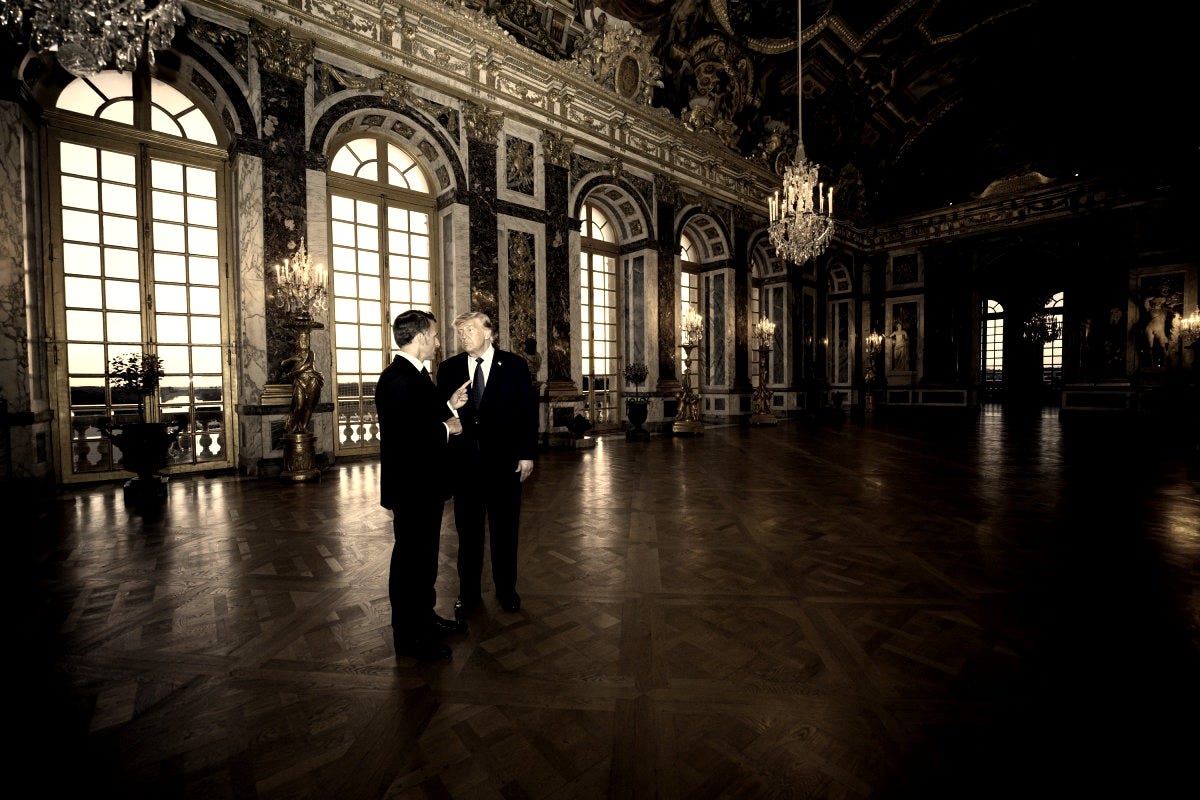
Why a Mob Prosecutor Sees the Mafia in Trump 2.0 (with Barbara McQuade)
Donald Trump has used his second term to coerce powerful people and institutions into serving his interests.
Episode 82 · September 3, 2026
Hey, welcome to another episode of the Oath in the Office podcast. I'm John Fegelsang, joined as always by professor of political science at Brown University, author of The Oath in the Office, and the man kicked out of Wu-Tang Clan for being too hardcore, Professor Corey Bretschneider. It's good to see you, sir.
Well, John, what a pleasure to show up here every week to talk about these threats to democracy that won't stop. We're going to have Barbara McQuaid, who's going to give us, you know, this is somebody who prosecuted mob bosses, who's going to talk to us about why the best analogy to understand Donald Trump is not as a traditional presidential leader, but as a mob boss. And of course, we're going to talk about the stories of the moment, including the Supreme Court's continued failure to stop this threat to democracy, most recently by refusing to stop his clearly illegal attempt to unilaterally build this ballroom.
But I also have to say in reference to.
The Wu-Tang reference, you know, that alone is reason to show up here every week to hear these.
I think so as well. I know. Listen, a lot of people don't know about your hardcore past in the hip hop community. And I know the Ivy League hiring committee doesn't want to hear about it. So I'm here to fill in the gaps in your resume. Professor, you know, people are paying more than four dollars a gallon for gas, ridiculous amounts for groceries. Rent is crushing people. Home ownership is out of reach for millions. Child care costs a fortune. Medical bills can wipe out a family. America needs a big gold leaf encrusted Russia inspired ballroom because that'll fix everything. And the Supreme Court is going to let that happen. The justices ruled five to four with a very strange dissent by John Roberts. It was an unsigned order. And the majority said that the historic preservation group that sued didn't have any legal standing. So I have many questions about this, Corey. They couldn't bring themselves to say the ballroom was legal. They just more or less said, you're not allowed to ask. You know, we're not saying Trump is right. We're just saying nobody has standing to tell him he's wrong. Did the Supreme Court actually rule that Trump's ballroom is legal?
Definitely not.
They ruled on a procedural issue of standing that I'm going to explain. But I want to first emphasize the big picture theme here, which I think comes through in your description. This is an attempt to build a symbol of his own grandiosity. It's a ballroom that Vladimir Putin, himself the head of a kind of mafioso state, would love. And yet he wants to do it unilaterally in this authoritarian way. And there's a substantive issue of the law of whether or not he has the power to do it. And my understanding, and I think it might be the understanding of.
A majority of the court, is that he definitely does not.
Because government property, the property of the United States, is under our Constitution controlled by Congress, not by the president. And legislation backs that up. Now, having said that, what you often see from this court, and now I'm going to really answer your question in.
Depth, is that often they don't.
Decide cases on the merits, on the substance of what the law is, but instead look for procedural ways to to give him a victory.
Think of the immunity decision.
We never got to the question of the guilt or innocence of the president. We were stopped instead by this question of whether or not sitting presidents could be indicted in the first place. And there are different ways for the court to take a procedural view without saying in the end whether or not somebody's violated the law. And the way that they've done that here is known as the doctrine of standing. So there's a case, for instance, called Lujan, where the Supreme Court, much earlier than this case, talked about the fact that you need an actual case and controversy in which essentially somebody is harmed. You can't have, in their words, third party standing. So it's not like I could just come in and say, you know, the president is doing something unconstitutional. There has to be a harm to the person bringing the case. And so here they're saying there is no standing. I think that's not right. We could talk about the details. I'll say a couple more sentences, actually. The group that brought the suit is a nonprofit that is really devoted to historic preservation.
And one of its members was claiming the National.
Trust's job, essentially, is to protect these monuments. And one other thing to say is you know, they're confusing us. They're trying to really say to the American people, oh, this is a technical legal thing. Let's just look away. We haven't aided the president. We've just done this technical legal thing. But in the end, you know, if our rights as American citizens, if the power of our democracy has been violated, there's got to be a way to get that across. And what they're doing increasingly using this doctrine of limited standing is taking our ability to appear in court, to vindicate our rights, and to vindicate the powers under our democracy, in this case, the power of Congress.
I mean, so the court did not say it's legal, and yet the construction is allowed to continue. So Trump didn't win because the court decided it was legal. He won because the court decided the lawsuit wasn't allowed to go behind the velvet rope, right? That's how they did it. That's the Weasley way. Is that why Chief Justice Roberts said the project is, and I quote, likely unlawful?
Look, if you read his dissent, it's partly about why there is, you know, possibility of standing here for the National Trust. And, you know, this is somebody who cares about American history, who sees, I think, the aesthetic harm that's being done here to our national monuments, and who also sees the common sense idea that if the law is being violated, and that's really playing the part in a lot of procedural decisions. if the law is being violated, well, there should be a way of vindicating that violation. There should be a way of appearing in court. The hope here, of course, is that the suit's going to be refiled and that although there wasn't standing in this case, that members of Congress, for instance, I think should be able to bring the suit certainly and have standing because their interests and powers as an institution have been violated. And sometimes we do see members of Congress getting standing in that way. So, you know, this isn't over by any means, but the court is, you know, again, figuring out ways to take his side without ruling on the law.
I mean, the DC Circuit had already concluded that Congress exercises control over federal property. And that the administration didn't have the authority to do all this. And this is how they do it, right? Like Trump's like, can I tear apart the White House and build a $ 400 million ballroom? And Congress says no. And the lower courts say no. And Robert says it's illegal. But five justices say, we're not saying yes, but keep building.
Yeah.
I mean, it's so often the case that, and we see this in the shadow docket decisions, that.
Even when Trump is wrong, he's right.
And that rightly makes us suspicious of this Supreme Court, because what it seems like, you know, if this was just taken in isolation, it might not be the case, but that they're using denial, for instance, of standing as a way of vindicating the president and allowing him to move forward. So even though, I mean, just, you know, to capture your main point that you started with, he's likely wrong on the law. I don't really see the argument on the other side. To my mind, the Constitution is Like in birthright citizenship, sometimes it's clear that the property of the United States is in the control of Congress. And yet what he's trying to do is a fundamental alteration, a destruction of that property and reconstruction of it. Look, it's one thing if he wants to decorate the Oval Office with gold leaf or fake gold leaf or whatever. I guess he claims it's a high-end gold leaf.
I don't want to get the facts wrong. That's fine.
But when you're altering the building, destroying it essentially and rebuilding it, that looks like a clear violation of Congress. And so, you know, trying to basically push the suit away as long as they can on the grounds that there's a lack of standing. I should say, too, there is standing for an organization that is devoted to the preservation of this national monuments, of the national aesthetic. And this individual, to my mind, certainly could have had standing. And as Roberts clarifies in his dissent, this wouldn't be the first time that there have been similar instances of standing being granted. And so the court is picking and choosing here, unfortunately, to pick a winner that they like, and that's Donald Trump.
But again, they're throwing so many lies at the wall in the court. I mean, you know, they were saying for so long, you should give us deference because it's a national security argument, right? We have to have the chief executive first waltz. Our lives depend on these chandeliers folks and the marble floors you think of the children right i mean they don't even acknowledge that they tried the private funding argument that this changes the requirement for congressional authorization they didn't even acknowledge that the dishonest arguments that the white house was putting forward but i'm curious.
The second just on that point john it's so important the second you hear national security in regard to an assertion of presidential authority And think of Nixon's claims that a lot of what he was doing was based on national security, even though it had.
Nothing to do with it. That's when you start to call BS.
And the facts really just don't support the president in this case. There was a bunker underneath the White House. And this destruction and creation of the ballroom wasn't a national security.
Issue to help the bunker.
It was obviously, as he says in his public statements, to further his own idea of what beauty, misguided idea of.
What beauty is.
And that would be one thing if he had the power to do it, but that's the power of Congress. If he wanted to build this ballroom, there was a way to do it. It was to get authorization from the body that actually under the constitution could give it to him.
God, I'm so tired of like talking about this ballroom. I'm so tired of this Marie Antoinette reality we're living in, but, but I got to ask you a couple of dumb legal questions before I get off it. I mean, does allowing construction to continue while there's still litigation in the courts create what you lawyer folks call a facts on the ground problem?
Well, obviously there is a question of facts on the ground, but you could have an injunction that you know, if members of Congress, for instance, are able to get standing and win this case that requires putting it all back. And I think that you can't allow a bad actor like Donald Trump to create an emergency and then say, hey, there's an emergency or to create facts on the ground and then claim that there's no way to repair it because it's a done deal.
You know, the reality is, you know, this is a real.
Estate mogul who's fond of bending the rules and in real estate just to to go into his terrain. If you build the building too high and you're violating the zoning restrictions, it might cost you a lot of money. But yeah, you could be asked to take it off.
Now, sometimes that doesn't happen.
There's a famous case actually on the Upper West Side, and I believe it's the building that's in succession, which really adds to it, in which they built too high and they made that argument. In that case, my understanding is they were allowed to basically continue and violated the zoning requirements. But a court can make a more sensible decision, which is you intentionally violated the law. They know that they're violating the law.
They're on notice.
They know that there's this argument about Congress's power and, well, fact of Congress's power. So being told to put it back through a judicial ruling is still a possibility.
It will cost money.
Likely, of course, it's going to be money that the taxpayers pay, unfortunately.
But you know what?
It's worth it to erase the memory of Donald Trump from our national White House, from our national monuments.
I mean, I just, I just, I don't know. Could this ruling somehow expand, Professor, to presidential power beyond Trump in this particular ballroom?
Well, the wider issue, which, you know, I noted, is that it's an example of why it sometimes, even if a president is violating the law, why one of many reasons why stopping him in court is very difficult. So a president, for instance, who commits a crime, there is now a decision, one out of thin air, that says even a former president can't be prosecuted in regard to his official duties.
Now, there are ways of overcoming it. For instance, it's a presumption. It has to be within the outer.
Perimeter of official duties, but it's certainly deeply protective of a president. It protects Donald Trump, for instance, in this case, from being sued almost certainly for his decisions here because those lawsuits would be stopped by a case called Fitzgerald, which gives immunity to presidents from civil cases in regard to his official duties.
And he would say, you know, the creation of this ballroom was his official duty.
So there are a lot of ways in which presidents, even when they're acting in ways that are illegal, can't be stopped. Immunity is one. And then standing is another. Who has the power to stop them? Not any citizen. That's clear under Lujan, under this case. And what really is going to become tragic is I am predicting and I think we will see members of Congress trying to stop this ballroom, trying to get standing.
And if this court refuses.
That, then we've really got a problem, because if Congress can't assert its own power and stop a president violating it, we're in real trouble.
OK, well, meanwhile, let me talk about Stanford, because this lawsuit was brought by the Free Speech Group Foundation for Individual Rights and Expression. or FIRE, on behalf of the Stanford Daily, the newspaper that showed that these student journalists were facing a lot of demands they censor themselves and were withdrawing stories over fear of government retaliation.
And U.S.
District Judge Noel Wise just ruled, 90-page decision, that the Trump administration broke the First and Fifth Amendments by weaponizing immigration laws to deport international students just because they criticized, not Judaism, but the civilian government of Israel's actions in Gaza. What exactly did the Trump administration do that Judge Wise found unconstitutional?
Well, it's part of a pattern.
They didn't just do it in the Stanford case. I think the most famous one that we've talked about in depth, and this is really the same issue as the Khalil case in New York, Columbia. Khalil, of course, was a representative of Palestinian protesters negotiating with Columbia. And at first, the administration was saying things about, you know, that they hinted that there was illegal action or something. But eventually, we saw through their briefs that what they were saying, and I'm bringing this up because it's exactly the same thing that they're arguing in the Stanford case, in which they've been stopped again, is that if you're not a citizen, you don't have First Amendment rights.
You don't have free speech rights.
And unfortunately, there is a case actually also involving Stanford called Mandel, which in which a lecturer was coming in, a Marxist lecturer was coming into the country to give a lecture in Stanford and was successfully kept out. And what the court said there is if you're outside the country, you don't have a First Amendment right. Now, this is going way beyond that because, of course, we're talking about legal residents. These aren't undocumented people. They have a right to be here. And yet what the administration is saying is if we don't like your speech, even though the First Amendment Free Speech Clause protects all opinions, all viewpoints, If we don't like what you're saying, even if you haven't committed.
A crime, we can throw you out.
So, you know, pro-Israel speech or pro-Palestinian speech, you know, it's not just about that topic.
It's anything that they don't like. That's their claim. That's criticizing the president, for instance. It's not that the government was threatening to deport them. It's that the government's reason for threatening to deport them was their political speech. And we've talked about this a lot. The First Amendment exists not to put limitations on citizens, but on power itself.
Right.
I mean, the First Amendment protects non-citizens, correct, Corey?
You know, when you read it, and that's always where we start is with the text. it doesn't use the word citizen in the First Amendment. It talks about a limit on government power and the phrase Congress shall make no law, abridging the freedom of speech.
That's not about citizens.
It's about the fact that in a democracy, we have to be open to hearing all arguments and to hearing them from citizens and non-citizens alike, because there has to be a calling to account of government power. And in fact, we often see in shutdowns of free speech, the targeting of non-citizens. So as you know, I often talk about the Sedition Act, which John Adams had passed, signed, and used to shut down the free speech rights of citizens. And yet that was combined with the Alien Acts, which were essentially the deprivation of rights of non-citizens. And if it's non-citizens calling leaders to account, that's supposed to be part of what a democracy is. It helps to limit government power that's illegitimate. And yet they don't like that.
They don't have a democratic idea of government.
But this is what they seem to be doing, right? Here's the concept to me is like if the government can't legally imprison a person for saying something the government dislikes, they can accomplish essentially the same thing by threatening that non-citizen with deportation or with something worse for your newspaper. I mean, it's stochastic self-censorship, isn't it?
They're not saying we're going to put you in prison because they know that they would be stopped.
That's clear punishment.
I think even for a non-citizen, it would be a violation of the First Amendment free speech right.
But instead, what they're doing is saying, well, immigration law is different. And notice this case that I mentioned.
If you're coming from outside the country, you know, OK, you don't have a right to come in. And now they're just saying this is just immigration policy. It's not punishment. And so deportation is analogous in many ways to not letting somebody in. The problem with that, of course, is that's not what our Constitution says. You know, these people are in the United States. There's supposed to be a limit on the United States government. And yet what the Trump administration is trying to do is to strip away entirely the right to criticize them from non-citizens. I should say, too, it's part of the attack on universities because a lot of professors, a lot of students, a lot of graduate students, and that's the case in both the Khalil case and the Stanford case, you know, aren't citizens. And that's why they're trying to do what they're doing. I want to talk, too, about the fact that there have been heroic judges pushing back in the Khalil case, although there was a procedural way in which he was undermined. There's an amazing judge in New Jersey who said, you know, we're not going to allow the government to strip the rights of non-citizens entirely to free speech. And just because you're not a citizen, that's not what I've been saying. That's not what the clause is about. Now, we're seeing that judge, by the way, was undermined on appeal because the idea was immigration— courts work differently, immigration cases work differently, and he shouldn't have had jurisdiction. Well, now we have another judge who's standing up and saying, I don't think so. You can't just strip the rights of non-citizens away. One tie-in with the ballroom case is notice that point about stripping away for procedural reasons somebody who, a judge, who might be making a really important substantive law point. Again, that's often how our rights are eroded, through the nuance and subtlety and maybe, you know, the hope of the people violating our rights is that people will find it too difficult and boring to pay attention.
So let me ask one more question on this, Corey, because I know we have to go to a break soon, but how important is the concept of viewpoint discrimination here? If the government, say, allows a foreign student to stay in the U.S. while they're praising American foreign policy, but then they threaten another student with deportation for criticizing that policy, is that not an obvious First Amendment problem?
Well, John, as is often the case on the Oath in the Office podcast, you get right to the point. You know, really, that question gets to the core of what free speech is about. And what it's about is the government isn't supposed to be picking and choosing, especially when it's punishing or deporting people. based on the opinion that they like or don't like. And the phrase in the law, the doctrine, is called viewpoint neutrality. You can't engage in viewpoint discrimination. In other words, you can't pick and choose the opinions that you like or dislike and treat people well or badly depending on it.
And yet that's exactly what's going on here.
It really is an attempt to revoke, and I don't want to mince words here, our right to free speech.
Well, when we come back, let's talk about mail-in voting and executive orders and presidential power, because it's still getting scary and everybody listening needs to go check as soon as you can and make sure that your voter registration is still intact. Back in just a moment on The Oath in the Office.
Hey all, Glenn Kirshner here. So friends, I hope you'll join me on my audio podcast, Justice Matters. Do you care about ethics in government, criminal justice reform, a conflict-free federal judiciary? I thought so. On Justice Matters, we take on issues involving the need to reform our government and its institutions. And we talk about real, achievable reform.
I hope you'll join us.
Look for Justice Matters wherever you usually get your podcasts.
Welcome back to The Oath in the Office. I'm John Fuglesang along with Professor Cory Bretschneider. Cory, last week we saw a judge again halt Trump's executive order limiting mail-in voting in the midterms. And can I just say nothing, Cory, says election integrity like trying to make it harder for other people to vote the exact way you like to vote, Mr. President. I mean, this guy, Corey, he keeps putting out these election orders and courts keep stopping them. I don't think James Madison ever imagined his beloved Constitution playing whack-a-mole like this. But the Supreme Court now paused the injunction, allowing the administration to proceed with this executive order that will impose restrictions on mail-in voting to make it harder for some Americans to exercise a right. 6-3, to be expected. And they're going to let him do this. The court didn't, as I understand it, rule that the president has constitutional authority to rewrite state election procedures. It just said, like in the previous case, the challenge was premature. Is that the crucial decision? Once again, they're saying we're not saying Trump's right. We're saying we can't say the challenge is valid.
Right. Trump administration, let's sort of start from the beginning. Please.
What they've been claiming is that they have the authority over the post office in the same way that the president of the United States has the authority over a secretary working in his office. That if he says, you know, he'd like a black ballpoint pen.
That he has a right to make that choice. Right.
Now, his claim is that the post office is part of the executive branch. And so he has the ability to come in and as he wishes, to tell them to stop the fraud that he sees. And his claim is that there are these lists that my understanding is really based on the fact that somebody is a naturalized citizen as opposed to a natural born citizen, that he can give these lists to the post office and essentially tell them not to deliver the ballots. Now, when there was an attempt, he was announcing that he was going to do this, there was a lower court decision that said, I don't think so. There are rules that protect the rights of voters. And by the way, I should add to that, voting qualifications and decisions about voting are supposed to be local, not national. And yet the Supreme Court here, and again, this fits with the theme of the ballroom. It's not that they said that Trump is right or that he has this ability, but it's that they came in. The Supreme Court said, it's too early to tell. Let's wait until Trump is actually implementing these decisions. Now that he's implementing it, we're in a different world and we'll see what the Supreme Court does.
But this is one of those cases where the headline can be a bit misleading, not unlike the ballroom case. I mean, somebody sees a headline, Supreme Court allows Trump administration to move forward with mail-in voting restrictions, and they're going to assume, oh, the Supreme Court has blessed the restrictions themselves. But just like with the ballroom, they really haven't, have they?
No, this wasn't a decision on whether or not this order to the post office, essentially to block the legitimate ballots.
From being delivered, whether it's legal or not.
What the court said, the Supreme Court, I should say, first of all, said was that things were too early, that it wasn't ripe and.
So couldn't move forward.
But there is a subsequent ruling by a district court judge that says Well, now that they are trying to implement it, we're going to stop it. So the Supreme Court has to make this decision in the end. They can't just keep delaying, delaying, delaying. Eventually, they're going to have to say, does the president of the United States have the ability to usurp the power of the states to make these decisions about qualifications and through the unitary executive theory, treat the post office like a secretary who he's ordering a ballpoint pen from?
And my worry is with the Supreme Court.
That they might just they might wind up doing that as much as, so again, you know, just to set it up, you have the lower court stopping this, the Supreme Court moving things forward, and we're about to enter another round of that. Yeah.
And Judge Katanji Brown Jackson accused them of just taking their eye off the ball and said, this is just creating chaos close to the election. But can I ask you about the ripeness issue? Can you explain ripeness for people who don't live inside federal courts? I mean, Why would the court essentially say, come back when the government actually implements this?
Well, you know, that fits with the ballroom case, that the court has these different procedural ways of keeping people from getting into court, even if something is being illegal, is being done. And what we talked about in the ballroom case was the question of standing.
Who can bring a claim? That's the question of standing.
And in the ballroom case, the majority of the Supreme Court said that, you know, this National Historic Trust individual that wants to bring it can't bring it. So now we've got to find somebody else to bring the case. So now here they're doing a different thing, not with the person involved, but with timing.
So what the Supreme Court, you know, and.
You could just see, you know, you can hear me, my frustration, because they're really refusing to make a decision on the merits and using this issue of ripeness to get away from it. So what it means essentially is it's too early. They haven't implemented the ruling yet. Well, now this back and forth is resulting in they are trying to implement it. And now you have a district court judge, it looks like, who's going to stop it. And eventually the Supreme Court is going to have to come back. That wasn't the end of the story. And tell us, is this legal or not? And the issue of ripeness, I think, is now passed.
So this is this is insane that I mean, because if Congress has not enacted a federal law giving the president this authority, can the president just create the authority through executive order? We already know there's three justices on this court who think that a presidential executive order overrules the Constitution and can rewrite it. Is that the level of authoritarian nonsense we're looking at?
Well, you know, just to really dig into why this is so concerning, although I think you've accurately said what's going on here, that they're trying to place a president above the law. And we're going to hear from Barbara McQuaid about how Trump sees himself as a kind of mafia figure above the law.
Indeed. But here's how they put it.
You know, I'll just do it in the language that you're going to hear from the Solicitor General, who defends essentially the government and the president in court. And what they're going to say is, The unitary executive theory gives the president total control over the executive branch. And it doesn't matter if we're talking about a ballpoint pen and a secretary, to use that example I keep coming back to, or mail-in ballots that he thinks are fraudulent. That when he's making the decision with his own employees in the post office as his own employees, he can do so. Just to worry us all a little bit, and I'll tell you why I'm concerned, is there's a case called Myers v. Nebraska that goes back to the early 20th century that is about the unilateral power of the president over the post office, in that case, hiring and firing. And it's seen as a bedrock of the unitary executive. And I could imagine the Supreme Court here finding for Trump and really turning to that theory. That's what the Solicitor General wants them to do, and they just might do it.
Right. But but but I get it. Trump wants his pen. But the Constitution gives the states the authority over the administration of elections. So how does the president go in saying the post office works for me? And that allows him to change how the states administer voting.
Because the way he'll put it, and this is not something I agree with, is, well, I know that the states have the power to set qualifications and to determine who votes. but I have the power to administer the mechanisms of what gets mailed or not. And I'm not supposed to mail fraudulent ballots. I, the president. So I'm going to tell my employees in the post office, don't mail those ballots that I sincerely believe are fraudulent.
Now, of course, that's ridiculous. That's BS.
We know that from his attempt to steal the election, that from his claim that he was fighting voter fraud while trying to steal the election, he's doing the same thing again and claiming that he's fighting fraud. Well, unfortunately, the court might say, well, it's just about what letters get mailed and what don't.
And that's the.
But again, once again, this is not about mail voting. This is about presidential power. If you had to explain to one of our listeners, Corey, why this isn't really just a story about mail in ballots, what would you say?
You know, I would say that in a democracy, the question of who gets to vote is really going to determine whether or not we are in a democracy or we're in an authoritarian regime. As much as the president might say that this is analogous to something like a ballpoint pen, that it's just his control over the post office, the bottom line, and John, you've really put this so well in clear terms, is that what he is trying to do is destroy a core constitutional right, the right of states to determine who is eligible to vote. and to sort of run a back end through the post office and undermine that right.
That's what's so scary about what's happening here. Okay.
I am really ready for Barb McQuaid to come in here and smack some fascists down, Corey. Are we all set for our big guest?
Let's hear it.
She's prosecuted mob bosses, and we're going to hear about why Donald Trump is the mob bossiest of the bosses.
We'll be right back. That makes sense. Sounds good to me. We'll be right back. This is The Oath in the Office.
The new John Fuglesang Show, every day at 12 noon.
Good afternoon, John, and welcome back to Afternoon Radio.
I have missed you.
Now you're back into the daylight.
Good afternoon, John. Congratulations on the new show.
Loving it.
Congratulations on the changes happening with this show. Excited for you. Excited for me, personally, because it's like, oh, my God, I can call in again.
The new John Fuglesang Show, every day at 12 noon on Sirius XM Progress Channel 127 or on the Sirius XM app. Welcome back to The Oath in the Office. I'm John Fugelsang. Professor, I'm really excited about this next guest. I got to say, I can't stop complimenting your Rolodex. You're bringing in some of my favorite thinkers that help restore my sanity during this Fellini film our republic has turned into.
Thanks so much, John. And it really is a pleasure and an honor to introduce our guest for today. Barbara McQuaid is a former U.S. attorney for the Eastern District of Michigan and She's also a professor at the University of Michigan Law School and certainly one of the leading experts on questions of the rule of law and the current threat to democracy. She's also the co-host of the great podcast Sisters in Law. And of course, we hosted her wonderful co-host Joyce Vance recently. And today we're going to focus on your new book, Barbara, The Fix, which draws on your experience as a former U.S. attorney and and really makes a powerful argument about how to understand the Trump administration and its threat to not just democracy, but the rule of law. So welcome to The Oath in the Office, Barbara McQuaid.
Well, thank you, Corey. Thank you, John. I'm delighted to be with you.
I thought we'd just jump right in by talking about the thesis of the book. I mean, the argument is that there's really a strong analogy between the way that Trump governs, I guess you could call it his leadership style, and the way that mob bosses govern. govern and the mob operates. So let's just start with that. I mean, what does the Trump administration and Trump's particular approach to the presidency, you know, as you know, from the title of our podcast, the president takes a note to preserve, protect and defend the Constitution. But the style that you argue that he has and that we've seen from him is quite different.
So tell us about this analogy.
Yeah, I would argue that rather than seeking to protect the the Constitution Against All Enemies, Foreign and Domestic, this president is using power to acquire more power. And it is very similar to the tactics that I saw from some of the defendants that came through the criminal justice system when I served as a prosecutor, organized crime figures, corrupt public officials, con men. And this idea of using power to acquire more power, what I mean by that is looking for rivals, other centers of power, finding their potential vulnerabilities, and then using those vulnerabilities as leverage to coerce them to come to the table and negotiate their own punishment. So the quintessential mob boss might be to say, nice restaurant you have here. It'd be a shame if something should happen to it. But if you pay me $ 10, 000 a week, I can look out for you and make sure nothing bad happens, right? Everybody knows what's happening. You're being shaken down. But you may feel powerless to do anything about it. In the same way, it's really a brand of extortion. What we've seen from President Trump is taking on law firms, right? That is a center of power. Law firms falsely accusing them in executive orders of engaging in lawfare and weaponization simply by associating with people who investigated Donald Trump or who represented some of his rivals. And then taking away things like their right to even go into a federal building. Good luck practicing law if you can't go into a federal courthouse. But if you should come to the table and negotiate with me, maybe you can buy your way out from under this. And many firms accepted that deal with the devil and agreed to provide pro bono legal services, free legal services for the charities or the interests of Trump's choice. And what that did is to take those law firms off the playing field from challenging some of Trump's pet causes because now that they're aligned with him, their conflict of interest rules prevent them from doing what they did in the first Trump administration when they sent armies of lawyers to airports to protect people who had become subject to Trump's travel ban. So he used his power as leverage to coerce people to come to the table and thereby take away their power and empower himself. And then he's repeated the exercise when it comes to universities and taking away the grant money or foreign allies and imposing these arbitrary tariffs, members of the media by filing what I see as frivolous defamation lawsuits and getting them to cave and settle these lawsuits because they fear that he does have real leverage over them in the form of FCC broadcast licenses or the ability to reject mergers that are very lucrative or even to order enforcement agents. So that's what I mean by the tactics.
The way that we've often seen him acting is trying to shut down dissent, going after his enemies, for instance, Attorney General Letitia James. But I take it that one of the things that I found really compelling about the argument and what you're saying now is that the goal is a little different than just a normal authoritarian leader who might worry about criticism or worry about dissent. It really is to co-opt the people that he's trying to shut down. So it's a kind of, you know, make him an offer. We're both fans of the Godfather. So we can't get all of us, I take it. So we can't get away from the offer. You know, you can't refuse. Like to really not just shut people down, but to bring them on side to his team.
Except he's the anti-FBI. He's trying to flip people. But he's trying to flip them to lawlessness as opposed to law enforcement.
There you go.
Yep, that's a good way to put it.
So often the mainstream media were cautioned about using words like mafia or Cosa Nostra or organized crime or authoritarianism when referring to this movement, of course. And that's why I find your analogy to be so powerful, because you spent years as a federal prosecutor going after these exact kind of people. I'm really curious, I guess, going back to the first term, was there an inciting incident for you? Was there One moment where you actually looked at this agenda and said, I recognize some of these tactics.
It really wasn't until the second term, which to me is very different from his first term. I mean, certainly his first term was extraordinary and different in many ways. But it was really right out of the gate in the first term when he started doing some things that were so different. I mean, one is pardoning all of the perpetrators of the January 6th attack. This is a reward to allies. And also, I think, an effort to rewrite history, to spread this narrative that they were somehow the victims of overly aggressive law enforcement. And what they did that day was somehow patriotic and that they were just martyrs and victims and great patriots who were trying to protect our democracy. When, of course, just the opposite is true. That is what struck me as, whoa, this is a very different ballgame from what we saw in the first Trump administration. But then those executive orders started kicking out against the law firms. The grants were rescinded from universities.
That's right.
These lawsuits being filed against members of the media, that struck me as very unusual. I also think, to this co-opting point, one of the things that also struck me was on Inauguration Day, when in the front row, his former critics- these billionaires who run the tech industry, Tim Cook was there and Mark Zuckerberg and Jeff Bezos. These were all people who had been critics of Donald Trump during his first term for plenty of legitimate reasons. And now they had realized it's easier, safer to just play the game. I'm going to start paying the protection money because that's easier. I'm going to go along to get along. That's easier than standing up to this tyrant because what I want is I don't want to be regulated. I don't want to have enforcement actions. I want my mergers to be approved. I want those government contracts. Maybe I ought to just keep my mouth shut about my criticism and appease the leader.
And I think.
That's also something that's been so different.
Yeah.
Yeah.
I mean that that scene too where they're all around the table and of course praising him in that sycophantic way that he loves that at least is reminiscent of you know mob movies where the sycophants are around worrying that they're going to get their head bashed and i'm thinking you know the depiction fellas yeah yeah Or the depiction of Capone. John can help me there. Is that De Niro who plays Capone?
Yes, that's De Niro in 1987. It's The Untouchables.
Yes, Professor.
You're exactly right.
Giving these speeches as everybody worries about their heads being bashed in.
I'm so sorry, but I just think back to the call to the Georgia Secretary of State, to Rappensperger. I just need to have just 11,000– I mean– not check all the votes, not be sure you get the right count, but find me the exact number. These tactics have always been around. You're right. I'm sorry, Corey.
Yeah.
I mean, one question I was going to ask, we're always looking for a balance, of course, of being honest about the reality that we're facing and also some hope. But of course, mafia figures often, and you participated in this as U.S. attorney, you and your colleagues, and they often are bad at hanging on to power long term. And there are certain weaknesses that in the way that their style of governance operates. So, I mean, is there hope in this idea that he governs as a mob boss and that so many of these figures have found themselves on trial? Do you see it as a vulnerable moment for him? Or is it that, you know, sometimes the don is really good at cracking down on dissent and hanging on to power?
Yeah, you know, ultimately, most of these criminal organizations disintegrate in one way or another. Sometimes they're dismantled through law enforcement, but oftentimes they fall apart on their own. Eventually, people who are loyal to the boss realize that this is not a good deal for me and decide to part ways with the boss. I also found, especially in fraud cases, ultimately people who supported the cause realized, I didn't get what I bargained for here. So when you've got a president who is promising to lower inflation rates and improve the lot for working class Americans, not to start any foreign wars. At some point they realize, I'm not getting what I bargained for here. And so ultimately the con man, you know, the Ponzi scheme ultimately reveals itself because it relies on perpetrating the fraud again and again and again. And ultimately somebody says, I want my money. I want to withdraw my money. And the whole house of cards comes falling down. But I don't know that we have to wait that long for people to, you know, on the inside to flip or to change their loyalty. That's one of the things that gives me hope is that we, the people, have the power in a democracy to take back our power, to say we don't accept this, that a corrupt president is not what we deserve or we expect. And we have the power at the voting booth to determine who is going to represent us in the White House. And this ain't it.
I have a question. I mean, one of the things that I've learned is that political corruption can often happen without anyone technically breaking any criminal laws. Does corruption necessarily have to involve some explicit exchange? I give you X, you give me Y? Or can a political system become corrupt just through a culture of expected favors and promised access?
Yes.
So, you know, the term corruption is one of those loaded terms. It's kind of like the word collusion that was used during the Mueller investigation. It's a little bit of a fuzzy term. Certainly there is criminal corruption. We talk often in the law about a quid pro quo, so the acceptance of a bribe. you know, if you pay me a certain amount of money, I will vote in a certain way. I'll approve your contract. You know, that's illegal. That violates the bribery statute. Extortion usually comes with a threat. Unless you pay me, I'm going to do this bad thing to you. Those are illegal. But corruption, in my view, means more than that. I talk in the book about a concept that was first articulated by Oliver Wendell Holmes, who was a Justice of the Supreme Court. And he talks about the bad man theory of the law. So the good man enters into a contract, for example, and he follows the law. The contract is enforceable. I have to do what I promised to do because the law recognizes contracts. But it's just not the law that makes me obey and fulfill my promise. It's because my word means something. And I shook hands on it. And I said, I promise to do X in exchange for what you're giving me in terms of Y. And so I'm going to honor that contract. That's what the good man, most of us do when we're trying to follow the law. The bad man instead will calculate, well, what's the penalty if I breach this contract? I don't care about my word because if I could sell the goods to someone else and make more money, maybe I'll just pay the legal consequences of breaching this contract because in the end, it's better for me to do that. So that's the bad man theory. I'm looking for the loopholes. I'm looking to manipulate the system. I'm looking for the way that maximizes my benefit. And I think what the founders of our constitution talked about was civic virtue and about service to the people for the common good. And I think we've gotten away a little bit from that concept of the common good, where all that matters is every man for himself, self-enrichment. And I think Donald Trump typifies that. He's doing some things that are not technically illegal, but dealing in stocks and then promoting those companies and enriching himself, I think we would all agree, is a form of corruption. But there's not a law in the books that says he can't do that. He's not technically under the law defined as an insider, even though he can get inside tips. And also, you know, we know that the president has often been said as to be able to speak and move markets based on his words.
He knows that.
So he buys up the Dell stock and then talks about what a great company Dell is. So stock transfers, the cryptocurrency, his meme coin, profiting from his service in the White House, even accepting this plane from Qatar. All of those things strike me as corrupt in this broader sense.
Yeah.
And one of the lessons of all this might be that we don't have laws on the books that ban the kind of corruption that a president, and we've seen this from Trump, is engaged in.
I'd add to your rightly.
Long list, the selling access, of course, to early information from social, which certainly should be illegal. I was on with your co-host on MS Now, actually, with Joyce Vance, talking about the fact that You know, there is unfortunately a hard case about whether or not this is criminal and whether or not a prosecution could be brought about these issues.
Of course, it shouldn't be.
There should be laws on the books that ban emoluments violations using the office for profit. One thing, you know, in that vein, just sort of moving to some of the examples that I know that you're focused on, because the thesis of the book, you know, it's not one of these instances where the book is outdated. It becomes more relevant with every story and every day.
But is the attempt to co-opt the New York Times.
The Southern District of New York, of course, subpoenaed the journalists who are looking into that bribe plane from Qatar.
You know, I mean, so tell us about that.
I mean, how does the analysis in the book help us to understand this sort of not so veiled threat against the New York Times and these journalists? And of course, you're covering as well the fact that the Department of Justice ultimately seems to be backing down on, or the Southern District seems to be backing down on those subpoenas. So how does the sort of mob frame help us understand that story?
Well, you know, again, looking for centers of power, and certainly the media is one of them. Donald Trump has famously referred to the media as the enemy of the people for a long time. Of course, they're anything but. Sometimes the press can get sensationalist or muckraking in ways that maybe we find distasteful. But at the end of the day, A free press is essential to a democracy because we, the people, get to decide what our laws are and who governs us. And we can only do that if we have access to information. Certainly, there's some information that's out of bounds for us, classified information and the like. But most often, we need information. We need newspapers. And so when there was this effort to subpoena reporters, it came right after there was some reporting about this plane and about the fact that Donald Trump had to fly on a different plane because it did not have adequate information. security features to protect his life. And that, you know, some other people were on the plane and he switched planes and all that sort of stuff. It's all very interesting to national security. There is a right under the law for the government to subpoena news outlets. They are not exempt from testifying before a grand jury. But when you are a Justice Department lawyer, you are trained to respect people's constitutional rights. And sometimes there is a tension. between investigating a crime and respecting constitutional rights. And so until the Trump administration, there had been a policy of using legal process against reporters only as a last resort and not as a way to interfere with the news gathering process. I would submit that that's exactly what happened in this case, an effort to interfere in the news gathering process by intimidating not only the reporters, but also their sources. if you know that you might be exposed because you provided information to a reporter, I think those sources will dry up eventually and we won't know about what's happening inside of our government. And so I think these very heavy-handed tactics are an effort to chill reporters and to chill the sources who might be sharing information with them. And that's an important part of How we, the people, learn about what's happening in our government is by hearing from those on the inside who share what's happening.
But they're trying to control everyone on the outside of the tent and inside the tent with the same kind of fear.
Yes, I think that's right. We saw another example of this earlier this year when the Pentagon said, in exchange for having a credential to come inside the building, you must agree that you will report only news that is authorized by the leadership of the Pentagon. No more digging up news stories. What's the point of being a reporter inside if all you're going to do is reissue their press releases? But they conditioned that access to that agreement. And to their credit, every news outlet, including Fox News and others, said, no, we don't operate that way. So now, you know, you have to be escorted if you want to go inside the Pentagon.
Yeah, I mean, I guess part of the story to me, too, and I'd be interested in you reflecting on the differences between the Department of Justice now and when you were serving as U.S.
Attorney, you know, it seems to me.
That part of the mafia tactic's are not just external in regard to the press, but are internal in regard to the entire Department of Justice, including the U.S. Attorney for the Southern District of New York, Jake Clayton, you know, had a reputation as being different, that this was a real civil servant. As listeners know, he had visited Brown about a week before he issued these convenas and was sort of welcomed on campus as a former SEC chair.
And then went ahead and did this.
And, you know, to my mind, watching all of that, it seemed a symbol of the idea that although the paradigm of the Department of Justice had been that these officials, U.S. attorneys, also take oaths to defend the Constitution and, of course, to defend the law, that he is succeeding, and this is a case in point, in upending that and in demanding loyalty. And, of course, Jay Clayton's reward is that now he's the director of national intelligence, so far from being punished for it, he's He's been, you know, promoted into one of the highest reaches of the government.
I mean, so what do you think?
I mean, how does this story compare to what you saw at the Department of Justice? And then I'd ask you, too, to think about the future of that, you know, storied institution created, you know, in the Grant administration to protect civil rights and really resurrected after Nixon in order to reestablish the rule of law after a corrupt president. And yet here we are in this case in point. subpoenaing journalists in order to intimidate them.
Yes. The word weaponized gets used too much, I think, and overused. But boy, has President Trump really, in my opinion, weaponized the Justice Department. It's heartbreaking for me to see it. I spent 20 years of my career there. I mean, in my soul, I feel like I'm an assistant U.S. attorney because I really came up there in the law. And prosecutors there are trained that you are not a representative of an ordinary party, an ordinary dispute. Your job is to seek justice. That means admitting the flaws in your case. It means sometimes dropping cases or declining to prosecute cases if the evidence is not there. There are also some policies that we consider to be the essence of the Justice Department. One of them was that criminal charges may never be based on partisan politics, someone's beliefs, someone's associations, someone's activities. And that's where this idea of DOJ independence comes from, it doesn't mean that the president can't say, I'd like you to fulfill these certain priorities. But what it does mean is independent from the president's partisan political agenda. And so to use the Justice Department to go after people like Jim Comey or Letitia James or Adam Schiff or other people who have been directed by Donald Trump to be the targets of criminal cases, that is completely a foul of that part of what's called the principles of federal prosecution. So you hear people talk about DOJ independence. And, you know, Dodd Blanche is a former criminal defense attorney. And as a result, he's very skilled in taking words and reframing the argument. So when he was asked, both in his confirmation hearings and by media outlets, do you pledge to be independent of the White House? He'll say, well, no, that would be ridiculous. I mean, what if the president were to say, I want you to go after violent crime? I'm supposed to say, no, sir, I won't do that. No, he's being very clever in how he defines independence. Certainly, the president can have priorities and agendas and accountability for people who aren't doing a good job. But it's when the president is asking Justice Department lawyers to attack his enemies and use the legal process to do that is when they run afoul of those post-Watergate reforms that were designed to protect the rule of law from the president's partisan interests.
I just want to ask about the fix, because first off, I love that the title of your book refers to the problem and the solution at the same time. But you really lay out three major themes we witnessed, and that's the corruption and the chaos and then the cruelty. I'd like to just briefly ask you about that category, because this whole notion of deliberately inflicting pain on political opponents or universities or media organizations or whomever. And this is a guy whose parents sent him to military school where he learned how to haze people. But why do you consider cruelty a political tactic rather than just the ugliness of political rhetoric or this man's poor character?
Yeah, I think it's a deliberate tactic. It's not just an accident that we see this cruelty in the same way, you know, the mob might need to break somebody's thumbs or put them in cement overshoes to make an example of them. I think we see the same thing. I also think that the Trump administration is using cruelty to turn public opinion against certain out groups. That is one of the ways President Trump has come into power, is by cultivating and exploiting resentment in society. You know, telling people that the reason you are not so well off economically, worse off than your parents' generation, is not because of the financial policies of the Reagan administration that continue to this day that has created this huge wealth disparity with salaries that escalate for CEOs, corporate tax cuts, and other kinds of things. That's not the reason you're so poorly situated financially. It's because of those immigrants or it's because of DEI. It's because of woke educational systems. And so we have to demonize those groups. It's not enough to speak rhetoric about We want to show and we want people to become excited and even gleeful when we see pain being inflicted on people. So the White House has posted all kinds of videos of immigrants being subjected to suffering, poor treatment, suffering. You know, there is that video that was put out after those men were deported to El Salvador to the terrorist prison. And we saw them, you know, in their underwear, head pushed down, head shaved. and set to dramatic music with Hollywood production quality. And the goal was to be gleeful in our superiority to these awful, bad, worthless people. And it builds a kind of resentment. It is a divisive tactic. It's been used by authoritarian leaders throughout history, and it certainly gets used by mob bosses. And so I think the cruelty in some of these instances is not just a collateral consequence. It is the goal. in some of these enforcement actions and certainly in the use of social media.
Yeah, and I guess we can see in the opponents that Donald Trump targets the tendency to want to rewrite history, to shut down dissent, to co-opt people. I mean, one last question I want to ask about is his attack on the Southern Poverty Law Center, which we've been talking about and I know you're very focused on.
I mean, what do you make of that?
This is an organization, of course, that's traditionally gone after hate groups.
And now he's targeting them.
So tell us about that and what the framework that we've been discussing, how it helps to shed light on it.
Yeah.
So I want to start by saying we don't know what we don't know. Maybe there's more to this case than we've seen. There was recently a superseding indictment that suggested that an employee was sharing a bank account and cohabitating with one of the informants whom she paid as she led that program. If that's the case, then the Southern Poverty Law Center is a victim of this crime. But aside from that, in the first indictment, their theory seems to be, the prosecution's theory is, that the Southern Poverty Law Center isn't dismantling these cases, as it tells its donors when it attracts donations. It is, instead, advancing their work. Now, of course, the defense of the Southern Poverty Law Center is if you want to dismantle an organization, the best way to do it is by putting people on the inside and infiltrating it. and having people undercover who can learn about things in advance.
That's how we take down the mafia.
It's exactly the way the FBI operates to take down all kinds of criminal enterprises. And so this idea that donors were deceived because, in fact, what's really happening is that the Southern Poverty Law Center is manufacturing this hate crime. This is, again, an effort, I think, to rewrite history, that there is no white supremacy in America, that this is all conjured up by agitators who want you to believe that there is white supremacy in this country, but it's actually these leftist organizations who are creating it themselves simply so they can be the hero and enrich themselves at the same time. That's the narrative. And so if you believe that, then you can portray the left and left-wing organizations like the Southern Poverty Law Center as the villains. And they're victimizing people poor white people like us who are just doing our thing and we're not doing anything wrong and they are falsely accusing us of doing all of these bad things. I think that's part of the narrative there. And even for those who don't believe that this is all literally true, they like it that Trump's on our side. they're all corrupt. One of the things Trump does is spend a lot of time talking about the corruption of the Biden Justice Department, how that was weaponized, despite a complete absence of evidence, in my opinion, that that was weaponized in any way. His evidence is that Trump himself was charged with a crime. Therefore, that's how you know it was weaponized. But I think part of the narrative is, if everybody is corrupt, then I'm going to choose who I follow based on who shares my values. And I see this administration going after the organization that is falsely claiming these ideas of white supremacy when that's not what's happening at all.
So he's on my side.
So well put, because these themes are all connected, these prosecutions, these attacks on opponents, and the attack on the Smithsonian, which, of course, we've been talking about, the attempt to really take out of American history anything that's offensive to white people, the white nationalist ideology of this administration.
Anything offensive to lousy white people, Corey.
And right in his view, what's quote unquote offensive.
And yet it also combines the shutdown of dissent and the attack on speech and organizations that he simply doesn't like. And the other thing that you said that I just want to emphasize is is that to him, the law isn't some ideal that we should all aspire to. It's just a weapon to be used the way that, you know, well, Roy Cohen, of course, a famous mafia lawyer who also was his mentor.
That's not an accident.
Another fact that really backs up what you're saying that, you know, the way Roy Cohen operated for Trump and the mob was, you know, not to aspire to some high idea of the law, but to get people off and to, you know, to win at all costs.
And that's what we're seeing. John, anything else to add or any final thoughts?
I'm just so amazed we got Barbara McQuaid to come here and talk to us for this long. I don't know how we pulled it off.
Well, what a pleasure.
It's my pleasure, Barbara McQuaid, to have had you on The Oath in the Office. Hopefully you'll come back. And it really was a pleasure. Thanks for joining us.
And again, everyone needs to pick up a copy of The Fix. For me, it's casual beach reading. Just wonderful. Thank you.
Thank you both very much.
My pleasure.
Corey, what a pleasure to talk to Barbara McQuaid. My God, I never felt stupider than sitting in between the two of you. But that was just great.
I mean, you know, it's such a moment in which we're just bombarded with this attack on democracy. And I do think that the analogy with mob bosses, the association, of course, with Roy Cohen, a famous mob lawyer.
All of that helps to make sense of all this.
And also, you know, the other thing that I liked about the discussion, John, as always, is mob bosses are not inevitable. You know, they're not forever. They're often taken down internally and externally. And, you know, that's some of the hope here, too.
Right on.
I know.
Just imagining Trump as a mob boss, he'll he'll make you an offer you can't take seriously. Professor, I want to thank you so much. What a great show. And I want to thank all of our listeners. Thank you to Wendy and Beowulf and everyone who keeps this right away. Train on the tracks. please, please subscribe to us and buy a copy of the book, The Oath in the Office. My book is called Separation of Church and Hate, and I'm on SiriusXM Progress 127 five days a week. Corey?
Well, I just want to thank listeners. We're growing rapidly.
We're on Apple Trending Podcast, usually in the top three and often the top trending podcast. And that's thanks to listeners telling their friends, leaving reviews. And so if you haven't, certainly push that subscribe button.
Send it to a friend.
And of course, you could listen to us anywhere you get your podcasts on.
Spotify, on Apple.
You can also watch us on YouTube and you could check out to the Oath in the Office sub stack, which has links to the stories we discuss and a lot more.
I want to thank everybody for joining us and we'll see you next time on the Oath in the Office.
Donald Trump has used his second term to coerce powerful people and institutions into serving his interests.
Follow the show
A new episode every week with Corey Brettschneider and John Fugelsang, free in your podcast app.
Now playing
Episode