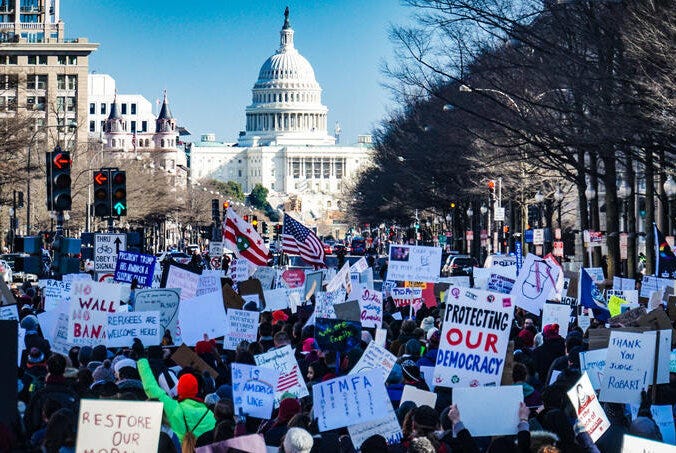
Christian Nationalists Stormed the Capitol on Jan 6 but Congress Buried The Story (with Representative Jared Huffman)
Nearly six years ago, Americans watched thousands of co-citizens storm the U.S.
Episode 81 · August 27, 2026
Welcome to The Oath in the Office. I'm Cory Bretschneider. My co-host, John Fugel, sangs away. So we have a special edition for you today, an episode with Congressman Jared Huffman. I'm really excited to announce our new sponsor for The Oath in the Office. Their name is inspired by the First Amendment, the idea that we don't have an official or an established religion. So this episode is brought to you by the Freedom From Religion Foundation. Quick civics question. When public officials swear an oath to the Constitution, does that mean protecting everybody's rights or promoting their own religion? Because as students head back to school, that question matters. Public schools serve families of every faith and no faith at all. They should not be used to pressure students, promote religious messages, or make any child feel like an outsider. FFRF says... The oath is to the Constitution, not a creed. The Freedom From Religion Foundation works to keep state and church separate and speaks up for free thinkers, atheists, agnostics, and non-religious Americans. Learn more at ffrf.us slash office. That's ffrf.us slash o-f-f-i-c-e. And we'll have a link in our show notes. I had a conversation with Congressman Jared Huffman from California. The congressman has written a really unusual book for a politician in that it's extremely honest. No Profits, which is out with W.W. Norton, really makes the point of trying to talk about a threat to democracy that's not appreciated, a threat that was present in January 6th and in many ways hasn't been reported enough on and in some ways, as you'll hear him talk about, was buried. And that's the threat of Christian nationalism, which, as the congressman and I will talk about, is a kind of movement that isn't just dangerous in terms of the policies that it's recommending, but it really is an anti-democratic movement, a movement of theocracy. The very idea that the First Amendment ban on the establishment of religion was meant to stop. And yet here we are dealing with that threat once again, the threat that the framers imagined. So I hope you enjoy it. This is a discussion with Congressman Jared Huffman of California. It's my pleasure today to introduce Congressman Jared Huffman, who was first elected to Congress in 2012, and he's now serving his seventh term representing California's second congressional district, which is in Northern California. And I'm especially excited because we're going to discuss in depth his book, No Profits, which is about the rise of Christian nationalism and really about how Trumpism is best understood in the light of Christian nationalism. So, Congressman, welcome to The Oath in the Office.
Thanks for having me, Corey.
Really looking forward to the conversation. I'd love to. I mean, I should say, you know, it's an honest book, which is not always what you get from politicians who are writing. It's one that doesn't strike me as, you know, just trying to win a popularity contest. You're quite honest about religion in the way that we often don't hear from politicians. That's part of what it's about. And of course, it's also about the current moment, about Trumpism and how to understand it. So I'd like to start with, to my mind, one of the key moments in the history of Trumpism and the history of both white nationalism and Christian nationalism, which is your focus, and that's January 6th. I was really taken by the way that you describe January 6th, not just in personal terms, but in terms of what it teaches us about this movement and this idea of theocracy, related idea of theocracy that you talk about. So take us back to that day. Tell us about it and tell us how it's related to No Profits.
Yes, thanks. I actually opened the book with January 6th as I saw it unfold. And it's an appropriate place, I think, to start our conversation about this threat to democracy. And by the way, thank you, Corey, for pointing out that my book is a little different than what you see from other members of Congress. I'm not running for president of the United States, for one thing. But I'm also wading into some, you know, perilous and uncharted waters for Anyone in national politics, most people steer clear of this stuff because it is fraught and it is, you know, a little bit dicey and provocative for many people. We're going to have to get over that and start talking about it. And that is sort of one of my big takeaways. But here's the thing with January 6th. I have watched during my time in Congress, this Christian nationalist movement grow stronger and more militant. And it really did erupt for all of us to see in the January 6th insurrection. It was a religious coup. And the sights and sounds and symbols were everywhere. Scholars of religion were screaming about this, demanding that these religious extremists be held to account. And I really thought it would be the wake-up call we needed to start taking Christian nationalism seriously. Unfortunately, I watched the country just go back to sleep And my own colleagues in Congress who the mob wanted to kill that day didn't see the religious elements to it and kind of went back to sleep as well. There's a little more to the story of why the country wasn't told about the religion that was so central to the insurrection. But that's sort of the basic takeaway is that I see a country that desperately needs a wake up call. And I see this direct threat to our democracy and our basic rights and our freedoms getting stronger and more militant. So I wrote this book to sound the alarm and take folks inside the Capitol to see what I see every day.
I mean, tell me more about that and tell the listeners, I mean, why is it that we might, I mean, because I do think that, of course, the January 6th committee and many of us who are focused on January 6th have focused on the anti-democratic aspects, the nationalism, the plot to really, you know, not just, I think sometimes the reporting, you know, focuses on the violence, which was horrific, but of course, more dangerous was the attempted murder. coup to try to deny certification of electoral votes in order to throw things to the House of Representatives that John Eastman and others had hatched. But what I think really is new, there's a lot new in the book, is the idea that among the different anti-democratic forces, that a prominent one was Christian nationalism in particular. So, I mean, I want to ask you, one thing you do so well in the book, I spoke to David French about the different coalition of the new right and how it includes Christian nationalism, white nationalism and other groups involved. But you really do a great job, I think, of pulling out in depth, you know, who these groups are. And so I want to ask you about that. But first, I'm going to ask you a preliminary question, which is just to elaborate on that point. Like, why don't we know more about this? What's the incentive or reason for why it's been hidden?
Yeah. So you mentioned Eastman. We think of Eastman, Giuliani, these folks that were at the War Room and the Willard Hotel. very much kind of plotting out the attempt to stop the certification of Joe Biden's victory. What we didn't get to learn about is the fact that all of these extreme faith leaders, these self-declared prophets and apostles that I write about in the book, were at the Willard Hotel too. And were in the White House days before the insurrection and had been enlisted by the Trump campaign to basically... radicalize and mobilize these religious shock troops for January 6th. They were a huge part of what happened that day. And we didn't learn about it because in the final days of the Select Committee preparing its 845-page report that was, you know, supposed to be the full picture of what happened, who did this, who should be held to account, one member of the Select Committee vetoed any reference to Christian nationalism in that report. And that was Liz Cheney. The other members of the committee wanted it in. The staff had written it up as a very central part of the right-wing extremist groups that fueled the insurrection. But Liz Cheney did not want to offend conservative Christians. And so, you know, I think we praise Liz Cheney for lots of things. She was one of the few Republicans at that time that actually did stand up to Donald Trump. I will give her credit for that. But she did a great disservice to the country by erasing that, by censoring that in a way that allowed these folks to escape accountability. And as a result, they have grown stronger and more dangerous since then. And we are less safe because of that.
And what is it you think that was motivating that urge to suppress this really important part of the story? Is it that there's a risk that if you criticize Christian nationalism, you'll be seen as criticizing Christianity. Is it a deeper worry that her father is, you know, and if you go back, the Republican Party more generally has a longstanding relationship, at least, let's say, with Christian nationalism?
Well, you know, I don't know that we can know for sure. But from my observation, it seems like two things to me. It seems like, number one, she wanted the onus on Donald Trump. And anything that complicated the narrative that Trump was sort of singularly responsible for the insurrection was frustrating to her. I also think she had ambition to run for president at that time. And she understood that you don't win votes in a Republican primary by picking a fight with right-wing Christians. So I think she was very nervous about how that would be portrayed on Fox News in her attempt to seek the presidency. So, you know, I can't say for sure that that was her calculus, but for whatever reason... She singled this out. She was fine with the report talking about the Proud Boys and Roger Stone and Eastman and all of these other extremists. But she absolutely put her foot down and said, we're not talking about Christian nationalism.
Fascinating. I mean, I guess, too, as much as I agree, I think we both agree with Congresswoman Cheney about the idea that this president is different. There really is a sort of attack on democracy that is distinct from Bush Jr. or senior or Ronald Reagan. We could go back. But yet the Christian nationalist element is not brand new. And that's part of what you talk about so importantly in the book. So tell us more about, you know, one thing I really appreciated is, of course, there's the danger of theocracy. We hear this phrase and these ideas, but you really get into the details. of who these actual people are as political actors. And I appreciate that you named their specific role in January 6th. So tell us, I mean, who are they? I feel like with David French and I, we got a nice map, I think, of the new right. But what we didn't do is go internally within Christian nationalism in the way that you do. So who are these people?
Yeah, and let's be very clear. Theocracy is the right word. I think some people often wonder, well, is it really theocracy? Do they really want a theocracy? Because theocracy is pretty extreme stuff, right? We think of it as unthinkable, really, in the United States of America. So let me start there. They really do want a theocracy. This is not hyperbole. This is the endgame. And I spend some time in the book showing you their own words and their own belief systems that compel them as their religious duty to impose a theocracy, not to persuade people. through the democratic process. They're done with that. They abandoned working within the system of democracy after they lost the culture war of the 1980s. They have resolved to dismantle democracy, starting with church-state separation, which absolutely stands in their way. But they're on a collision course with pluralism and secular democracy in a huge way. And there are three ascendant religious subcultures within this mega-Christian nationalist movement that we need to understand. And so I do, with the help of some serious religion experts, take folks through the belief systems, rejected by most Christians, by the way. I got to make that loud and clear. This is extreme stuff. Most Christians want no part of it. But it's known as dominion theology. And there are three sub-factions that are slightly different. So the most dominant is this independent charismatic evangelical group. led by this cohort of self-declared prophets and apostles known as the New Apostolic Reformation. They were hugely involved in the January 6th insurrection. They have a dominion theology known as Seven Mountains Dominion that requires them as a religious duty to conquer all aspects of society, including government and business and the arts and everything else for Christian hegemony, essentially. The other one you can think of as Pete Hegseth's group. So this is known as the Theo Bros, also Protestant, but not charismatic evangelicals. They call themselves Reformed Evangelicals, but Theo Bros is a pretty good name for this group. The leader of the movement is an extreme pastor named Doug Wilson from Idaho who has made news recently. He likes to go on TV. He likes to sort of put a happy face on this really radical extremism. where they believe that the 19th Amendment was a mistake, that women should not have the right to vote, that only Christians should hold public office. Doug Wilson will tell you, oh, it's not theocracy that I want, it's theonomy. He will split hairs and kind of talk in this high-minded, sarcastic way. But it's Old Testament biblical law pushed into our government, an amended constitution that includes the Apostles' Creed. as black letter law. So it's theocracy by any other word. And then the third are the radical traditionalist Catholics. Again, a small fraction of American Catholics who mostly reject this intense Catholic integralism that is their version of dominion theology. But you can think of folks like Nick Fuentes and Candace Owens as pretty good examples of this very bigoted extremism that is its own theocratic agenda.
Okay, we need to take a quick break. When we come back, we'll have more with Congressman Jared Huffman on the oath in the office. This episode is brought to you by the Freedom From Religion Foundation. We talk every week about the oath, the promise to preserve, protect, and defend the Constitution. So here's the church-state version of that question. When public officials take that oath, are they promising... to protect everyone's freedom of conscience, or to use government power to promote their own religion? Because as students head back to school, that question is not abstract. Public schools serve children from Christian, Jewish, Muslim, Hindu, Buddhist, atheist, agnostic, and many other families. No student should be made to feel like they belong less because they don't share the government's preferred religious message. The First Amendment is not a bridge to government-backed religion. It is a limit on government power. The Freedom From Religion Foundation works to keep church and state separate because freedom of conscience means the right to believe, question, doubt, or not believe at all. FFRF also speaks directly for free thinkers, atheists, agnostics, humanists, and non-religious Americans who are too often erased from the story. Learn more at ffrf.us.office. That's ffrf.us slash o-f-f-i-c-e. Welcome back. We're speaking with Congressman Jared Huffman on the oath in the office. We've talked on this show a lot about certainly the academic version of all this. I should say, too, that Pete Hegseth took class with a professor at Princeton who I was the TA for, the preceptor, as we called it, Robert George. I'm sure you've come across in this work a colleague of Finna's and Bradley and some of the other theologians. But, you know, as I would say, conservative and bordering, certainly anti-establishment, as some of those figures are. Adrian Vermeule is another one from Harvard in the integralist tradition. I mean, really, you're doing more in the book than just talking about ideas. You're saying, no, these are groups that are actively undermining our democracy. They're not sitting around in classrooms and just talking about theoretical ideas. And you mentioned, of course, Pete Hegsath. And we've seen that from the rhetoric and the symbol's we've seen from him. I mean, I'd invite you to comment more on Hegsath and how he demonstrates this theocratic view. But what I'm especially interested in getting to is, and we've started doing this a little bit in talking about why we never really saw this evidence in the report, but to hear about your colleagues who you would associate with Christian nationalism, if you'd be willing to, and to tell us if you want to name names, great. If you don't, just to say something about how does it present itself in Congress, you know, in the day-to-day discussions and debates? Because I take it, you know, part of it is the danger of the end goal, but there are elements of Christian nationalism that are just opposed, as you said, to the ban on an official religion, which is in the first part of the First Amendment. Yeah. So how does it manifest itself with your colleagues? If you want to comment on our, he calls himself, of course, the Secretary of War, the legislation that creates the Department of Defense doesn't call it that. So I try not to call him that. But I would be very interested in how all of this presents itself.
Yeah, I'm not using that term without air quotes either. I think it's just absurd that they have done that. But You know, you ask about my colleagues in Washington, and I do want in this book to show people just how advanced this Christian nationalist project is, because it's much further along than most people realize, much more entrenched in our institutions and our practices in Washington, D.C. So I profile to a degree Mike Johnson as a good example of one of the Christian nationalist power players. This guy is an extreme nationalist. Christian nationalist. In any normal time, he never could have become Speaker of the House, but he sort of stumbled into it because of the debacle of the way they deposed Kevin McCarthy and couldn't find anyone else after overnight. a month of trying to get the votes. And all of a sudden, he just slid in without any vetting or real scrutiny. So Mike Johnson has dedicated his life and career to what he calls biblically sanctioned government. That's a euphemism for theocracy, obviously.
Remember his first interview?
With Sean Hannity, when all of a sudden he was Speaker of the House and people wanted to know who the heck this guy was. Hannity asked him, what is your worldview? Mike Johnson said, the Bible. The Bible is my worldview. And that is how he sees it. He has spent his life trying to impose morality codes from the Old Testament, trying to control women's bodies, trying to push laws that Implement covenant marriage, which makes it very hard for women to escape an abusive spouse. He's super hardcore. And as speaker, he hasn't been very good at governing the United States of America, of course. But he's been very impactful in advancing this Christian nationalist project in platforming and mainstreaming a lot of real fringe operatives, including folks from the New Apostolic Reformation. He's created this new kind of flagship event for congressional Republicans called the National Day of Prayer and Repentance, where it's sort of meant to supersede the national prayer breakfast, because that just wasn't extreme enough for them. It was ecumenical, right? They sometimes allowed non-Christians to participate in that. So he set up this explicitly revival-style, hardcore Christian nationalist kind of altar call. really, at the Museum of the Bible. And dozens of members of the House and Senate go over there and take the stage with the most radical prophets from the New Apostolic Reformation, folks that were up to their necks in the January 6th insurrection. And they call out how sinful our nation is, and they ask God's forgiveness for all of the sins of liberalism and women's rights and all of these other things. It's quite a spectacle.
I mean, how does it I mean, this might sound a little abstract, but I'll bet you can think of examples. I mean, I would just imagine that apart from the extremism of the goals that just trying to cooperate on ordinary legislation. with somebody who espouses theocracy, it might be difficult, you know, well, let's put aside our differences and find commonality. Well, if every first principle is, you know, let's look at what the Bible says and think from there. I mean, is that right? Is it as bad as it sounds when it comes to the ability to cooperate across the aisle with this element anyway of the Republican Party?
It certainly doesn't help. I mean, look, when you're in Congress, your job is to, you know, try to put aside those first principles and find something you can get done with your colleagues, no matter how bad the politics are. So yeah, I've still been able to, you know, find a bill here or there that I could do with some of these, you know, more extreme Christian nationalists, then I'll keep doing that. But their agenda scares me. And, you know, the extent of it We talked about the New Apostolic Reformation. Again, people need to get to know this group because it's a power player in this movement. The symbol of the NAR is this appeal to heaven flag, really popularized by a very radical pastor named Dutch Sheets. There are over 20 congressional offices that have the appeal to heaven flag flying outside their office in the U.S. Capitol. And that flag is explicitly theocratic. It is the Seven Mountains Mandate. It was used to beat cops over the head on January 6th. So that's just one of many signs. There are all of these Christian nationalist ministries and pastors that roam the halls recruiting people into these Bible studies that tell members of Congress and staff how God wants them to use their power. And it is extreme right-wing stuff.
Yeah. And of course, and you're extremely clear in the book and you have been here, too, that this isn't a criticism in any way of Christianity. It's of really trying to co-opt the United States government, which had its founding, as you also nicely point out, was devoted to the idea that not only did we not have an official religion, but that we don't have laws that respect or relate to religion. An official religion. And of course, he pointed out that Madison, after he was in Congress, looks at the establishment of ministry, which I guess at the time they sort of thought was benign and says, wow, this is really bringing us down a terrible path. So the symbols matter because they're about the kind of government that I think the foundation of America actually in the First Amendment is anti-theocracy. Tell us about the policy implications of all of this. I mean, there's the sort of frightening anti-democratic element that you talked about in the extreme of January 6th. But what about things like the right to gay marriage, which is, of course, enshrined in the United States Supreme Court opinion, but that opinions, as we know, over and over again can be changed on speaking of which the Supreme Court, of course, has reversed its opinion on Roe versus Wade and Dobbs. But that's left things state by state. And there's a question, of course, of whether or not Theocrats would be comfortable with that. I imagine not that they're aiming for a national ban on abortion, something that hasn't gotten enough attention. So aside from the big picture, you know, if theocrats could have their dream, Christian nationalists could have their dream government, what would they want to do? What do you see them in the more near term trying to accomplish if they're able to grow and succeed in continuing to have an influence in our government?
Absolutely. Well, look, they do not accept the Obergefell decision as the right word. on marriage equality. I mean, Mike Johnson has voted to criminalize consensual gay sex. So you can imagine how he feels about gay marriage. He is obsessed with this stuff. He was a senior attorney at a group called the Alliance Defending Freedom, which was on the wrong side of Obergefell and has been on the right-wing Christian side of all of these pieces of litigation moving up to the Supreme Court for many, many years. It's coming. I mean, they're going to come for marriage equality and for LGBTQ rights. Absolutely. And we need to be clear about that. You can't avoid this reckoning if you care about these things, if you care about our form of government, if you care about these rights and freedoms. In fact, you know, sometimes people wonder, how did Donald Trump, this non-religious, sinful narcissist... Managed to get more than 80% of evangelicals to support him, and they still do. That remains his most loyal political base, these white evangelicals. They're so devoted to him. He is a quasi-religious figure in their eyes. How did that happen? It has a lot to do with the aftermath of Obergefell, which was such a low ebb for this movement and for the NAR folks. They decided that business as usual wasn't going to cut it heading into the 2016 campaign, that they needed a bully. And one of their prophetic Christian fanatical faith leaders, Paula White, who was very close to Donald Trump, brought Trump into this apostolic group, introduced him, and they saw something they liked. They thought this could be our guy. And they came up with this Cyrus anointing prophecy. I don't know if you've heard of this. But the prophecy that a guy named Lance Wall now concocted is that Donald Trump is God's flawed vessel to save his chosen people, conservative Christians, just like God did with the pagan King Cyrus in the Bible. And this prophecy just went viral and it worked.
I mean, he just won.
He won over seriously religious candidates in 2016 on the Republican side. And then, you know, the legend only grew when he survived a couple of assassination attempts. So as crazy as it seems to most of us on the outside, Donald Trump, for this cohort of his base, the hardcore Christian nationalists, especially the evangelicals, he is a religious figure.
Amazing. You know, one thing we're always trying to do on The Oath in the Office is tell the truth about the threat to democracy. And I think we've done a really nice job of getting into the specifics of what this threat of theocracy, the very threat the framers themselves were worried about, why it's very much alive today. dangerous. But we're also always looking for hope in the future. And I know you could provide us some of that. I mean, part of it, I guess, that I want to ask you in getting to that idea of hope is, what is the way with this knowledge that we all have of what's going on? And thanks to your book and this discussion, and I'm sure what will be a concerted effort to try to make sure that we're aware of this threat and the details of it. How to fight back? I mean, is it enough to reveal it for what it is? Do you have thoughts about that? I don't imagine that it played, you know, for all of Liz Cheney's personal reasons for wanting to bury this information, the January 6th report. I don't think the American people are going to receive well a movement that is devoted to destroying democracy in the name of theocracy. So I'd be very interested to hear from you and what we can do to really resist and more than that, fight back against this movement. dangerous idea and movement.
Well, there's part of your hope right there, Corey. Most Americans, whether they're Christians, non-Christians, non-believers, they want no part of a creepy right-wing theocracy. They still, to this day, value church-state separation. It's very popular. And we've got all of that going for us. So that encourages me. I am encouraged by the way I see more Christians stepping into this fight. Now, they're doing it from a faith perspective. When Tallarico or David French or others call out Christian nationalism, they do a great job of nailing the hypocrisy, of critiquing the movement, you know, according to the gospel and kind of revealing it as a bastardization of certainly the core teachings of Jesus Christ. I'm rooting for all of those good Christians to win this fight. That is good stuff. I am worried there's not enough of them and that they are not powerful enough to stop this juggernaut of theocracy that is so entrenched at the highest levels of our government, far more so than most people realize. And so one of my big points in the book is that we've got to work together. 35% of the country is either non-Christian or non-religious and And you can't just have that group wait on the sidelines for David French and the others to win the theological debate over the gospel, right? This is about more than that. It's about our democracy and it's about our rights. And in a large way, it may be about our ability to continue living on this planet because you and I have been talking about the fight over our form of government, right? But this movement is also at war with modern science, with higher education, with critical thinking. And I have an entire chapter that talks about that part of their agenda. We depend on these institutions that they're tearing down to come up with cures to terrible diseases, to get us through the next pandemic, to help us tackle the climate crisis. So this is more than just a political debate about our liberty. This is in many ways really about our existence. on this planet. We've got to find a way to come together. I think there's still time, but it requires us to quickly get better at talking about something very awkward to most Americans, the intersection of politics and religion.
I've got to ask you one last follow-up on this, and you've already really raised the issue that I wanted to end with, because there is something in the book that, there's a lot that's different, but one thing that I especially appreciated this moment was is, as you say, there's been a pivot, let's call it, of Telerico and others to try to reclaim Christianity. which I appreciate and approve of. And of course, my co-host, John Fuglesang, is part of that movement, as you know. And yet, at the same time, I don't want that to be the only way of resisting theocracy, because after all, the idea of not having an established religion isn't to make room for the right Christianity, it's to make room for a plurality of ways of thinking and plurality of religions. And now this is where I think This book really is very new for a politician. I mean, you tell the story of being flummoxed at being asked to be sworn in on the Bible, to being asked by Colbert directly, Stephen Colbert, if you're an atheist. And that sort of leads you to a kind of honesty in the book, which is that you really think of yourself as a humanist, as I understand that you don't really think of yourself that. in terms of a major religion. And that is different for politicians, regardless of what they believe and what they say. So tell me about how that fits in. I don't see a lot of praise from politicians for Christopher Hitchens. You're unabashedly a fan, you know, the- Oh, I love Christopher, yeah.
Yeah, so look, I grew up as a devout Christian. I was ordained into the priesthood of a branch of the Mormon church. So I'm fairly fluent. in all of this stuff. And it's perhaps why I sort of understand. I think it gives me an empathy for many people of faith and faith communities, but also, you know, a clear-eyed wariness of religious extremism. And that's really where I'm coming from. When religion stopped working for me in my early 20s, it was a hard thing. And it is, I think, for many people who lose their faith. I ultimately figured out that the things I liked about my religious upbringing were are just universal values that are there for people of all faith perspectives and non-believers. And humanism is the label I have landed on. That is my moral framework and worldview. I believe most of the same stuff as John and a bunch of other, you know, good, decent Christians that I know and admire. It's just not the supernatural part. So I'm a little like Thomas Jefferson, if you will. Back to our founding and this whole Christian Nationalist conversation. Thomas Jefferson thought that the teachings of Jesus Christ were great, but the supernatural stuff had to go. He didn't believe in the divinity. And so he actually took a razor to the New Testament and cut out the mysticism and the magic and the miracles. And he wrote in a letter to John Adams that it was as easy as separating diamonds from dunghills. So Jefferson was pretty critical of revealed religion. He was a rationalist But he's a very, you know, he had his flaws.
We all know that, right?
He kept slaves and so forth. But, you know, he was certainly open to the moral teachings of Jesus. And that's sort of where I am. Sorry you got me started on the religion part here, but I am an oddball in Congress. I'm the only one who's publicly non-religious and a humanist.
Great. Well, what a terrific conversation, Congressman Jared Huffman. The book is No Profits. I highly recommend it. Congrats on its publication. I should say I'm a fellow Norton, WW Norton author, so happy to be connected in that way too. And thank you so much for joining us on The Oath in the Office, Congressman. We really appreciate it.
Thanks for having me, Corey.
That was an amazing conversation with Congressman Jared Huffman. I recommend that book, No Profits. It is a moment in which we're used to really hearing about the threat to democracy, white nationalism. But what this book really does is bring out the specific threat of Christian nationalism, not in some abstract way, but directly from somebody who was there during January 6th who experienced it and has really researched this movement behind it. We look forward. John is away on vacation. He'll join us next week. And thank you, as always, for joining us on The Oath in the Office. If you haven't subscribed, please do. Leave a review. We're getting plenty of these, and it's really helping momentum. Tell a friend about it. And every week we're in the top three of Apple trending podcasts. So thanks for making that happen. You can also find us on Substack, the Oath in the Office Substack. You can find us on YouTube. And we'll see you next week, as always, on the Oath in the Office.
Nearly six years ago, Americans watched thousands of co-citizens storm the U.S.
Follow the show
A new episode every week with Corey Brettschneider and John Fugelsang, free in your podcast app.
Now playing
Episode