Episode 58 · March 19, 2026
Stacey Abrams on the SAVE Act: The New Voter Suppression Threat
Show notes
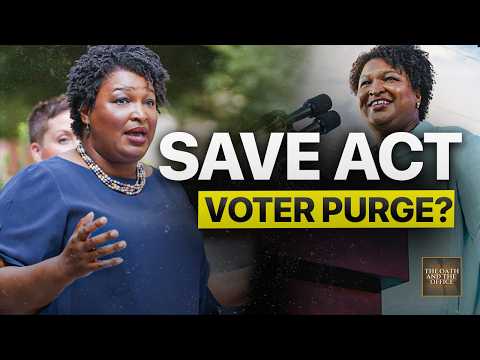
On this episode of The Oath and The Office, Corey Brettschneider and John Fugelsang break down the latest fight over the SAVE Act, why its proof-of-citizenship requirement could make it harder for millions of eligible Americans to register and vote, and what this battle reveals about the future of democracy.
Then Stacey Abrams joins the show to explain what the bill would do, why it is so dangerous, and how the broader attack on voting rights fits into the Trump-era push to undermine democratic institutions.
Also in this episode: Gregory Bovino is out, Judge Boasberg pushes back against politically charged legal tactics, and Trump lashes out at the courts yet again.
This is a conversation about voter suppression, constitutional democracy, and who gets to decide the future of the country.
Learn more about the ACLU and its upcoming Supreme Court case at aclu.org/barbara.
Transcript
Automatic transcript
Nothing says [music] freedom like a bill designed to save democracy by throwing several million citizens out [music] of it. The Senate is debating the Save America Act, the bill President Trump has urged Republicans in Congress to pass. >> Republicans have finally realized if they called it the We're losing elections because women and minorities keep [music] voting act, it would not a poll as well. >> It's not about election integrity. It's about targeting in a way that doesn't look like you're going [music] to get caught. Leader Stacey Abrams, political leader, best-selling author, voting rights champion, Stacey Abrams became one of the nation's leading voices.
[music] >> I believe we are very fully in the grip of an authoritarian regime. It's no longer a question [music] of do you have elections? Is do elections have meaning? Welcome to The Oath and the Office podcast. I'm John Fugelsang. It's so great to be with you and today, well, when you throw an illegal war to get the Epstein files off the headlines, and then that war kills many civilians and troops, and it's run by lying idiots, and it doesn't make you more popular, and judges are pushing back on your gerrymandering, you have to do something to rig the midterms, which brings us to the Save Act, friends, because nothing says freedom like a bill designed to save democracy by throwing several million citizens out of it. For more, let's go to the star of our show, the author of The Oath and the Office and The Presidents and the People, Professor Corey Brettschneider. It is great to see you. Welcome.
Uh thanks so much, John. Uh an amazing show planned today. Of course, we'll talk about the Save Act, and we have the honor of talking about it with one of the most important pro-democracy activist, somebody who's been in the state house, uh Stacey Abrams, an incredible voice for democracy. So, we'll have our segment as usual in the beginning, and then we'll bring her on to really go in depth on some of these issues. It's It's really a uh interview that I've been so excited about and that I think the listeners will love. Uh I'll say too, if you're just joining us for the first time, be sure to push that subscribe button. And then finally, John, I was just speaking to a journalist today for a story that's coming out soon who listens to the podcast who was asking me some follow-up questions from discussions we had, and he gave us an amazing compliment. He said uh that um uh we're not the odd couple, we're really this different, you know, two different personalities that work well together. The best analogy is uh Butch and Sundance. Which is all thought was the nicest compliments that I've ever received. Or maybe it's
symbiotic. Like I'm like a parasite that gives you scythe A back for this. >> Is that how Butch and Sundance work? >> No, not really. No, they were much more They were much more in the same way. Should they were They were both equal outlaws. Uh you You You passed the bar. So, um but I I I'm I'm so thrilled that Stacey Abrams is here today because I I really want to I've been wanting for a while, Corey, to go deep with you on the Save Act. It's very scary. They don't think it's going to pass the Senate. However, it is getting more popular. And the Save Act is really the political equivalent of a bouncer, I think, who says, "This club is for everyone, but only if you brought three forms of ID, your original birth certificate, a time machine, and the name you had before the patriarchy got involved." This is really scary, Corey, and I I I'm grateful that you wanted to go deep on this because I think they named it the Save Act because Republicans have finally realized if they called it the We're losing elections because women and minorities keep voting act, it would not poll poll as well. So, just to dive into it, I mean, for for listeners who are
hearing about this fight brewing over this act that could dramatically reshape who can vote, what exactly is the Save Act, Corey? And um what problem do its claim it is solving? Well, the argument for it, and it it seems kind of straightforward, and if you're not well informed and you don't go deep as we will in this segment and with Stacey Abrams, uh you might think it's innocuous. What's the big deal? And the way defenders put it is it's just a way of ensuring that only American citizens are voting. And of course, in our federal elections, you have to be an American citizen in order to vote. So, what's the big deal that you have to show in particular uh ID. That's how they're framing it.
But when you really get into it, what they're doing isn't just requiring showing ID, but showing forms of ID that they are listing in the Save Act that a large percentage of Americans don't have. And you might wonder who doesn't have ID because it is true, most Americans have the kind of ID, for instance, passports that they want or so-called real IDs. Um but but uh many don't. And uh it it it it most uh jurisdictions, I should say, require some form of ID, and the whole maneuver here is to to pick those forms of ID at the national level, usurping whatever local understanding, local needs are in order to demand this specific kind of documentation. And who doesn't tend to have it? Well, Mhm. big surprise, it's young voters who um uh Trump is worried, of course, is going to turn on him and his party. Um it's often uh minority voters. Uh and uh it's by and large people uh who have been
moving, for instance, state to state. Um and you know, the the estimates vary, but we're talking Yes, I mean, we're talking about millions of people that are potentially going to be dis disenfranchised. And even if most people have the ID, you know, that's not how elections are won. They're They're won by the sliver of votes that they are going to try to shave off using this. And I love your analogy of the uh you know, this seemingly welcoming bouncer. But when when it comes down to it, right, what the rules are doing is they're extremely exclusionary at the same time as pretending to just protect democracy. Well, Republicans say the Save Act is about stopping non-citizens from voting. And hey, we we all believe in that, except non-citizens voting is already illegal. It has been illegal. It is aggressively illegal. And you have to register to vote to vote illegally. So, they can't vote because they can't register. It's like a go to jail, felony, deport yourself on the way out illegal. There is no evidence of mass non-citizen voting.
Donald Trump has pushed a lie since 2016 that 3 million undocumented citizens were somehow able to register and cast votes illegally. And no one talks about this. He's still pushing this lie to justify him losing the popular vote in 2016. And more importantly, there is no voter impersonation problem. You know, we we do a signature and match the address, and that's how we know you are who you say you are. And it's never been a problem because there has never been an election that has been swayed by voter impersonation. This is a solution in search of a problem, but more accurately, it seems like it's a problem in search of voters to eliminate. And critics say, "Professor, this could be the most restrictive voting law ever passed by Congress." Is that an exaggeration or or is that accurate?
Because I think our African-American brothers and sisters know the history better than a lot of white folks do. Well, I don't know about most restrictive if you look back, for instance. And you know, people who study history as I do are often skeptical of claims like that. And does something doesn't have to be the worst ever in order to be really bad. But it is in the tradition of rules and laws that were meant to and and especially usually at the local level, this is now at the national level, that were meant to look neutral and really weren't. So, I'll give you one of the most important ways that southern white supremacists tried to suppress the black vote after the Civil War, and that was, of course, um so-called literacy test, which often didn't just test literacy, which itself, you know, why would that be a requirement, especially for formerly enslaved people? But, you know, would they would ask in particular black voters questions that were extremely obscure, for instance, about American history in the name of literacy test.
So, you know, you might say, "Well, what's the big deal? We're just trying to make sure we have informed voters." But this supposedly innocuous technique was used to disenfranchise people. So, you know, was that worse? Yes, I think in a lot of ways that was worse. Um but that doesn't hide the fact that this is extremely dangerous. Also, I mean, another difference, and we will talk about this with Stacey Abrams as well, the complexities of this, is that in the past, a lot of the the voter suppression techniques were done at the local level.
Correct. >> Donald Trump has we talked about it on the podcast last week and previously is promising to nationalize elections, which we know means to use the power of the federal government to steal them. And this is a technique that he can use in order to do exactly that. I'll say one other pernicious thing that's in the Save Act that I'm very concerned about if it passes, is uh it really um threatens to punish poll workers who don't enforce the the law, the Save Act. Uh and that could lead to, rather than common sense prevailing at these moments, and of course, a lot of poll workers throughout the country, this isn't some federal office. It's people who are holding a job for a brief period of time. They're nervous. And if there's a penalty associated with with on the side of allowing somebody to vote, you might get at the local level extremely restrictive poll workers who just don't let people cast the ballot. And you know, what's going to happen to somebody who shows up? They just might get frustrated. So, we are talking about millions of people potentially that using these various
techniques, and what's so pernicious is they look innocuous, but really uh are anything but. And I want to point out, the Save Act doesn't just say show ID at the polls. That That would be too honest. It says, "No online registration, no mail-in registration, no mail-in voting unless you're uh stationed overseas with military, no voter registration drives, no using the kind of IDs Americans have used for decades." Instead, as you said, Professor, you must produce specific proof of citizenship documents. These are documents tens of millions of citizens don't have readily available, uh especially those born in certain parts of the country before 1965 when people weren't always born in hospitals.
And that's the trick, right? If you can't vote, it's not voter suppression, it's just paperwork. This is like Jim Crow's greatest rebrand. The supporters say though, I mean, they say this is about election integrity. What is your response to that argument, Professor? It's not about election integrity and I think we've already started to unpack that. It's about targeting in a way that doesn't look like you're going to get caught uh people who are um going to vote against you. And it's a Republican, it's a very partisan way of trying to shut down the opposition parties' voters. And that's what we've got to call out. Unfortunately, it's hard to do because it again, it looks innocuous. But when you look into the details of how it's aimed and what its impact is, it's it's a plan. Uh I love the idea um of calling it for what it is, which is a an attempt to rebrand Jim Crow. Jim Crow is obviously associated with literacy tests. I just had to say that phrase and people know it's not really about making sure there are in- informed voters. It's anything but. It's an attempt to shut down at the time in
the 19th century uh and after those associated with the the the attempt to um reconstruct the country, to re- uh up on the rights of formerly enslaved people and of black Americans generally. Now, how did they do that? They didn't say, "Let's bring back slavery." They tried to do it by stripping the real meaning of the rights of citizens through this supposedly innocuous thing. And that that's what's happening again. By the way, I'm not completely opposed to debating a national literacy test to vote. Can you imagine if everybody who can't spell your correctly can't show up?
What what gets me is, you know, we we talk about how in the past these voter ID bills have yes, they've gone after African Americans, they've gone after um seniors, they've gone after college kids, especially college students who go to colleges universities in cities because they are the least likely to have a driver's license. >> Right. But this bill this bill, unlike previous editions, this one hammers women. And Republicans know it because in this country, as you know, Professor, millions of women do this thing called getting married and then this radical thing that's called changing their last name. And so now their birth certificates don't match their legal name. And I can't wait to talk about this with Stacey Abrams because under the SAVE Act, married women, suspicious.
Widowed women, suspicious. Divorced women, extremely suspicious. 69 million women could face barriers because Republicans suddenly discovered they care deeply about name consistency. And it's kind of funny, Corey. We talked about this before, but this concern appeared right after women started voting against Republican by double digits for 30 straight years. Since 1992, women have voted Democratic in every presidential election. And Republicans look at this data and they're like, well, we we could change our policies or we could change who's allowed to vote. And guess which one felt easier.
What do you see happening? Is this likely to pass the Senate or is this going to head for a long bloody showdown? I don't think so. It's passed the house and now it's in the Senate. And um the thing that's going to save us, ironically, is the thing that also stopped civil rights legislation. And that's the bizarro moment that we're in and that's the filibuster. For um many decades, there was an attempt to get a civil rights bill that eventually culminated in the Civil Rights Act of 1964 and the Voting Rights Act of 1965. Among other things, the Civil Rights Act of 1964 banned uh segregation in public accommodations like hotels and restaurants. And the 1965 Act uh was a serious attempt to shut down uh various forms of local restrictions on voting. Uh and we'll talk to Stacey Abrams about both of those and how the SAVE Act is part of a long-standing plan to um to to attack those two pieces of legislation. But to go back to my main point, the the reason
why it took so long uh to pass those bills in the in the '60s, and remember, this is, you know, almost 100 years after the end of of slavery, the 13th, 14th, and 15th amendments about 100 years later. Um there are originally civil rights bills in the 19th century that are destroyed largely by the Supreme Court, including in a famous moment, the Civil Rights Cases that destroyed the original attempt to ban segregation in public accommodations 100 years later. So, why does it take so long? Now, I'm getting to uh the SAVE Act. Uh the filibuster in the Senate uh is used to block this legislation. But the thing that's going to save save us now from the SAVE Act, so to speak, is the filibuster. And Republicans, um as much as they want this bill and as much as Trump in particular wants it, they see that the the institution of the Senate has a bulwark against tyranny and and, you know, or against laws they don't want in their case. So, what I'm saying is all these angry liberals have to thank Chuck Schumer for saving the filibuster? Is that what you're saying,
Professor? >> in this instance, you know, we could talk in depth about whether this is a good thing or a bad thing for democracy, but right now I think it's undoubtable as we're facing a threat from a president who is a want-to-be authoritarian, it's a good thing it's in place because it's what's going to block the SAVE Act from from becoming law. And again, just just because, you know, of shiny things confuse me, Corey. Is there any evidence that non-citizen voting has ever been widespread enough in any of the 50 states to justify any kind of law like this? No, I mean, I and I you know, we can't emphasize that enough that it's a non-problem, this idea of voter fraud in the form of showing up as a non-citizen. You know, why would you do that? Especially with ICE out there.
>> want to get caught, Corey. They want to get caught. Come on. I'm saying the non- non-citizen, you know, I almost know We're going to show up to to beat the authority. I've been here for so long, I crossed the border, and I've got a job. And now I've got to go to get you away here risking my life, you know, in dire conditions in order to show up to vote. I don't think so. That's what they're claiming though. And it's a non-problem. So, then, you know, when government is lying to you and that that is what's happening here. Donald Trump and all the supporters of this act uh including in the Senate are lying when they say this is about protecting democracy. So, what is the purpose? It's it's voter suppression rather than voter enhancement.
>> That's it. Now, speaking of politicians lying to us, and thank you for the artful segue, Professor. Uh Donald Trump launched uh this ran- random flurry of late-night attacks against the Supreme Court, his Supreme Court, for not overturning Joe Biden's lawful 2020 election win. And I quote, "They wouldn't even call out the rigged presidential election of 2020 because they said that I, as president of the United States, did not have standing" in quotation marks to challenge it. Now, Trump was referring to the Supreme Court declining to hear the 2020 lawsuit filed by Texas and supported by 18 Republican state attorneys general and 106 lying Republican members of Congress who tried to invalidate Joe Biden's victories in Georgia, Michigan, Pennsylvania, and Wisconsin. Trump said, "They they're completely inept and embarrassing court was not what the Supreme Court of the US was set up by our wonderful founders to be.
They are hurting our country and will continue to do so." Now, th- there's a lot we have to cover, but this seems to be an overt pressure campaign ahead of any future election races. We're very used to politicians criticizing courts. How unusual is it for a sitting president to attack the Supreme Court of the United States for not overturning an election he lost with 60 lawsuits to prove he lost it? Well, I got to say, you know, he's figuring out, unfortunately, and this is what's scary about the moment, that there is a way to destroy democracy. And the way to destroy democracy is to see who is protecting it. And who protected it on January 6th and in the events surrounding it? It was the courts, including the Supreme Court, uh who refused to allow this lie that there had been some sort of mass voter fraud that which is connected, of course, to our previous discussion, that that lie, uh including the the the libel of the lie that non-citizens were somehow being included here. Uh none of that was true.
And as the lower courts looked at the evidence, that's what they said. Like, I don't think so. There this is just not a thing. And the Supreme Court, not wanting to comply with his coup, I think is part of the point. There is one thing, you know, before we get too heroic about what the Supreme Court might have done or might not. I should say just a general thing, which is January 6th, we talked about this with Tom Jocelyn who literally wrote the report um about uh what happened, the details. He shared with us the role of white supremacist organizations, white nationalist organizations, but also the nuance of what was going on, which was it really wasn't about the riot. It was about using the chaos at the Capitol to pressure Mike Pence in order to deny the certification of these votes and to um to also simultaneously have these fake sl- sl- slates of electors sent. Now, we never got to the moment where that happened because Mike Pence didn't comply, as we talked about. But what if he did comply? And what if in the end, like Bush versus Gore, this went to the
courts? They might very well have intervened on his side in the big picture. Now, they didn't do so here, they might have. And what that what does that show you? That what was missing and what is missing in the future, if you want to have a coup, are the courts. Not the lower courts, the Supreme Court of the United States. And so this pressure campaign is recognizing his weakness, which is that the Supreme Court in the end didn't back him. And to try to put pressure for next time. And, you know, he has such a lazy way of doing it, just to to to criticize them, to rant, to threaten them, uh threaten threaten threaten. But um uh you know, thankfully that that isn't what's happened when when to the lower courts.
The Supreme Court, I don't have much faith in, but uh hopefully this will be a wake-up call to them that they're dealing with somebody who is going to attempt to steal another election. Corey, again, like what scares me is this isn't just political venting. This is This guy's This shows how his executive power views the judicial branch, that it works for him. And this is again over the court because they he's mad they wouldn't hear this Texas case to overturn the 2020 election results years ago. Corey, just for dopes like me, can you explain what lack of standing actually means?
Uh the courts and including the Supreme Court have a variety of ways of not even bothering to get to the merits of the case, the question of whether or not the law was violated. And they do that often by looking at whether or not some particular person has an injury or a claim that allows them to be in court in the first place. And so that's what that means. If the courts were to ignore standing requirements in politically sensitive cases, what would that do to the legal system?
Well, you know, it's That's an interesting question because on the one hand you don't want to I think it's good to not allow the president when he's trying to steal an election standing. But the question of the standing doctrine and how courts use who gets to sue and who doesn't is actually a wider issue. I mean, to me, they're probably too narrow actually in what we're when they allow standing. So we're going to face for instance a question in the war powers case about whether or not Congress has standing in order to challenge the war. We've talked about that before. That's something where I think the court should be generous. There's an issue of what's called third-party standing, the question of whether or not, for instance, environmental organizations can sue on behalf of all of us as a result of the destruction of the earth.
There's a case called Blue Jean about that that narrows who has standing. So, on the one hand, yes, I don't want the president to have standing to try to steal an election, but I think, you know, the the wider issue is an interesting one that that we might want to open up the possibility of more advocacy by citizens with a even broader standing doctrine than we have. One more question about this and then then we'll take a break. But um it seems like all this changed last month. He's always gone after lower courts and and judges like Judge Bosberg, who we're going to talk about after the break, but it seems like something shifted last month when Trump unloaded on the Supreme Court after they declared that he had violated federal law by unilaterally imposing those tariffs all over the planet last year.
Yeah. And after that ruling, we discussed it on the show, Trump accused certain Supreme Court justices of being unpatriotic and disloyal. A disloyal Supreme Court. He never said their names, but it seems like he's looking at, you know, Amy Coney Barrett, Neil Gorsuch, and Brett Kavanaugh or not Brett Kavanaugh, he was a fiend, but uh John Roberts. I mean, you know, he didn't just criticize past rulings. He's saying how he expects the court to behave in future election disputes. At At what point does criticism become attempted intimidation?
I mean, I think that's all he's about is intimidation. You know, his lawyer Roy Cohn had a famous line, um don't ask what the law is, ask who the judge was or is. And the idea, of course, was, you know, certain personalities are on our side and certain are. And that's not how things are supposed to work. Judges are supposed to interpret the law, enforce it against everyone. And of course, no president is supposed to be above the law. That's not how he sees it. He sees the the judiciary as especially his justices as doing his bidding on his political team. And thankfully, in at least in the tariffs case, it was 6 to 3. And as you said, Roberts, Barrett, and Gorsuch voted to strike down those tariffs because they looked at the law that had given him far from giving him the power to enact them, had actually restricted his power. And they did what they're supposed to do. Now, that makes him livid. And what these two stories have in common that we've been talking about, the tariffs case and also that earlier threat to the judiciary for not intervening on his side in his attempt to have a coup, what what they're about
is his desire to control his justices. Now, some justices, I think, are pretty much in that mold. When I look at Kavanaugh in the tariffs case, they they the majority actually says, "It looks like you just took the government's argument and cut and pasted it into your own opinion." He is the kind of judge justice that Trump wants, somebody's doing his bidding. And if you remember, you and I were on SiriusXM together the night that he was um the nomination was announced, and he gave the most sycophantic speech about how this was the most carefully vetted choice that had ever been done by a president in American history, and it just so happened to pick him. And he's simultaneously building stuff up in the most arrogant way and also kissing the ass of the president in the most embarrassing way. That's the kind of judge that he wants. And thankfully, that's not what we've seen from the lower court judges who who we've often talked about and we'll talk about. Uh and at least in the tariffs case from these three three three justices, you know, thankfully, we never got to the point where we we had to ask whether or
not the Supreme Court was going to steal the election for Trump. I you know, we've talked about this before. We could have a future episode on it. When I look at Bush versus Gore, I do think it was an example of the Supreme Court usurping and really stealing an election for a Republican candidate. Yeah. Uh and we'll see what happens with this court. The tariffs case gives me some hope that they wouldn't. And the fact that he's railing in the way that he is also gives me some hope because his frustration is an indication that things something's working. I I got to say I'm terrified, Corey. I I I don't want to ask Stacey Abrams to hold me when she's here, so please don't don't don't don't let me say hold me, Ms. Abrams, please, cuz it's it's too scary. But we we we got to take a break. We're going to get thrown in podcast jail. I want to ask a bit more about Judge Bosberg and about Greg Bovino as well. Back in a moment on the Oath and the Office. Welcome back to the Oath and the Office. I'm John Feugelsang. So, Professor Gregory Bovino, let's talk about him. Top US Border Patrol who led those aggressive, illegal, racist immigration crackdowns
and dressed like he shops at a boutique for petite Nazis. He was removed from his Minneapolis post in late January after uh the murder of American citizens, and now he is out. Um Why is this significant, his departure from Border Patrol? What does this represent in terms of immigration policy? Well, you know, I don't want to get too excited about it, but I think it's one of the signs that what's happening when citizens resist uh works. And as you know, and listeners to this show know, my view is that the traditional checks on a president are relatively weak. We haven't seen an impeachment actually remove a president. We have seen one resign as a result of an impeachment, the Nixon case, but two egregious cases of impeachment, and yet Trump survived them. Um the Congress has been so weak.
The Supreme Court, well, despite the tariffs case, which we were talking about, has just so often through the emergency or shadow docket enabled this president. And yet, here we have an instance in Minnesota, and I I really want to speak to this, where um citizens rising up, you know, documenting, witnessing ICE and its abuses, uh resulted in them pulling back, I think, in Minnesota, and also in the firing of one of the faces of this really horrific moment for our history, the shutdown of civil liberties, the And let me just say in particular what I think is going on there, you know, in the name of removing undocumented people from this country, it was an attempt to really shut down protesters, to shut down the opposition.
Yes. And this guy was the poster child for that, both with his cosplay Nazi outfits, but also with some of his statements really indicating along with Kristi Noem that these were terrorists who were literally murdered by his people. Uh refusing to acknowledge that you need serious investigation. I mean, this was uh about as horrific a nightmare for in the kind of thing the framers worried about, using uh national deportation force, really becoming a national police force without authorization of law to go in and shut people down. And here was the guy cheering it all along. When you look at the white nationalist language uh that was used to recruit ICE officers, the fact that ICE itself has so little training, um here here is somebody um in Border Patrol, I should say, too, more generally. Here here is somebody who who really was the face of all of them.
Yeah. Yeah, he got He was fired. So, it worked. He well, he retired. He retired. Yeah, but I mean, again, like to me, this is like Kristi Noem being replaced by Mark Wayne Mullin. So, what? Like I don't see how his exit signals any kind of policy shift. We we've talked a lot on the show how I think Donald Trump in his first term tried to hire competent people, and competent people say, "No, sir, you can't do that." So, he hires these miscreants and henchmen in this term. So, when things get too close to him, he can easily cut them loose. None of these people from Kash Patel to RFK Jr. seem to realize, especially Pete Hoekstra, that they're fall guys. I mean, isn't this just a personnel short change with the same exact policy approach continuing?
I'm a little more optimistic, you know, I think that Yeah, that I'm not a lot. I don't want to pretend the war is over and, you know, civil liberties are safe. No, we're still facing a shutdown. But I think the plan here was to use this national deportation force in this kind of guise for really shutting down the opposition, what they call the radical left, what is really the Democratic Party. In my view, John, you know, the firing of Bovino really does mean something. I wouldn't say the war is over, that we can declare victory, but I think the plan was that Bovino was going to lead these kind of rollouts throughout the country, and we would have seen cities across America with him appearing and his with his white supremacist rhetoric and his anti opposition rhetoric. So lovely awful costumes. Yes, in the costume and instead the fact that he was fired doesn't show again the end but it shows that we've we've slowed them down at minimum and we've not really seen the same kind of presence that we saw in Minnesota and we're definitely not seeing the rollout. So I don't want to celebrate too quickly but yeah I think citizen protest is working in Minnesota
and that this firing yes he says he's retired is an example in that. Meanwhile, let's talk about Judge Boasberg who's really become a hero of just basically following the law and what used to be Boris boring old jurisprudence. Judge Boasberg just kind of quashed the the subpoena in the Fed investigation of Jerome Powell which was straight-up harassment. Donald Trump is furious at Powell because Powell won't change interest rates to make the damage of tariffs on the economy look better. We've discussed it many times. So the judge just blocked the subpoenas in this huge investigation and now Trump has lost his mind and is calling on the judge to well be be fired. He he called Judge Boasberg a wacky nasty crooked and totally out of control judge who suffers from the highest level of Trump derangement syndrome and then in in parentheses he puts TDS so you'll understand what he's saying.
And has been after my people and me for years. Again an illegal subpoena going after the Federal Reserve. It was all made up. I mean what happened here? The judge I might understand is the judge found evidence the subpoenas were just there to pressure the Fed rather than to investigate any actual crime. Oh I mean Trump has been on this for a long time. I should just set it up with a little context. We've talked about this before. The Federal Reserve is protected in its independence its board and including its chairman from political firing. You have to find that there's malfeasance. So the first thing that Trump tried to do was find malfeasance. Well what is it? They claim that there was some sort of fraud in construction and in fact he appeared with the chair of for the Federal Reserve together with some form claiming that he could show fraud and this highly educated chairman of the Federal Reserve was a was ready to respond by saying you know I don't think so and had the numbers and the receipts and of course there is no evidence of any of this mismanagement or malfeasance and the idea that there's some sort of
criminality here is ridiculous. And Judge Boasberg who is one of really the heroes of the moment one of those lower court judges who has pushed back in crucial moments was basically said the same. He just stopped this case so early on in its tracks way before we get to to any kind of thing like a trial. And that's how it should be. Judge Boasberg also is the one who stopped the deportation of Abrego Garcia to the or try in the Garcia case and the related cases that to the law in El Salvador and remember at one point he said to turn the planes back because there was no evidence really here and he rejected the ridiculous idea that 1798 law just stripped all rights to even appear in court. So those heroic moments it's not just this one have have earned the ire of Donald Trump and again you know when Trump's angry about something that's a good indication that the person he's angry at is a decent person and this is you know might see a hero. And I want to point out Judge Boasberg is
technically the conservative in this case. He is adhering to the rule of the law. Donald Trump is the radical and now he's calling and his allies are calling to remove or impeach this judge. Corey how unusual is that and how dangerous is that? I don't remember a lot of presidents demanding judges be impeached in my lifetime. Yeah we're going to hear it more and more. You know when he you know he he wants to govern as a dictator. That's clearly not hyperbole and what's in the way of governing as a dictator? It's not necessarily the Supreme Court although he's more recently turned on them but it's certainly lower court judges. And these lower court judges if they're in the way then what does he want to do? He wants to get rid of them and the legal process the the the political process for removing them is the same as removing a president. 50% of the House of Representatives votes to impeach and 2/3 of the Senate. We have had instances before of federal judges being impeached and removed a number of them throughout American history but you know it's for
high crimes and misdemeanors as the Constitution requires not for opposing a president. That's what's unusual about this piece that this moment this purely partisan attack. I mean even even America's top aristocrat Chief Justice John Roberts pushed back publicly against attacks on judges which is very rare. Corey what happens if if those lower courts are ignored or just politically delegitimized like this? Well they've already tried you know the Supreme Court of the United States has done a lot to undo the power of lower court judges in particular in the birthright citizenship case. They took away this crucial power of what are known as universal injunctions in the Casa case and that had the had meant that lower court judges like Boasberg would have the ability to stop illegal unconstitutional policies nationally not just when it comes to their own courtrooms in their own jurisdictions.
So you know there's a way in which they're already under attack but they still are pushing back on case-by-case basis including this one. They're stopping in many instances the attempt by Trump to simply imprison his political opponents which he's trying to do obviously in a lawless way. He hasn't bothered to get a new sedition act passed. He couldn't do that the way that John Adams did and succeeded in shutting down the opposition and so that has meant that these judges along with you know the American people are a real bulwark against tyranny and he sees that and he wants tyranny. He wants dictatorship. So talking about impeachment trying to intimidate them as he's tried to intimidate the Supreme Court. All of that is part of a pattern.
So but because Stacey Abrams is waiting backstage but Corey when when you look at the Save Act and this unlawful immigration enforcement and these attacks on judges and the Supreme Court I mean what what's the pattern here? Is this just normal partisan conflict or is this something more fundamental about our norms breaking down? Is is is this a constitutional crisis? It is beyond a crisis. I mean a crisis is a good thing because it means that we're fighting back. If we were in dictatorship there wouldn't be a pushback but we are fighting back and that's what we're going to talk about with Stacey Abrams. We're going to talk about the fact that it's happening on a couple of levels sometimes with hard power simply going after political opponents and sometimes more subtly as with the Save Act trying to dupe the American people into thinking that you're protecting democracy when you're really destroying it. So it's really going to be exciting to speak to somebody who's been on the forefront of fighting against this attempt to turn our democracy into an authoritarian dictatorship. Well then enough of my yapping let's take a quick break and we'll be back with the one and only
Stacey Abrams. Welcome back to the Oath and the Office. I'm John Fugelsang Professor do you want to introduce our extremely special guest or or should I you want to do it? >> Yeah I think I'm going to fight for this one. This is all right an honor really. Okay I'm not I'm not going to debase myself in front of her. You go ahead. >> [laughter] >> It's my pleasure to announce our guest today leader Stacey Abrams political leader best-selling author voting rights champion and host of the podcast Assembly Required. I should mention I'm a huge fan and after serving 11 years in the Georgia House of Representatives including seven as minority leader Stacey Abrams became one of the nation's leading voices on the themes of this podcast on democracy on elections on political power and fighting authoritarianism. She's founded and led major organizations devoted to voting rights and civic participation.
Leader Stacey Abrams it's really pleasure to welcome you to the A prolific author too of both fiction and non-fiction. They're selling authors you too. [laughter] Look this is an embarrassment of riches. Thank you so much for the very kind introduction and for having me on this extraordinary show. I appreciate it. Thank you. Really a pleasure. I'm we'll jump right into it. As you know one of the things that we're really focused on every week on the Oath and the Office is the threat to democracy that's coming from this president and so just off the bat I wanted to ask you about Donald Trump's threat to nationalize elections and what that could mean and where are you as a real expert in this topic having seen so much of the threat to democracy up close where where you think the threat might lie in that rhetoric and and well I guess I should ask too whether you think it is beyond rhetoric.
So one of the reasons I appreciate this show so much is that you all have really been inviting your audience into understanding what we face. The way I frame it there are 10 steps to authoritarianism and autocracy. I borrowed it from and remixed it based on some research by Kim Scheppele but I've also looked at the work of Erica Chenoweth and the work of Tim Snyder. And what it all tells us is that there is a pattern to this behavior. There might be unique strains that are endemic to the US but it always looks the same.
And it starts with an election. You have the expansion of power the diminution of competing powers the scapegoating of vulnerable communities the termination of outside voices and the rise of propaganda but the ultimate goal is always to dismantle democracy for everyone. And so when you get to that 10th step you know you've reached the end game. The US has spent more time than any of us expected on step nine which is normalizing state violence and that's an important one to hold because we know that elections are the moment where the people say as loud as they can what they want. And if you're an authoritarian, you've done steps 1 through 8 to convince them not to speak. Step 9 is where you threaten them and say, "If you try it, we're going to get you." We're at step 10. And the SAVE Act is one piece of it, but we have to look at the whole of what they're doing. And what they're trying to do is use all of these pieces to tell us that it's not worth our voices being heard. I am not concerned about them calling off
elections. You don't have to. Venezuela has elections. Hungary has elect- Russia has elections. It's no longer a question of do you have elections? Is do elections have meaning? And that's what they're trying to erase. And so I believe we are very fully in the grip of an authoritarian regime that has every intention of gaming the system and denying us our full voices and our full rights. And I'm happy to walk through why and how they're going to do it. But yes, they intend to vitiate our elections, but not by declaring martial law, not by declaring state of emergency. Instead, they're going to game the system and use administrative authority and threats in order to convince us that it's not worth trying.
Yeah, I wanted to ask about some of the specifics just as a first follow up. You mentioned the SAVE Act. And I think one of the challenges is some of what's mentioned in the SAVE Act and what Republicans um Trumpers, I should say, have tried uh is to institute things like voter ID, which sounds innocuous to some people. But to go in your theme, if you understand what they're really up to, it might look innocuous on the surface. So I on the one hand I'd love it if you could explain to us what's in the SAVE Act, things like voter ID, why that actually is exactly the kind of thing that you're a threat uh talking about when it comes to threatening democracy.
And then I also, you know, to throw in another uh kind of aspect of this. I mean, when you're thinking about the administrative moves that they might make, I mean, does that include things like having ICE monitor elections? Are you worried about that as well? Exactly. So look, let's start off with some framing. We have always had voter identification. You have never been allowed to vote in the United States of America without identifying yourself. >> That's right. >> That is a term of art that has been weaponized in order to hide what they're actually trying to accomplish. I One of the books I've written is called Our Time Is Now. It was actually briefly banned by the US Naval Academy.
In this book >> crying? It is. It very much does. Uh because one of the things I talk about is voter ID as this false flag operation. We've always required identification. No one says you shouldn't have it. The argument is over what kind of paperwork do you have to have to prove that you have the right to be heard. That's the question. They are trying to deny you the right to vote. And what the SAVE Act does is build on years of this narrowing of opportunity that began in 2006 when the state of Georgia and the state of Indiana fought you know, passed restrictive voter ID laws. And it was the first time this country at the federal level through the Supreme Court said, "It's okay to deny people access because they don't have the paperwork you want them to have."
Not that they can't prove who they are, but you don't like the proof. That's it. And that that's that's that was the starting gun. And since then we've watched states like Ohio, Wisconsin, North North Dakota, North Carolina, Georgia, Florida, Texas, all of these states to jump on the bandwagon. The reason all of this matters is there are three points of access to voter suppression. So when we talk about voter suppression, here's what it is. One, can you register and stay on the rolls? Because that's the point of entry. That's that's the driver's license. The second is can you cast a ballot? So, can you vote by mail? Does your polling place stay open during the time that you're awake? And then three, does your ballot get counted? Or do they raid Fulton County and try to take all the ballots they don't like? So, let's start with what the SAVE Act does. The SAVE Act tries to attack all three points of access to democracy and voting rights.
It starts by saying we're going to restrict the kind of proof you have not to cast a ballot, but to even get registered. In the United States right now, every registered voter has to provide proof of citizenship. What they're saying is that that proof is no longer enough. The Heritage Foundation studied 2 billion votes cast in the United States over the last decade plus. They found 85 examples of non-citizen voting.
And most of those were mistakes. Mhm. Not intentional fraud. So, what they are trying to do is stop people at the gate and say, "You can't even get on the rolls without paperwork we know you can't find." That's women losing the right to register because their last names no longer match what was on their birth certificate. That's people of color, lots of black people who were born either who were born before 1968 when you weren't allowed in many states to be born in a hospital.
You don't have a birth certificate that matches the requirement of the SAVE Act. >> That's right. >> It's the more than 100 million Americans who don't have a passport. And if you're talking about elections in the United States that get decided by 1.5 million votes give or take, I just gave to you cate- categories that can include up to 100 million people who would suddenly lose their authority to participate in democracy. They can't register. Or if they have registration, they will lose that registration and have to start all over again.
The second part of the SAVE Act is then, if you jump that hurdle, now you have to have a certain form of proof when you show up to the polls. Well, that changes the rules in a number of states. Then the next piece is who gets to be there to oversee it. And that's can you cast a ballot? And Corey, your question about ICE showing up is one of the issues. In 1980, uh New Jersey got in trouble because Republicans in New Jersey had officers standing outside of polling places where they had too many black people voting, and they would scare people out of voting. For the next 30 years, the Republican National Committee was prohibited from having that kind of poll observation in the country. That got lifted after Donald Trump became president the first time. Well, this would put that on steroids. And so what you would see is absolutely ICE agents roaming.
You don't have to not be a citizen to be afraid because in the United States, the Supreme Court has said that it is completely permissible to pull someone, to detain them, for ICE to detain you if they suspect you may not be a citizen based on your race, your accent, or the language you speak. Mhm. And so you don't have to actually have harm. The threat of harm is sufficient to induce people not to vote. And then the third is what's coming up with the MEGA Act. And that is the act that would seek to eliminate absentee balloting or mail-in voting across the board. Well, if you are elderly, if you are rural, if you are Native American, if you are disabled, often vote by mail is your only point of access to democracy.
And so if you think about all of those component pieces, what the SAVE Act intends to do, what the MEGA Act would want to do, is to stop you from being able to register and stay on the rolls, stop you from casting your ballot, and ensure that your ballot never gets counted. And if those things happen, our democracy is dismantled in total. Leader Abrams, I have so much appreciation for your leadership on this. Obviously, this this would also among the other groups affected would of course be college students who are very likely to not have a driver's license, especially the ones going to university in cities with public transportation.
It's so insidious. And uh we we've talked about this a lot and how undocumented folks are not able to register to vote. But one of the areas where we keep trying to break through to our friends on the right is um what would this do to US servicemen and women stationed overseas? How would they be able to exercise their constitutional right? So you're you're absolutely right. In the state of Georgia, we had to fight in 2024 to block an oppor- an you know, an intent by the State Election Board to deny the return of absentee ballots. Most of those ballots were coming from service members. And so we don't have a federal system of voting. We have state-by-state voting according to the Constitution. But we also have acknowledged that we no longer live in the days of carts and buggies. That's you know, we still have Tuesday voting, which was largely around an agrarian economy. But we have these new neat and nifty things like airplanes and telephones and phones, but we still have to get the
information to its location. Vote by mail is essential for our service members. And to your point about our students, New Hampshire tried to pass a law limiting the ability of college students to participate in elections because they were not getting the outcomes they wanted. Texas and Georgia will not permit you to you in Florida will not permit you to use a student ID to cast a ballot. In Texas, you can use your gun license, but you can't use your student ID. And so I want everyone to understand, when you hear them say voter ID, they do not mean identification.
They mean it's proof that you believe what they want you to believe. That's the argument. And my best example is twofold. In North Dakota in 2012, Native Americans, the Sioux Standing Rock Sioux Tribe, they had a an outsized effect on the North Dakota Senate race and Heidi Heitkamp got elected. The following year, they passed a law saying that Native Americans in North Dakota. Well, that everyone in North Dakota had to have a street address on their ID in order for that ID to work. The problem is the state of North Dakota and the counties decide who has a street address. Well, if you are Native American and live on a reservation in North Dakota, the state had to give you that address and they refused through the body of the county.
So, you had an entire tribe that was told you can't vote. Not because you haven't proven your citizenship since you were here before everybody else. Not because you don't have ID, but because you don't have a form of proof that we refused to give you. And the Supreme Court said that was okay because the Native American population was de minimis. And if it didn't affect everyone, it didn't really matter. That's what we're talking about. This is about shaving points. That's it. >> you can shave points with Native Americans, with people of color, with students, with service members, you don't have to outlaw voting. You just have to outlaw their participation through administrative effort.
Yeah, our theme has been so far the idea that you don't need a military style coup in order to destroy democracy. You can do it with the existing laws on the books and with the veneer of supporting it and in some ways that's what makes it the most pernicious authoritarian threat that we that we've seen where Trump is able to claim that he's supporting democracy. I guess another example of this certainly is claiming to investigate so-called voter fraud the same time that you're really trying to undermine elections and you've certainly had a front row seat in Georgia to that process. I'd invite you to to remark on that, but what I really also want to just dig into on this big theme as you mentioned the Supreme Court and you having listened to your podcast, I know that you grew up around the Civil Rights Movement. I believe your parents were involved in the Civil Rights Movement to to and what's if I were to pick one of the things that's most frustrating to watch right now, it's in instance it's instances in which we have legislation
on the books and in particular the 1964 Civil Rights Act and 1965 Voting Rights Act that were so hard fought for and yet are being eviscerated before our eyes in the name of the law, you know, so when Clarence Thomas talks about the seems to indicate that he thinks actually section two of the Voting Rights Act might be incompatible with the equal protection clause totally absurd idea. I think that the the idea of reconstruction of course what is reconstruction?
>> [laughter] >> So, so I mean what do we make of that danger in all this because on the one hand defeating dangerous legislation which we've talked about in the long term trying to pass legislation. My my worry as I look at the and try to be honest about the current moment is that we have a court that will just undermine even the best legislation. So, I'd invite your thoughts on that. I I think you're right and part of what I try to encourage people to do is to not pay attention to the moment in time but to how those moments are woven together.
And so, if you think about the passage of the 1965 Voting Rights Act, yes, it was designed to operationalize and require states to do what the law already said. Federal law already said through the 13th, 14th, and 15th Amendments that black men were citizens and had the right to vote. The 15th Amendment in particular was about making that manifest, but it took until 1965 because even though the law said it was true, they used the law to deny how you got to access it. And that's what we have to be so afraid of in this country.
Not that we don't have the laws that say the right thing, it's that we have people who decide if those laws count. And that's antithetical to to democracy. What we are watching happen with the Calay decision, that's the one you're referencing, Professor is a case out of Louisiana where a group of white voters who watched in horror as a group of black voters for the first time had access to one more seat. So, in the state of Louisiana black voters for the last 100 plus years have basically only been able to elect one person who may possibly say they want to represent their interest in terms of knowing that race is one of the strongest predicates of political leanings. And so they got that seat because in the census the black population of Louisiana hit the threshold that said, we can't ignore you anymore. We've got to do what's right. And the Supreme Court actually in 2023 said, yeah, do what's right. They did it based on a case in Alabama. But it was so effective because that one
extra seat wasn't going to change anything in the house. But those voters basically brought suit saying we don't think that you should have the right to say that our racism is wrong. That's what this decision is. Because if you this mantle that you break democracy, you're targeting black voters, but let's be clear. When the Voting Rights Act was reauthorized in 1975, it wasn't done just because of black voters. It was done because Latino voters had been uniquely targeted by this guy named William Rehnquist who went on to become the Chief Justice of the US Supreme Court and his protege John Roberts Mhm. were entirely the architects of trying to dismantle and deny access to the right to vote for Latinos and Native Americans and Asian Americans who are also growing population. And so, now sitting on the Supreme Court, you have people who have never believed in the fullsome nature of our democracy. They do not believe in
full citizenship for all Americans. Because that full citizenship is made manifest through voting. But if we know that our job is to do something about it. And so, the work that we are doing through the 10 steps campaign, the work that I'm proud to founded through Fair Fight, the work we've done through my organization that I I launched but it's independent now, Fair Count, is that we got to look at all of the mechanisms that touch our democracy and not be so focused only on elections. Elections matter. But we show up on the day of the party but had nothing to do with the invitations, the guest list >> True. or the menu. And then we can't figure out why we're not having fun. And so, we've got to do all of the pieces and one of the reasons your show is important, the reason I do what I do, is that now is the time for us to understand all of it because they do.
They understand all of it. And even if you are in the most protected class in America they're coming for you, too, if they don't like what you say. And so, we should all be concerned about the Calay decision coming out of the Supreme Court. We should all be terrified about legislation that redraws districts in the middle of a decade in order to game the system. We should celebrate what happened in North in California and what's happening in Virginia because anytime we can nullify the bad actions of the court we are buying ourselves a little more time to build the democracy we deserve.
And I really want everyone to understand, yes, I grew up in a family that was steeped in the Voting Rights Act because my grandfather fought in World War II and in the Korean War, once by choice, once by conscription, but could not vote each time he came back from defending democracy abroad. My dad was arrested at the age of 14 for registering black people to vote. I believe in voting rights because I know that's how we access the American dream. And the reason they're fighting so hard to stop us from leveraging our democracy is they're afraid it might actually work.
>> That's it. I I want to thank you for mentioning Rehnquist who was a segregationist and defended segregation. We are not that far removed from that period and John Roberts is the living, breathing aristocratic proof of it. Um when you were first running for governor in the primary one of your opponents was was was saying we have to try to reach out to our MAGA loved ones and neighbors. We have to try to connect to them and what I always admired most about you was you said, no, we we don't. We need to reach out to the people who haven't voted. We need to reach out to people who've turned 18, become citizens, or been too jaded to show up in the last election. And I've I've always kept that in my heart.
You really really convinced a lot of people that this is the way to go and it's only going to be a massive turnout. Only huge democracy can save democracy. Um beyond that though, what what else can ordinary citizens do? What actions can people take right now to defend democratic institutions because I'm with you. I think the greatest problem among those who oppose fascism is folks tend to show up and vote and they've done their civic duty and then they check out for two to four years. So, John, I'm going to revise and extend our remarks just a little bit. Please. I spoke to everyone. I campaigned in all 159 counties. I talked to those who violently opposed my existence and those who were so desperate to be seen. My point was I was never going to change my values Correct.
>> in order to court their votes and that's the danger. The danger is when you compromise your values in order to achieve a victory. You lose because you're never going to change the values of someone else by not having your own. But you lose those who share your values because they don't trust you anymore. And so, I was very clear that I was going to live and talk and breathe my values and I was going to reach out to people who never heard from us because we were afraid it was harder to get them to show up than it was to try to convert those whose values were different than ours. And as a daughter of my parents became pastors eventually. And then the way I put it, my parents do conversion.
Their job is to change your soul. I don't have that kind of time or patience. My job is to help you change your behavior. So, you can change I'm not changing your beliefs. I'm changing your behavior. And the behavior that moves you from not voting to voting is it magic. It's actually seeing people and asking, "How can I help? What's wrong?" And that's what average folks can do. We keep thinking that we have to have the right polling and the right message. People want their lives to be better.
They want to thrive. They want to be able to take their kids to a park and know that it's going to be there. They want to be able to wake up and go outside and breathe clean air. They want to be able to afford to go outside. Those are basic issues. And so, the average person who thinks, "Well, I'm not in power." has to understand that freedom and power don't belong to the elite. We loan it to them. And the problem is we keep forgetting to go and take it back. Right on. And that's why we say that there are 10 steps to authoritarianism and autocracy. There are also 10 steps to freedom and power.
And so, if you go to 10steps.org, we are walking you through what those 10 steps are. And we're doing it with more than 30 partners across this country who are doing that work and thousands of people who signed on. Because Don, to your point, this isn't about the elite suddenly deciding they don't want to be powerful anymore. This is about us deciding we want our power back. And that what they have taken from us, we are going to restore to ourselves. And that doesn't happen on election day. Elections are where we decide the pieces we're going to play with. But every day in between is about the game. It's about the work. It's about the effort. And so, I always say your first job is to find somebody who doesn't believe in voting and say, "What's wrong? How can I help?"
And you help them first and then you talk to them about voting second. And the help doesn't mean you have to solve their problem. Help me. I hear you. I see you and I recognize your humanity. And I'm going to make sure you know you're not in this alone. That's how we make change and that's how we get people to turn out. One of the things I love about your message that you're sharing with us here and that I know you've shared in your campaigns and also on your podcast is, you know, it one response to what we're facing now is very often cynicism or worry that we just can't beat these people. They have too much control. They have the court.
They have legislation that they're working on. They have administrative controls that really violate the fundamental spirit of the law that they're able to use to undermine our democracy. And you've been outlining an account of hope and and resistance to cynicism. So, in that spirit, I mean, I wanted to ask you long-term certainly the immediate threat to democracy is Donald Trump and the power he wields from within the presidency. But in the same way that there are these dangerous pieces of legislation including the Save Act that we've talked about that are pending um and that we have to resist in in the moment. Uh what long-term fixes would you want to see? We're often asking our guests that and I know you have a lot of ideas. What kind of new civil rights act, new ways of shoring up our democracy? Because we are facing a a threat from Donald Trump, but there's also a long-term threat that Trumpism might might survive him. Absolutely. I mean, Donald Trump is an avatar. He is not the architect of what we face. He couldn't explain what we're facing. So true.
So, but he is a very good salesman. And that's what we keep forgetting. We keep thinking he built the product. No, he just figured out how to sell it. Yeah. So does every other flimflam artist. So does every other populist strongman. They never ever create it. They only ever sell it. And so, we've got to stop paying so much attention to the salesman. I mean, you can't ignore him because he's got bombs. But we also have to pay attention to the architects, the people building, the engineers. That's why I'm more focused on Steve Miller and Russell Vote and the Heritage Foundation and everyone and the oligarchs who are Sam Altman should worry all of us.
People who are actually holding the levers, not the people they put up front to distract us. And so, one of our responsibilities is first to commit to understanding that. It is easy to pour all of our pain and our anger and our hope in the idea that Trump will be gone. His leaving doesn't change a thing. Nicolas Maduro >> True. has been was the president. Chavez was the one who undid democracy. He's been dead for 15 years. There is no Castro running Cuba.
And so, we've got to stop thinking about this in terms of the cult of personality that's designed to distract us. We have to think in terms of what do we need to see? And my response is we need to elect the people we need to elect. The midterms matter, but not just at the federal level. Most of the pain people feel actually happens at the state and local level. That's why they've been so assiduous in their attack on local elected officials, on state elected officials. So, we've got to pay attention to what's happening there. We've got to elect judges at the state and local level because that's the pipeline to the Supreme Court. But once we get our power back, we need to change the architecture of the Supreme Court.
We need to change the number of states in the United States. We need to make DC a state. And while I know Puerto Rico we we language has been to let Puerto Rico have autonomy in deciding, I think we need to go ahead and make them a state. We can't guarantee how they're going to vote, but if we're going to tax them, they should have a say. And then, we need to renew our fight for the um the John Lewis Freedom to Vote Act. We need to build architecture that can withstand those who would dismantle it. Our responsibility is not simply to restore what we had because what we had was clearly insufficient for this moment. Our job is to demand what we've always deserved. And that is a democracy where the right to vote is sacrosanct and they have to have a reason to take it away, not a reason to give it to you.
Where the access to elections should be easy, not hard. And where the outcomes of those elections should reflect the will and the need of the people. Even if we don't like every aspect of it, we should be absolutely certain that we had a say in it. And that means making it easier for people to not only show up to vote, but then to show up to protest, to show up at the committee meetings, and to show up in the hearings, and to be present in our democracy every day and every way. That's when you have a truly thriving democracy and that's when the American dream becomes real.
Yeah, I I love this vision and of course, looking beyond Trump, seeing that the threat both will last beyond Trump is so fundamental. Um and also though the vision of what we have to accomplish in terms of legislation that it has to go beyond just defeating the people in this moment. I have to ask you one more question because it's a question we've been um if you if you have a if you have a moment. Um one of the themes that we've been struggling with on the Oath and the Office is so much of the period that we've focused on 1964 and 1965 and before that as you mentioned the ideals of reconstruction and the 13th, 14th, and 15th Amendments were about reconstituting national power around the protection of the civil rights and civil liberties that we're talking about. And yet in the moment what we're seeing and you mentioned this too is local resistances and and state officials and sanctuary cities and states for instance are realistically one of the ways that we're fighting back against the national government that is undermining rather than protecting civil rights. So, I'm I'll leave you with a a kind of conceptual puzzle. We're often trying to
go really deep on some of these questions. You know, how do we think about that? That we that progressives are now turning to local resistance even though there's a shameful part of local resistance for instance, resistance to to civil rights in the 1960s. I mean, do you do you have a way of reconciling those? We just have to yes and do both? Oh, it it's a mechanism. We've conflated the usage with the instrument. I recently wrote a novel Coded Justice and it talks about AI, DEI, and veterans health care.
And the point of my book is to say that the instrumentality of AI is neither good nor bad. It is. Mhm. The question is who uses it and to what end? States' rights was never bad or good. It is an instrument. But it is up to us to determine what we will allow to be determined by the state versus what is guaranteed by our federalism. Freedom and access is guaranteed by the federal government. That should be sacrosanct. There should be no capacity for state or local governments to diminish your baseline access as a citizen. And what civil rights was about was that we were being denied in a a number of states the fulsomeness of the democracy that we were part of, of the nation to which we were citizens. And so, it took the radical Republicans and then the civil rights movement to put that into law.
But the reason it had to be put into law was that we forgot that states' rights was not about all rights. It were rights that were not reserved and powers not reserved to the federal government. Protecting our citizenship is the government federal government's responsibility. Expanding that is the role of the states. And so, we have to stop being afraid of doing the work of expanding justice, of expanding equity, of expanding what diversity actually means. Progressives have to stop being afraid of people seeing what we're doing because the other side is more than happy to crow its pro-Donald pro-natalist white supremacist Christian nationalist values.
We are actually right. We are what people want. They want to live their lives free of fear, free of harm. They know there is risk, but they don't want that risk to be undue. And they know there are going to be barriers, but they want those barriers to not be constructed because of who they are, who they love, and what they look like. That's the responsibility we have. And so, I believe that the states should absolutely be laboratories for expansion. What Oregon and Washington state have been able to do with voting rights, I wish everyone could do. What Georgia, at for one shining moment, was willing to do with voter registration and automatic registration until they saw it worked, is something that should be modeled if we're going to do it right. But more than anything, the smallest piece of democracy begins with what a citizen believes they are entitled to and how they're willing to treat each other. And that's the work I think that you are doing, that I'm doing. And when we do that work, that is the most profound resistance we can have in this country.
Uh what a great place to end this amazing conversation, to think about the different levers of power and the idea that what the Constitution gives us is a variety of mechanisms, but there is no Constitution police. It's not self-executing. We need all of us to be pulling on those levers. And right now, some of the most powerful levers that we can pull on in resisting the president of the United States and his attempted self-coup, his attempted authoritarian takeover, is to use the states and cities and local officials to fight back. Uh Stacey Abrams, thanks so much for joining us on The Oath and the Office. It's been been amazing conversation. Thank you for being honest both about the threat that we're facing and also of providing us hope. It's really been a pleasure.
Thanks, Corey. Thanks for having me. Thank you to John, as well. All right, thanks again to Stacey Abrams. Wow, Corey, what a booking. Um what's the best way, Professor, for our listeners to follow you and keep up with your brilliance all week long? Uh you can find me on and us, The Oath and the Office Substack. There's an Oath in the Office YouTube. You can watch this episode, not just listen to it. On Blue Sky, I'm Democracy Prof. Look for me there. And unbelievably, I'm still hanging on on Twitter as Brett Shneider C. You would need both, you monster. How dare you?
And I'm on Substack. My name is John Fugelsang. I host the primetime programming on SiriusXM Progress Channel 127 every evening. And my book is called Separation of Church and Hate. Corey, I hope Americans are grasping how fragile our our democratic norms actually are. And I thank you again for putting up this podcast to remind us of what's at stake and how we can fight back. What a pleasure, John. And thanks again to Stacey Abrams. And of course, to our new sponsor, the ACLU. I've heard of them. And thanks again to Wendy and Beowulf and everyone who helps put this monster together every week. Corey, always a pleasure. Thanks for making me smarter. Thanks for talking me off that constitutional ledge every week. And we will see all of you next time on The Oath and the Office.
More episodes
Follow the show
Get every episode.
A new episode every week with Corey Brettschneider and John Fugelsang, free in your podcast app.